Act locally. Act together. Act now.
Friends are guided by the knowledge that all persons share an inherent, immutable, and inalienable human dignity. But those facing or threatened by migration injustice today (including migrants, immigrants, and refugees) face immediate and dire danger. The Quaker Action for Migration Justice Network (QAMJN; pronounced “Q-imagine”) connects Friends who are committed to meaningful change in the face of these threats.
QAMJN is a tool to gather Friends, meetings, and other stakeholders to build community, share ideas, and organize and support actions for migration justice. It exists to help facilitate local, grassroots action, informed and supported by a nationwide network of Friends, to make the world we inhabit into the one we imagine.
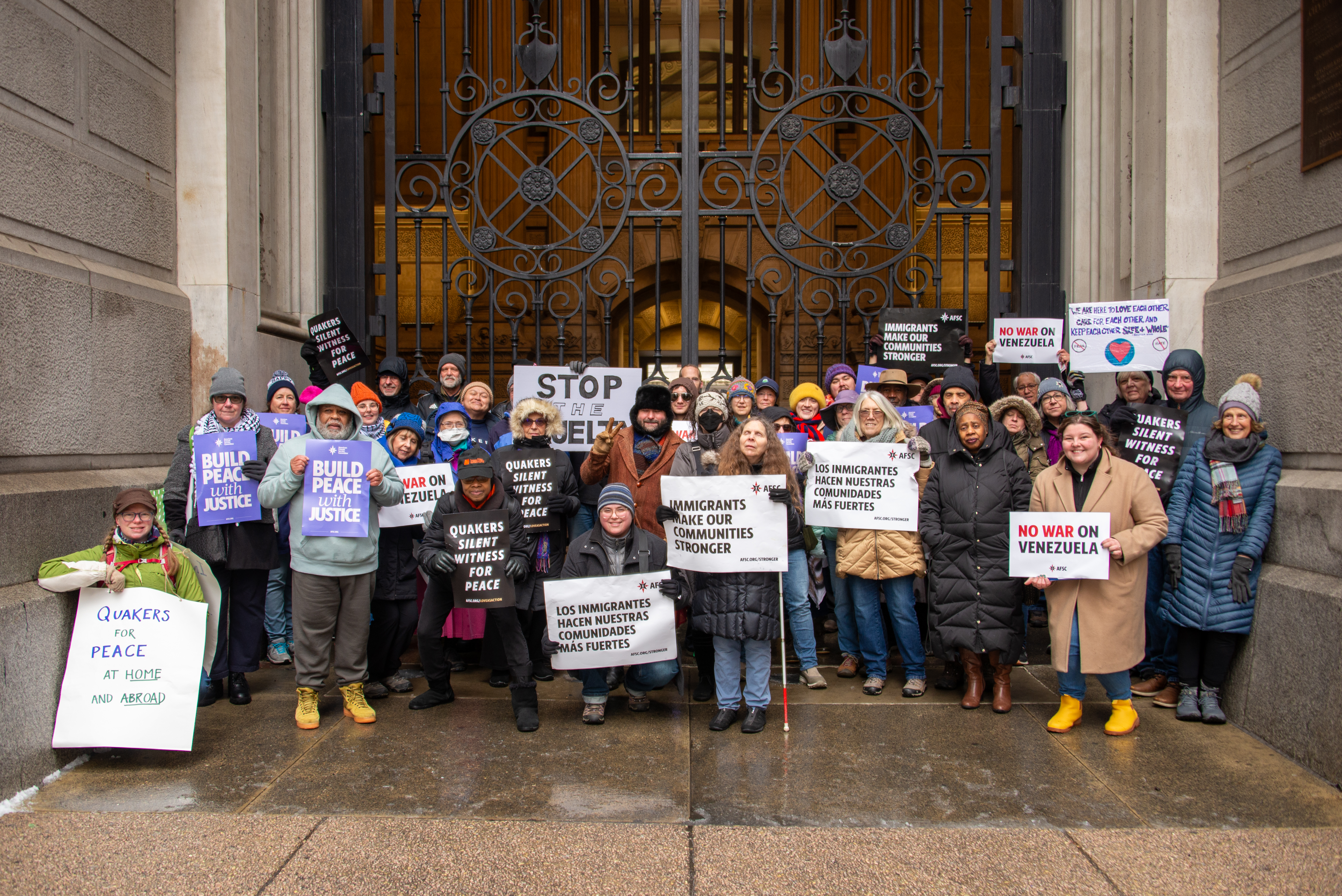
A day of vigils across the country, as part of the Love As Action Quaker vigils. Themes included immigrant rights, resisting authoritarianism, and protesting a war on Venezuela. Nathaniel Doubleday
What are the goals of QAMJN?
QAMJN seeks to facilitate community, collaboration, and action.
Community
Many Friends and Quaker communities see the existential threats immigrants are facing in the present time and want to act. They seek connection with Friends who share their Light, and many find themselves within broader communities who are apathetic or hostile towards their goals for migration justice. QAMJN creates lines of communication for Friends and meetings to hold each other in the Light, to listen and to share, to be present.
Just as important, though, is supporting Friends in creating community with those affected in their area. How have other Friends earned and maintained trust with the affected communities in their area? What strategies have they developed for creating opportunities for conversation and listening? How have they centered and raised up these voices? What other community stakeholders have they been able to involve in their work?
Collaboration
Friends, like all people, draw upon different sets of experiences, resources, wisdoms, and skillsets. We learn from what has worked and what has not. If you or your meeting is looking for advice on what you can do in and for your local community, there are Friends who can help. As QAMJN continues to grow, templates for action can be shared, and meetings can assist each other in planning, organizing, and executing them.
Action
QAMJN is action-focused. QAMJN is not an awareness campaign. It responds to the dire, imminent, and life-threatening reality that immigrants (and those the current administration profiles as such) are facing every day. QAMJN seeks to help facilitate ongoing, local action to affirm the inherent dignity of every life, working from the knowledge that grassroots local actions are feasible, actionable, and effective.
FAQ
Friends meetings, churches, worship groups, and other forms of gathering, as well as individual Friends, can join QAMJN. Led by the Friends gathered, we may explore inviting community partners to join.
AFSC will serve as a facilitator of and resource for QAMJN. QAMJN is first and foremost a tool for Quakers to gather together. We believe that more Friends will result in better discernment and clearer leadings in righting the manifold violations of migrants’ inherent and inalienable human dignity in the United States. AFSC will continuously seek feedback from QAMJN members about how best to maintain the network to meet their needs.
While the Friends gathered by QAMJN may choose to use it to organize such an action, QAMJN is not a single, discrete action or set of actions. It is an opening into possibilities.
For interested meetings, churches, and other worship communities, AFSC may be able to send out a representative to discuss QAMJN with your community. An AFSC representative can also host a Zoom meeting with your community, and we may be able to put you into contact with a local or distant Friends community that has already joined QAMJN.
Meetings and other communities can choose their level of participation in QAMJN. At the most basic level, member communities will receive updates from QAMJN, including invitations to QAMJN meetings. Communities can also agree to provide contact information to other member communities. At higher levels of participation, communities may agree to reach out to other Friends Communities about the network and/or agree to be points of contact for communities seeking guidance or help in organizing actions. No matter the level of participation, however, joining QAMJN is a commitment to action in the face of systemic and alarming injustice against immigrants, whatever that may mean for your Friends community.
The first step for local (or any) action should always be listening to affected communities. What are they doing? What would they appreciate your help with? What input can they offer you on the actions you have in mind? Most importantly, how can you earn and maintain their trust?
Friends are called to bear witness and to act, but the latter without the former has the potential for harm, and the former without the latter is aloof from those who are affected. Learn more about immigrant leadership here, and please see the resources page for organizations led by affected communities.
Please feel free to reach out to our dedicated inbox at qamjn@afsc.org for more information or to join the network.
A list of resources for migrants, immigrants, refugees, and those who want to assist them can be found here.
Gather. Listen. Act.
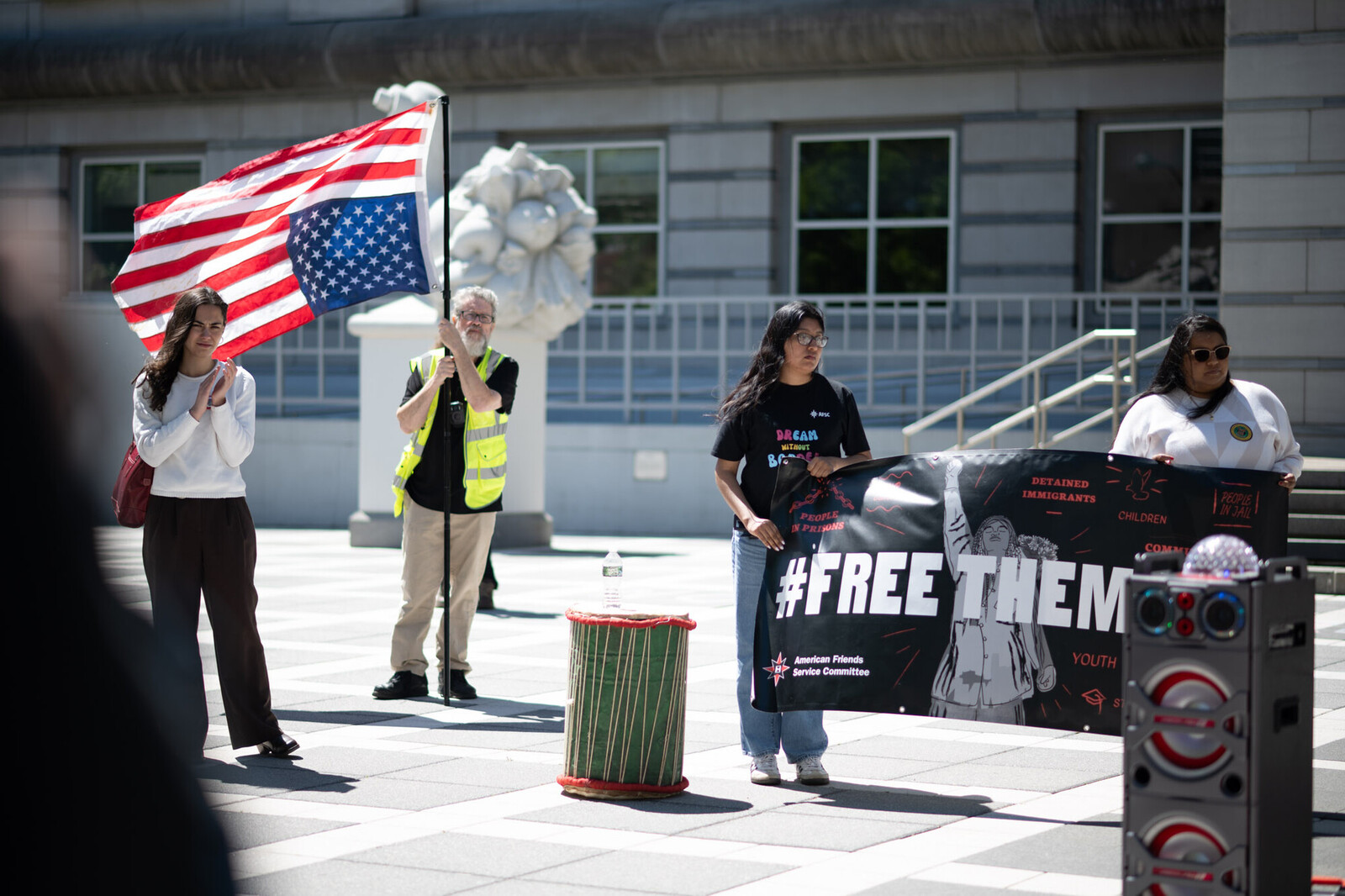
AFSC NJ IRP, partner organizations, and community members protest the proposed ICE detention center in Roxbury, NJ outside a hearing on a lawsuit to halt the facility's construction. Henry Craver
Friends and others have already provided examples of effective local actions.
Community members who are unlikely to be targeted by ICE can patrol areas of increased enforcement to alert the community to the presence of confirmed or suspected agents. Observers can also document ICE agents' interactions with community members. Example: Neighbors step up to protect their communities from immigration raids
Community members who are unlikely to be targeted by ICE can take up posts around schools, in particular immediately before school starts and immediately after school ends. Their presence alone can be a deterrent, and they can alert community members to the presence of suspected or confirmed ICE agents. Example: Protecting students and families from ICE
Young Friends or young people of affected communities may be called to demonstrate their support for immigrants and/or condemn actions against them. Example: Talk of ICE activity around schools prompts advocacy and a walkout
Friends and community allies can organize marches, concluding in rallies in public areas like parks or in front of legislative buildings, detention centers, or other key areas. Example: Quakers march against Trump’s crackdown on immigrants carrying on their long faith tradition
Friends can reach out to local immigration attorneys and solicit pro bono or sliding-scale legal assistance for community members detained by ICE. Large-scale efforts like The North Star Network and AFSC’s New Jersey Immigrant Rights Program can serve as examples for local-level legal assistance networks initiated by Friends communities.
Friends can hold meetings for worship or vigils for affected community members outside detention facilities, legislators’ offices, or other flashpoints to hold detainees and legislators in the Light, that the former may be protected from harm and that the latter may be led to act in the name of justice. Example: Weekly vigil for migrants works to raise consciousness
Friends can lobby to pass legislation that prohibits collusion between ICE and law enforcement (often called sanctuary laws) or other types of legislation that protect immigrant communities, such as creating municipal identification card programs. Municipal IDs allow undocumented immigrants and other vulnerable communities to get ID cards that do not put their document status into state or federal databases. Because municipal IDs are available to all residents, US citizens can also obtain and use these ID cards to prevent the IDs from being stigmatized or otherwise associated with the undocumented. See here for more information.