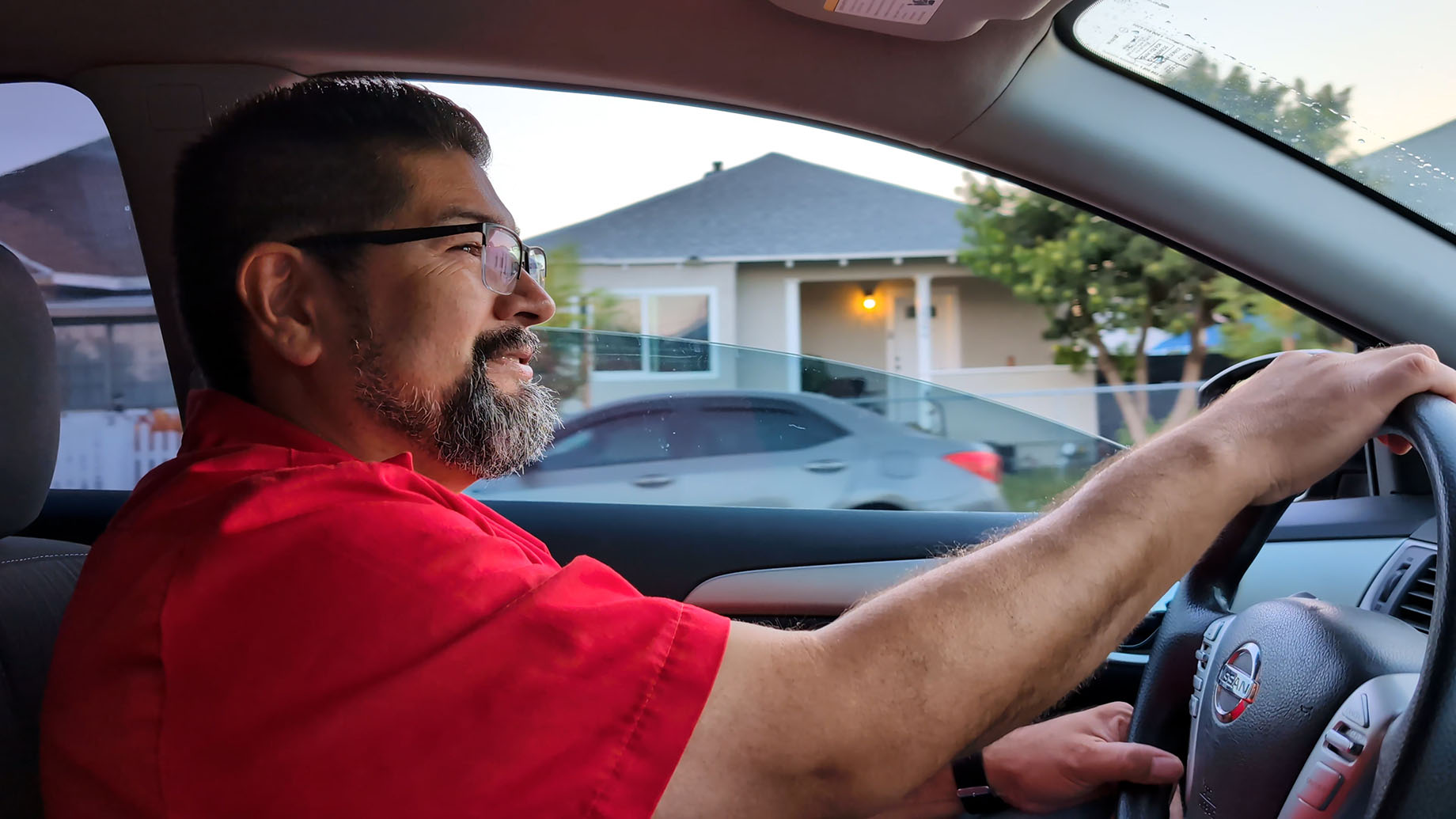
It’s just past 6 a.m. in Barrio Logan, a working-class Mexican neighborhood in San Diego. AFSC staff member Benjamin Prado is on his usual volunteer patrol. In the morning darkness, he notices what most residents would overlook: a white Ford Explorer with deeply tinted windows. Small lights inside the SUV hint that it may be a government vehicle, and two figures sit in the front seats.
They’re Immigration and Customs Enforcement (ICE) agents.
Within seconds, Benjamin radios other volunteers. “White Ford Explorer. Turning on to Ocean View, heading south on 32nd Street.” He begins live-streaming on the patrol network’s Facebook page, alerting hundreds of thousands of followers to ICE presence. He tracks the SUV through the neighborhood, ready to approach the agents if they stop.
By the time the vehicle realizes it’s been spotted, community members throughout Barrio Logan—and beyond—have already been warned. That morning, the vehicle drives away without any arrests.
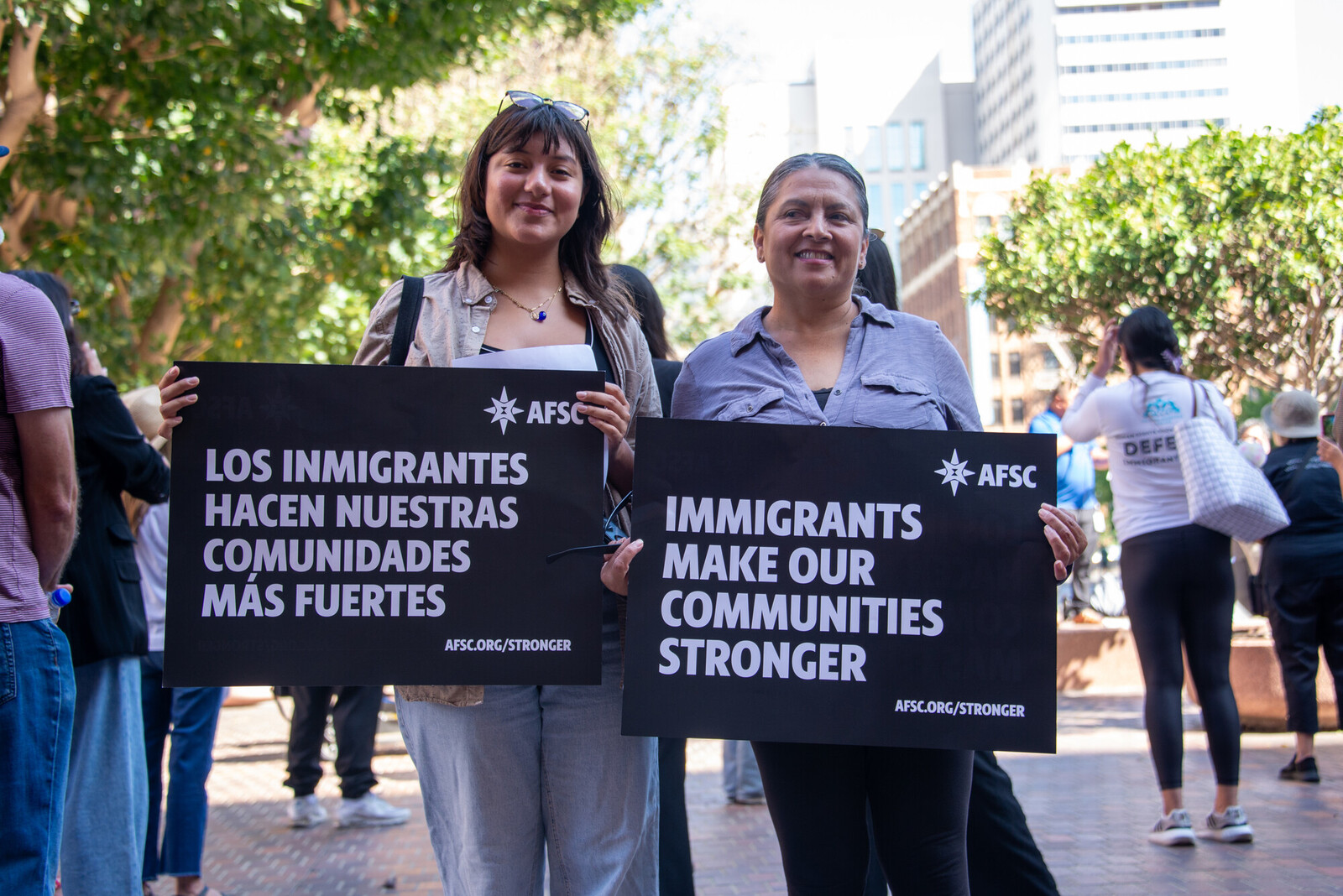
This is the work of community patrols organized by Union del Barrio, a volunteer network AFSC has supported for years. As the Trump administration expands immigration enforcement across the U.S., community defense networks like these are more important than ever.
From documentation to direct action
The community patrols began in 1992, born from movements against police brutality after the Rodney King beating, and ramped up police deployment under the 1994 Clinton crime bill. The patrols initially organized to document police activity in California neighborhoods but soon expanded to monitor immigration enforcement.
Today, patrols operate in more than a dozen San Diego neighborhoods. Trained volunteers drive through their communities several days a week, often during early morning hours when ICE and Border Patrol operations most frequently occur. They look for telltale signs: late-model U.S.-made SUVs, dark-tinted windows, no plates, small indicator police lights inside, or a person sitting inside a parked car.
When volunteers spot suspicious vehicles, they radio their team and observe. If possible, they approach the individual to determine whether they are an immigration enforcement officer. Once confirmed, volunteers alert the community. They use bullhorns to alert neighbors in English and Spanish and post live updates on social media.
AFSC provides crucial support: bullhorns, GoPro cameras, magnetic signs for patrol vehicles, and training for volunteers. AFSC staff members regularly join patrols themselves. Benjamin and colleague Adriana Jasso—both program coordinators with AFSC’s U.S.-Mexico Border Program—patrol neighborhoods at least twice a week.
Many more community members serve as “eyes and ears.” They call the network’s hotline when immigration enforcement is nearby. Volunteers verify reports before sharing them with the wider public.
“Once the community knows there may be an immigration enforcement operation, they can make informed decisions—whether to take their children to school, go about their day, or adjust their routines,” says Adriana.
The effectiveness of these patrols comes from something technology cannot replace: intimate knowledge of their own neighborhoods. “The empowering piece is that everybody, anybody can participate, especially if they do know their neighborhood,” says Benjamin. “Everybody has a role to play in keeping an eye out and building solidarity with their neighbors.”
The volunteers themselves come from diverse backgrounds—professionals, students, moms and dads who wake up as early as 4 a.m. to participate before going on with their day. What unites them is their commitment to protecting their neighbors, friends, families, work and school colleagues.
How patrols make a difference
Over the past year, volunteers have prevented ICE and Border Patrol from taking people from their families and communities in several cases. In August, they identified three ICE vehicles in the San Diego neighborhood of City Heights. Two ICE agents entered Herbert Ibarra Elementary School grounds as families dropped their children off for the district “6-to-6” program.
“That's when the community patrol went into action to inform not only the school community but also the neighbors,” Benjamin recounts.
Thanks to their efforts, ICE left without making arrests. The school district also implemented stronger protections and now publicly informs parents about nearby immigration enforcement activities. At some school campuses, educators have joined the patrols to keep an eye out for immigration enforcement activity during school drop-off and pick-up. Other San Diego districts have adopted measures to communicate with parents when there is an immigration enforcement action nearby, and more educators are getting involved to defend their students.
Sometimes, community patrols can’t be there to intervene. In these cases, volunteers do all they can to locate the individual in detention, inform loved ones, and connect them with legal services and other resources. They also post neighborhood alerts to keep residents aware of ICE and Border Patrol activity.
For Adriana, this collective protection is crucial. “The work of the community patrols mainly helps families and different communities to feel that somebody is looking out for them, that you have people who know what they’re looking for, who are able to identify, verify, and alert the community.”
A model for resistance
In a time when immigration raids can happen anywhere, anytime, the patrols give people both immediate safety—and a sense of power when so much feels out of their control.
"Psychologically, it empowers people to say, ‘We can do something about it,’” Benjamin says. “It’s not this sense of despair where we throw up our hands. We actually have agency in what is happening in our community.”
As immigration enforcement intensifies, the community patrol model offers a blueprint for grassroots organizing.
“Building community patrols will need to grow multiple times over,” Benjamin says. “That's what it's about—rebuilding the social fabric of our communities that have been under assault for so long.”