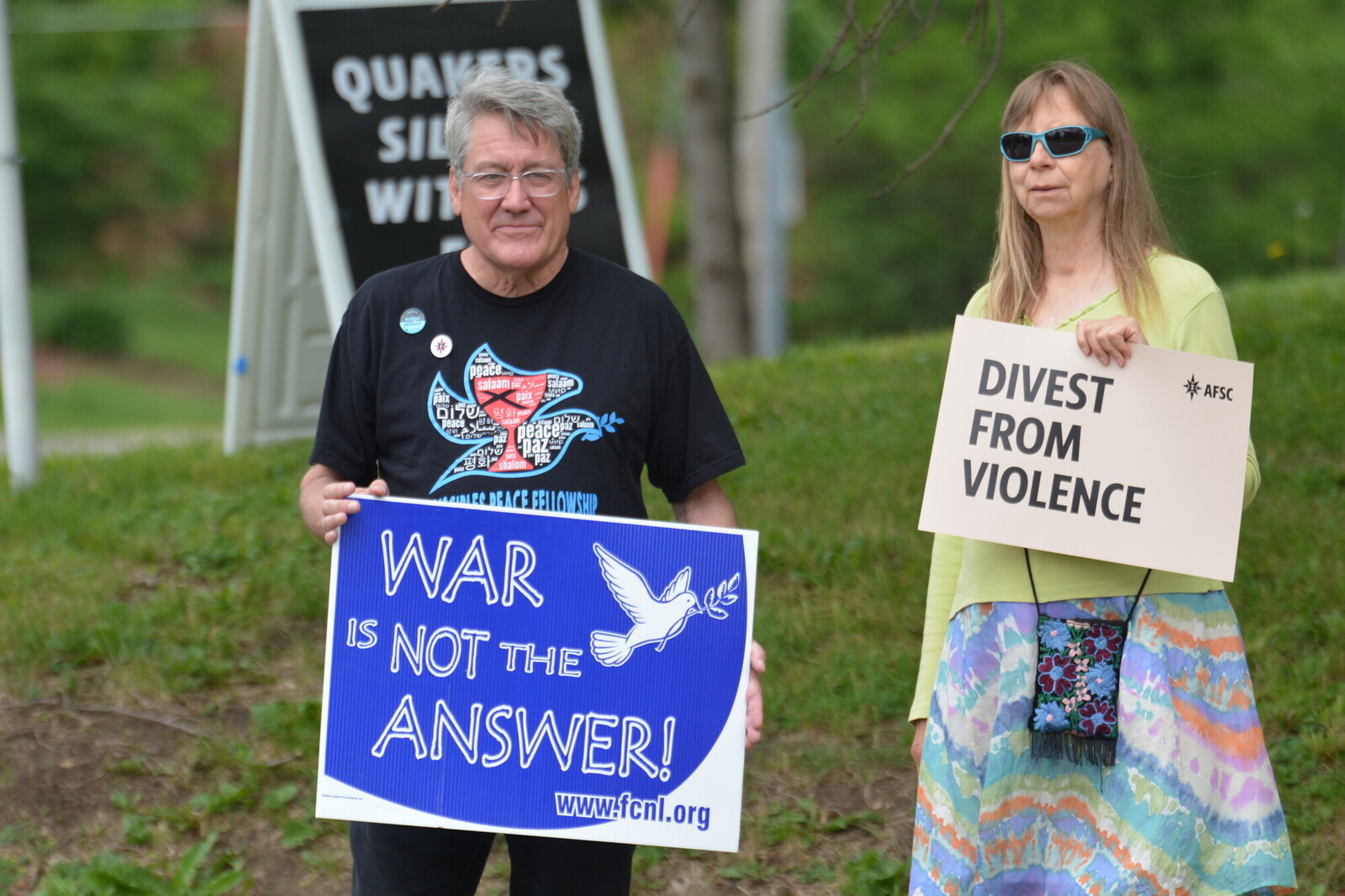
In Des Moines, Iowans protest war and violence at a "Love as Action" vigil. Photo: Jon Krieg/AFSC
The Trump administration has drawn the U.S. into war with Iran—without congressional approval and despite widespread public opposition.
But Iran is only the most visible example of a broader “might makes right” agenda that is fueling militarism abroad and repression at home.
Since the start of President Trump’s second term, the U.S. has launched military attacks in at least six other countries: Yemen, Syria, Iraq, Somalia, Nigeria, and Venezuela. None were authorized by Congress.
In the Caribbean and Pacific, the U.S. has killed more than 190 people in attacks on alleged drug-trafficking boats. Those targeted were never charged with a crime or afforded due process.
These are not isolated incidents. They signal a broader shift in U.S. policy.
Together, these actions reflect a worldview that prioritizes force, punishment, and domination over diplomacy, rights, and accountability.
As a Quaker organization that has long worked for peace with justice, AFSC opposes violence in all its forms.
We have seen this playbook before. And we know that the harm it causes lasts generations.
The Trump administration claims the right to attack other countries unilaterally.
Since taking office, the administration has prioritized military force over diplomacy and international engagement.
It has systematically dismantled the U.S. Agency for International Development (USAID) and core parts of the State Department. That includes offices responsible for limiting harm to civilians during war, monitoring human rights abuses, and tracking how countries use U.S.-supplied weapons.
At the Munich Security Conference in February 2026, U.S. Secretary of State Marco Rubio was clear. The U.S. “can no longer place the so-called global order above the vital interests of our people and our nations,” he said.
This approach is now being codified in U.S. policy.
In November 2025, the White House issued its National Security Strategy (NSS). It stated that the U.S. will “reassert and enforce the Monroe Doctrine to restore American preeminence in the Western hemisphere.” It also said that “The United States must be preeminent in the Western Hemisphere as a condition of our security and prosperity—a condition that allows us to assert ourselves confidently where and when we need to in the region.”
The administration's Counterterrorism Strategy, released in May 2026, goes further. It explicitly authorizes military force against drug cartels, even without cooperation from the countries involved.
The document states: "If they cannot, or will not, we will still take whatever action is necessary to protect our country."
This is a revival of the Monroe Doctrine that caused decades of harm.
The Monroe Doctrine, and the later Roosevelt Corollary, claimed the U.S. had the right to dominate the Western Hemisphere through military force. In practice, that meant decades of U.S. intervention across Latin America and South America—with devastating consequences across the region.
In the 1980s, AFSC witnessed firsthand the impact of U.S. military intervention in Latin America. We documented the violence in El Salvador, Nicaragua, and Guatemala and supported those facing repression.
Instead of bringing stability, the U.S. fueled conflict that killed and disappeared hundreds of thousands and displaced millions. The result has been ongoing cycles of violence, forced migration, and deep poverty that continue today.
The Trump administration’s new “Shield of the Americas” initiative, military strikes against drug cartels, the U.S. kidnapping of Nicolas Maduro, and the intensified blockade on Cuba—all point toward a renewed Monroe Doctrine in the region.
The U.S. is breaking international law—and undermining the institutions that enforce it.
The attacks on Iran and Venezuela are the most blatant examples of the Trump administration’s violations of international law.
The U.N. Charter states that no country has the right to use military force against another country’s territory or independence. In attacking other countries without just cause or international support, the U.S. is opening the door to more conflict and instability worldwide.
The U.S killings of alleged drug smugglers in the Caribbean and Pacific are state-sanctioned murder. Drug smuggling is not a capital offense, and those killed have not been afforded any due process.
In Iran, the bombing of civilian infrastructure and killing of civilians are likely war crimes. But nobody is being held to account.
To the contrary, the U.S. is actively blocking accountability.
In 2025, the U.S. sanctioned the International Criminal Court after the court opened its investigations into possible Israeli war crimes in Palestine—undermining a key mechanism for accountability. The message was unmistakable: The U.S. does not believe that human rights protections are universal.
Undermining human rights law and the institutions that enforce it leaves everyone less safe.
As the Trump administration wages war abroad, it is militarizing life at home, too.
The same “might makes right” logic driving U.S. actions abroad is now being applied at home.
Soon after Trump took office in January 2025, the administration issued executive orders to further militarize police and communities. These actions include:
- Increasing use of the federal death penalty.
- Sending more surplus military equipment to local police departments.
- Ending processes to hold police accountable for rights abuses.
- Expanding cooperation between ICE and local law enforcement.
The Trump administration’s “One Big Beautiful Bill Act,” passed in June 2025, poured an additional $170 billion into immigrant detention and deportation through 2029.
ICE has now hired more than 12,000 new agents. Congress is also moving to give ICE and CBP up to $140 billion more, even though both agencies already have over $100 billion in unspent funds.
The results are visible in neighborhoods across the country: Masked agents snatching people off the street. Homes and businesses invaded without warrants. National Guard troops patrolling city streets. People have been killed during encounters with ICE, peaceful protests, and in detention. There is effectively a new secret police force that is neither identifiable nor accountable.
Meanwhile, the Trump administration has opened massive new detention centers and plans to double the number of people in detention by creating ICE warehouse jails. Individuals are being held and deported without due process. Some are being sent to locations outside of the U.S., where they have been tortured, abused, and held without rights. The Supreme Court has made all of this worse by explicitly allowing racial and racist profiling.
Democratic norms and rights are under attack.
If the president’s 2027 budget is approved, this situation will only get worse.
The Trump administration has proposed increasing the U.S. military budget by $500 billion for 2027. That increase alone exceeds the combined total the U.S. spends on SNAP, childcare, the Social Security Administration, public health, education, transportation, energy, agriculture, and international affairs.
At a time when millions of people are struggling to afford food, housing, and healthcare, the administration wants to spend $1.5 trillion on weapons, war, border militarization, and immigrant detention.
The 2026 budget already set records, with military spending surpassing $1 trillion and making up 70% of discretionary spending. Those increases were made possible through devastating cuts to Medicaid, food assistance, and other essential programs.
Every dollar added to military spending is either deficit spending or taken from programs that people depend on to survive.
Congress must hear from us today.
None of this is inevitable. Wars, deportations, mass detention, and repression all depend on public silence and congressional complicity.
History shows that when people organize, we can change the course of U.S. policy. But we must act together now.
Contact your representatives today and urge them to:
- End murder in the Caribbean: Congress must pass legislation to end these strikes immediately.
- End the war in Iran: Our elected officials must assert their war powers authority and urge the administration to end the conflict.
- Fund human needs, not war and militarism: Congress must reject this budget and redirect those resources to the programs that keep communities safe and healthy.