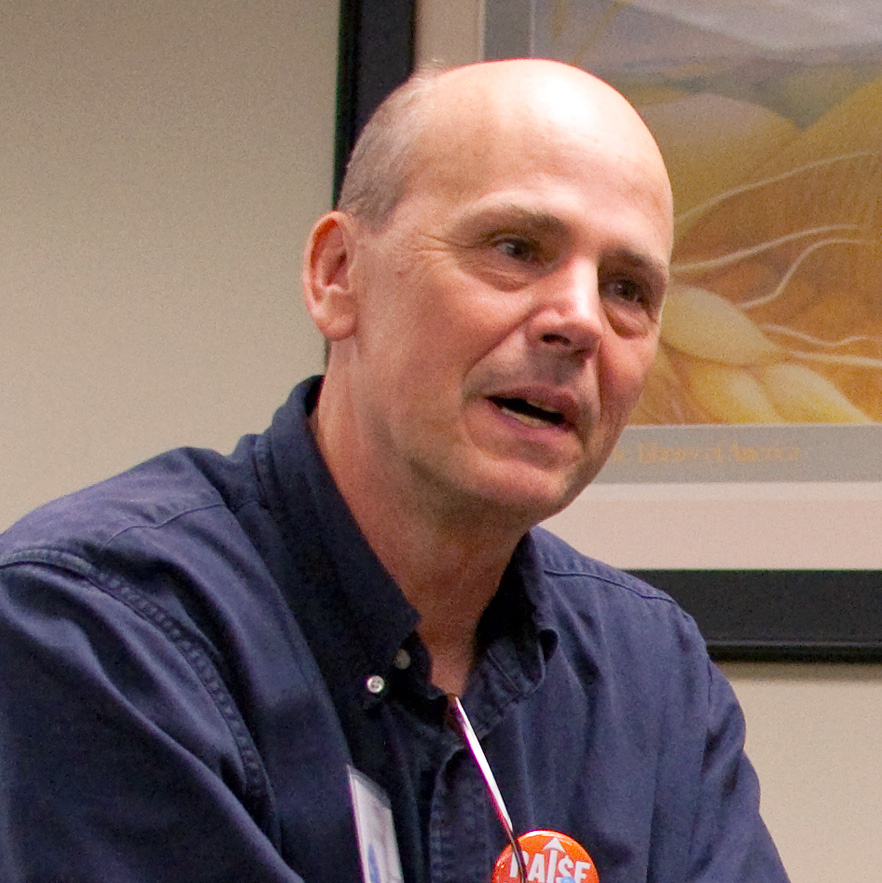

In Iowa, AFSC, partners, and local Quakers wrote letters and successfully advocated to get the governor to adopt the federal Sun Bucks program. The program provides grocery-buying benefits to low-income students during the summer months when school is out. Photo: Jon Krieg/ AFSC
Remember the domino theory? It was a justification for supporting the war in Vietnam based on the idea that a victory over U.S. forces there would topple countries across Asia like a line of falling dominoes.
That didn’t happen. But in domestic policy, there’s a real version of the domino analogy, and it works in our favor.
It can happen when a piece of federal legislation creates options for states and localities. The more locations that adopt the policy, the harder it is to repeal. It also becomes easier for the next place to follow.
The more dominoes that fall, the greater the momentum we build. Until it becomes almost unstoppable.
We’ve seen several examples of this in recent years. Take, for instance, the Medicaid expansion provision of the Affordable Care Act, which provided health coverage for people earning up to 138% percent of the federal poverty level. This benefited millions of low-income working people. However, after a 2012 Supreme Court decision, this became a state option rather than a national mandate.
Initially, only 24 states and the District of Columbia signed on. I’m pleased to have been part of a successful struggle to get my home state of West Virginia to do so. Still, the opposition to the ACA was strong and grew stronger during the first Trump administration, which pushed for its complete repeal.
But we knew that the more states adopted Medicaid expansion, the harder it would be to eliminate, especially if it worked in red as well as blue states.
Today, 41 states and the District of Columbia have expanded Medicaid.
(It’s probably not an accident that seven of the 10 holdout states were part of the Confederacy during the Civil War.)
Something similar unfolded at the county level in West Virginia, when a 2010 federal law made free school meals for all students a local option. It took several years of advocacy, county by county, but now all 55 have adopted it. Quakers and others successfully advocated to make that happen.
The more county school boards that agreed to expand free school meals and witnessed the benefits, the easier it became to persuade others. Eventually, many of them did so without a struggle.
That’s the rationale behind AFSC’s No Hunger Summer campaign. Federal legislation created an option for states to help more low-income children get the food they need when school is out. The USDA Sun Bucks program provides an electronic benefits card worth $120 in groceries per summer for every child eligible for free or reduced school lunches. The funding for the benefits comes from the federal government, with states sharing only administrative costs.
All but 12 states participated in the program's first year. AFSC worked with others to convince other states to join. We built an advocacy toolkit and an easy way to contact governors in the states that opted out. We reached out to Quakers in person and online, with the strongest response in Iowa and Tennessee. Friends and others joined efforts led by groups like the Iowa Hunger Coalition and the Tennessee Justice Center.
There were bumps along the way. In 2025, governors in both states responded to public pressure with inadequate half-measures, which were better than nothing but not nearly as good as the real thing. The political environment made everything more challenging. But people persisted.
That persistence paid off. In 2026, Iowa’s governor relented and opted into the Sun Bucks program. As of this writing, benefits are rolling out to families across the state. An estimated 240,000 children will receive the benefit this summer, according to the Food Research and Action Center. That will bring in around $29 million in direct benefits and generate over $40 million in economic activity, according to USDA estimates about the multiplier effect of SNAP benefits.
In Tennessee, organizing and advocacy by the Tennessee Justice Center and others made progress in the state legislature. Lawmakers appropriated money to fund the program in 2027—reaching around 700,000 kids, bringing in $84 million in benefits, and generating over $125 million in economic activity.
Back to dominoes. The momentum to get Sun Bucks to kids in more states continued in Georgia, where the legislature also funded the program for 2027. That will benefit over one million kids. And in a surprise move this spring, the governor of Wyoming funded the program by executive order after the legislature failed to act.
One delicious aspect of food justice campaigns like this is that they provide an opportunity to use the “dilemma strategy.” This happens when we set up struggles so that the opposition can either do what we want or look bad by not doing so.
The optics of denying food to kids when you easily could provide it aren’t great. Advocates know that. And we use it.
Each victory makes the next one more possible. Even in this tough political environment, we are demonstrating that sustained, principled advocacy can change policy. It feeds children. It saves lives.
The dominoes are still falling. We just need to keep pushing them.