Amjad Al Fayoumi
This is a conversation between Yousef M. Aljamal, the Gaza Coordinator for the U.S. Palestine Activism Program and Arwa Alzraiy, a teacher and PhD candidate in Peace Education from Gaza. The conversation took place on the Action Hour for Palestine, a weekly call that the U.S. Palestine Activism Program hosts each and every Friday at 12 noon ET/ 9 a.m. PT. On the Action Hour, we share news updates from Palestine, feature inspiring guests, and take collective action toward peace with justice. The interview has been edited for length and clarity.
Yousef: Now I'll go to our guest today. Arwa Alzraiy is a third generation Palestinian refugee. She’s been working as an English language teacher for UNRWA, the UN Agency for Palestinian Refugees, since 2015. Her education philosophy is embedded in empathy, care, and trust pedagogies. She is currently pursuing a PhD degree in Peace Education while trapped in Gaza trying to survive the genocide. Her work is framed within the pedagogies of resistance, emancipatory approaches, and teacher student agency. Thank you very much for joining us today Arwa from Deir al-Balah where we reported the horrible news of killing the Abu Khasem family, and where you live very close to the yellow line.
Arwa: Thank you Yousef. First of all, I apologize. I'm a bit unwell, so I will be occasionally out of breath. Second of all, thank you for inviting me for this, I'm truly honored and I would like to thank Jennifer for directing this and everyone else for taking the time to attend and act in solidarity with Palestine. I'm very much honored with this act, and I'm sure other Palestinians are as well.
Yousef: Thank you. There is no need to apologize, and we pray for your recovery very soon and for your safety all the time—you live very close to the yellow line, and offline you told us that Israeli tank shells could be heard around you, where you live. Could you please tell us more about you growing up in Gaza and how it was like growing up and what did you do until we got to this point of genocide today.
Arwa: Well, I was born in the city of Deir al-Balah where my family became refugees. Living in Deir al-Balah means I was very close to my original hometown, Be’er Sheva/Beersheba. I remember going with my grandma by car and closer to the border we could see our land. We could see some of the trees that my grandparents planted before they were forced to leave their hometowns. Growing up in Deir al-Balah on Salah al-Din street I was living close to a settlement, Kfar Darom settlement, and that has impacted my life, my childhood greatly.
Because living that close to the settlement, the first thing that happened was that I remember one day I was—this is a big story for me—I remember when I was growing up, I was probably five or six years old, I was playing with my two sisters in our backyard, and we were just dancing and jumping and all of a sudden we heard a chopper. We were just three little girls. My eldest sister I think was probably six, I was maybe four or five years old, and my younger was two, and I remember that I saw the soldier, the Israeli soldier, he was looking at us out of the window of the chopper, he held a gun machine, and he started shooting at us. We ran immediately to the house, I think he never meant to shoot us actually, but he shot very close to us. We started running back to the house—we were extremely terrified. My dad was at work and my mom was luckily at home. We started crying. Till this very day, I’ve never understood why the soldier did that. There was no point in it. We were very young, we were clearly kids. We saw his face, and I'm sure he saw our faces as well. And I think this is not just a story for me as a child, I think this envelopes the entire Israeli philosophy towards Palestinians. It's a philosophy of terror—regardless of who they're facing, whether it's freedom fighters, whether it's regular people, whether it's like terrorists according to them. They just believe in terror, even if it's completely pointless.
A couple of years later I started studying at a UN school for refugee students which was unfortunately right in front of the Israeli settlement. I remember we used to go to the roof of the school and we would see the Israeli settlers just living their lives: maybe sunbathing, doing barbecues and we would wave at them and they would start shooting at the school. Just settlers, just regular people. Maybe three years later, my school was demolished by the Israelis. They knocked it down entirely, and for a full year I had no school. I used to go—well first my mom just took the initiative, and put us in different schools just like for a couple of months until school is back.
Saying this you might think, oh you found a way out, well for me it was very traumatizing. I thought we'd never be back. My school was my community, my friends, my teachers; I felt like I lost my home and I thought we'd never go back. A couple of months later, the entire school decided to rent a government school. So the government school students would go in the morning, we would go for the evening shift. We stayed there for about six months. I felt good, because partly I was back with my friends, my teachers. I felt partly at home. A couple of years later the school was rebuilt and I managed to finish sixth grade in that school. I was in the second grade when we left the school, and I was back in the sixth grade. Funny enough, it is the same school that I am now volunteering at with the UN as a teacher to teach students English and other restorative activities.
I remember I said this before, and I’d like to say it again: This is a story, this is why Gaza resembles the phoenix. And this is a great symbol to us because in second grade, when the school was demolished, I thought we would never go back, and we did go back. We studied there for the sixth grade, and now a lot of people are assuming we would never go back; we will! Just like the phoenix we will rise from the ashes. This is something I don't even like about us, but this is what we do.
In 2014, I graduated from Al Azhar University. I double majored in English Literature and education. I started working with the UN organization in Gaza which is for Palestinian refugees. I worked with them until the year 2021. That's when I decided that I wanted to continue to pursue an MA degree. I went to the UK. I got an MA degree at Birmingham University. I graduated in 2022, and that's when I was offered a PhD from the same university in Peace and Trust Education. I did a year in the UK, and I was supposed to come back to Gaza in September 2023 to do my field work. I have been stuck ever since. Recently, I've been just trying to do as much work as I can do from my home and my computer. My story is not just my story Yousef. Of course you know this. This is something that is the story of every Palestinian, whether in Gaza, the West Bank, Jerusalem, or in the 1948 lands.
Yousef: Thank you for sharing these stories with us. I think these are very important stories to give context into the life that we had prior to the genocide. Now we'll dig deeper into what's happening in Gaza, what has been happening since October 2023. So you mentioned that you got stuck—you were supposed to do a research trip and go back to your post graduate program. You got stuck in Gaza. You've seen the education system before and after the genocide. As an educator, how do you see the impact of the Israeli genocide in Gaza on education? On students? On teachers? On the educational process as a whole?
Arwa: Well I'd like to clarify something before I start talking about education post October 2023. It was never a breeze in Gaza before October 2023. This is what a lot of media outlets maybe deny, maybe neglect purposely. We always struggled. I remember in 2019, I was teaching third graders. And in the middle of our fourth session, we hear a rocket, and I tell the students—like I was trained as a teacher—to go below the tables. And we were sitting under the tables, me and the students, and they were like, “this is an F16 Miss, it's not very scary” “no, no, I don't think it's an F16 Miss, I think it's just a chopper's rocket.” And the third graders were trying to just locate where the rocket fell. It fell in the cemetery by the way.
But I'm traumatized more by that. Because now, everyone is trying to categorize that, and frame it out as if that was natural, that was okay, “now we're living in hell, but before October 23rd we were having a nice lovely”—no we weren't.
It started for us in 2021, when COVID broke out, with the UNRWA because we're providing educational services for more than half a million students in Palestine, and for over 300,000 students in Gaza. We started working on an online platform, and I was working on the platform, I was preparing materials, I was making videos, I was preparing assessments. I remember we had to stop in the middle of everything. Why? Because the Israelis were reviewing everything. Whatever we were trying to do, they would stall it, they would make it take more time, and they would deny some of the materials without any reason. You know, sometimes they would say, “we want this unit out.” And what are the reasons? There are no reasons and UNRWA had to follow the rules, otherwise the platform would be taken down. There were subjects that we were not allowed to teach. This is part of the surveillance, this is part of the control that we had before October 7th.
After 2023, education became something you wouldn't imagine in your worst dreams. So, schools are bombed, universities are bombed, professors were killed, teachers were killed, head teachers were killed. This has been described as scholasticide, and I do genuinely think they are targeting education. Otherwise why would you bomb universities? Why would you buy bomb—okay, we have 13 universities in Gaza—why would you bomb all of them? You know?! A lot of high profile researchers, whether it's in literature, whether it's in chemistry, they were killed. So this is part of it. I remember someone who used to work in UNRWA, who would have been wonderful at leading the emergency we're in as an organization was also killed in the war. He was described as a casualty. To us, he was a great loss.
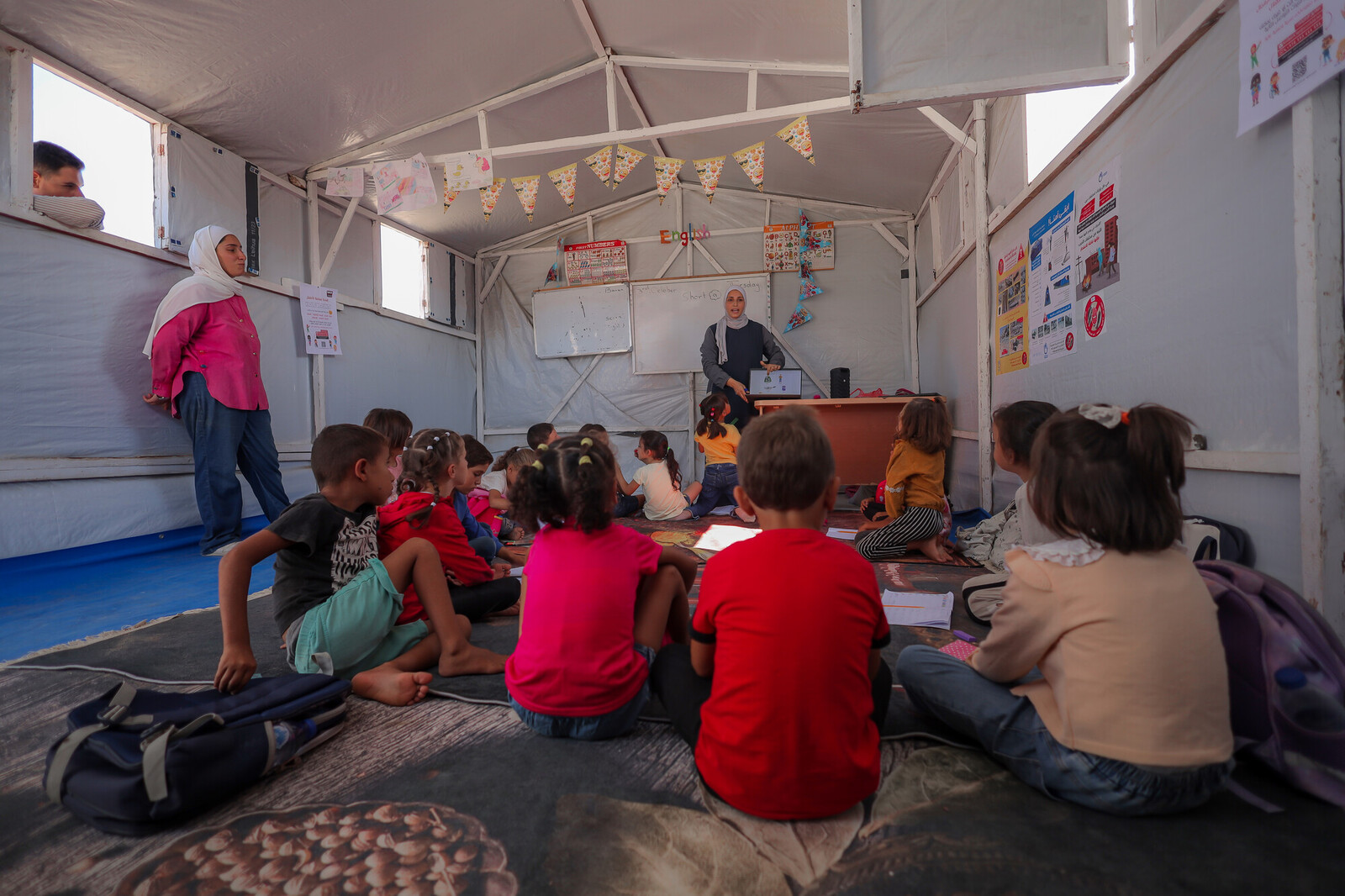
I will be more specific about the case of my classroom. My classroom has no door. It has no windows. The walls are burnt. There is no board. We painted a part of the wall black, and I buy my own chalk to write on the “board.” The students sit on the floor. The school volunteered, and bought some blankets for the students. We can't bring any aid to the students. We don't have books. We don't have teaching aids. We don't have materials. Over 300 teachers were killed, we're not allowed to bring any substitute teachers. The students, they suffer from malnutrition. I did say this before, there were cuts on the World Central Kitchen, which was offering meals for a lot of Palestinians. The meals were cut down. I heard from some of my students, they were like, “they used to serve us soup and bread, now there is no bread and even the soup is now uncut.” Given the fact that UNRWA is a renowned UN organization—so is UNICEF—but they have very minimal access, they have very minimal ability to help with bringing books, bringing tables. This has been described as if this is something impossible— they're not able to bring in these supplies.
The students, most of the time the conversations are like, “miss did you know yesterday, when I was going home, they bombed a tent on the way. I almost died.” This is like the regular conversation we have. Some of my students would be like, “miss, we want to stay a little bit late in the class,” and I asked “why?” and they're like, “they're gonna probably need us to help at home, fill in bottles of water, and we don't wanna go back home and help.” So, no matter what I say, I won’t be able to pin down how catastrophic it is. And the sad part is there is very, very little done to help out in any way possible.
Yousef: I don't know what to say, Arwa. You describe a catastrophic reality that probably has not taken place anywhere else. It's unprecedented. I was going to ask you a question about recovery, but I don't know if I can ask you this question now. If we talk about recovery, is it even possible? And if it's possible, what are the immediate needs that we need to start talking about for recovery when it comes to education?
Arwa: Well, a lot needs to be done. A lot. It's beyond description. And to be honest, it can be done, but the Israelis are doing everything they can to stop things from working. I'm very fortunate to be working at a school which is on Salah al-Din street, which means it's a bit dangerous. And therefore there aren't people living inside of the school. There were in the past, but once the ceasefire started, they felt “no, this is too dangerous to stay in, it's on Salah al-Din street, it's close to the yellow line, our life is gonna be jeopardized anyway, so why not just go to the west.” In other schools, the students are learning while families are living in the classrooms. It would be very easy to provide tents for the people to leave, but no one is allowing enough tents into Gaza, and therefore people are stuck living in the classrooms.
I remember I worked with the UN to provide tarps for a classroom. This was part of my other volunteering project. We just needed tarps for the windows, just to close the windows during winter, because it gets rainy. It rains on me and my students in the classroom in winter. And we weren't allowed to bring any of it into Gaza. So again, some little things can be done, but the Israelis are putting so much pressure for nothing to take place. It's just heartbreaking—the capacities that people have, that the international community has, UNESCO/UNICEF has—but very little is being done. UNICEF had a project. They gave out one notebook, one pencil, and a plastic bag to students. I've worked on projects as part of UNRWA with UNICEF before the war. They would give out entire backpacks filled with stationary, filled with toys. None of this is being provided to students who are deeply traumatized. Not enough effort is being—for the Gazans everybody's doing more than enough—and it's actually for me, as you were saying in my bio, this is part of where a teacher has to have hope.
This is a pedagogy of hope. Going to the school, you know the students, they're not forced to come into the school because technically they're not 100% safe, but the students show up. The teachers the same thing. Some of my friends, my other colleagues—they live close, even closer, I think some of them evacuated today because they're very close to the new and always proceeding yellow line—they would come to school and I'd ask them why and they would be like, “well we should do something, somebody needs to teach these students.” I'm always honored. I did the same thing, I mean I was at home and this was right after the payments stopped, and I was like I need to go back, I need to teach the students. Somebody needs to see them. They can't be cooped up in tents all day long. They just need to go out and do other activities. It's inspirational. Even parents—they come to schools knowing that the students, they get no grades for coming to schools, they get no certificate for coming to school, but they attend—the parents they're very devoted. “What parts of the English language does my son need to work on? What is something my daughter is good at?” We do competitions in schools, and we do games. The students are very engaged…deeply traumatized, but I get this feeling that everybody is trying to live in a bubble inside the classroom, if you know what I mean; where we would almost, almost, almost be capable of ignoring what is going on.
I remember two months ago, I was in a classroom, and they would have a warning for foreigner staff working in Gaza with other organizations like Médecins Sans Frontières, and everybody would see the warning because it would get published to Facebook and Instagram. I told the head teacher, “there is a warning, they're gonna bomb something near us,” and she was like, “well, we can't do anything, just keep on with the classes and hope for good.” And that's what we did actually.
So like my overall message: so much can be done, so little is being done. And to be honest, the majority of the work that is currently being done is from the inside, if you know what I mean. It's like a lot of work is being done by the Gazans to survive as much as they can. But I'm very sad that we're getting very little international support. I understand there's a lot of solidarity, including everybody here. I'm very thankful for everyone, but my point is there is little legal, official pressure on the Israelis to allow everything into Gaza—like to allow books, to allow windows, to allow tarps, to allow chairs. The Israelis say, “you're not allowed to bring books into Gaza,” and everybody will be like, “okay we won't bring them in.” So why isn't enough pressure being practiced?
I had some books left in my library, and inside of the school we decided to make our own little library. Everybody volunteered whatever little books we had left. Because we burnt a lot of books during the famine because we had no other source of fire and we needed to boil water for whatever food we had left. So everybody burnt their books honestly, including myself. I burnt a lot of books just to get fire. So, all in all, when there isn’t security in food and medical aid, it's hard to say we want more into Gaza for the education sector. We want more food into Gaza.
Yousef: This is a tremendous experience. Even like trying to imagine how it feels like. People outside Gaza still fail to capture the exact feeling of how it really feels like to be under these conditions and circumstances. As a peace educator, someone who went back to Gaza with a research plan, after this experience, how did your research plan change? How did your research agenda and your understanding of Education and Peace Education change after enduring a genocide?
Arwa: When I came into Gaza, I came with one word in mind which was “investigation.” Now, I look back, and I feel like this is a very Western word. I wanted to come and see how the everyday interactions of teachers and students were promoting peace, or whether they were promoting violence, and what was going on inside of a Gazan classroom. During the war, and reading news articles in a lot of American, British, and international newspapers, I started feeling we have very little say in the world. There is always someone speaking for us. There is always someone telling the world how we feel or how we should feel. And I decided for my academic work, I wanted to be a voice into academia. I wanted to be a Palestinian voice from Gaza in academia. I realized so much work is being done by teachers and students to promote peace in the world—so much work that isn't being recognized as peace if you know what I mean.
I remember I was working with my head teacher, and she was giving out biscuits to students. And a student came in, and she said, “I was late, I didn't get a biscuit, can I have a biscuit?” and the head teacher—we have a very limited number of biscuits, we get them from the World Food Program for the students—she said, “sure, take one.” And I looked at the head teacher, and I was like, “well shouldn't you consult another teacher? I mean we have a limited number, we just get one biscuit per student,” and she said, “we'll manage, the students shouldn't feel they have to prove anything in the school.” And I said that was brilliant, this is an act of trust. Telling the students, just go back and check with your teacher, she should give you the biscuit. This was a brilliant act of trust on the part of the head teacher—allowing the student just to take a biscuit even if she had already had one.
A lot of little things like this are being done by the teachers and the students just to have a peaceful school environment, and I thought to myself, “this is my opportunity to make this something intellectual, to dig deeper and frame all of this into an intellectual piece of work, and say this is the peace we are living, this is the peace we are teaching.” There are multiple definitions of peace. There are multiple perspectives on peace, but this is our perspective on peace especially during genocide. This definition that my work—Inshallah—will be providing is not prescribed by Western theoretical frameworks. This is a work that nobody said, “you should say this,” “you should feel that.” No. I'll be saying what is being said. I'll be stating what is being done. And I'm hoping this is gonna be a thesis that will be for the Palestinians.
Yousef: Thank you. I think this is very important. Speaking of framing an intervention, you mentioned Israeli attempts to intervene in the Palestinian curriculum even before the genocide during COVID by controlling Palestinian education through online teaching. Have you seen anything like that during the genocide?
Arwa: Of course. During the time of the online platform, some subjects were denied—we were not allowed to teach them online. Such as religion, such as civic studies, such as history—world history—not Palestinian history. After that, now we're only allowed to teach four subjects: Arabic, English, Math, and Science. Nobody has given us a rationale as to why the other subjects were prohibited. Why aren't we expected to teach Art? PE? Civics? Why aren't we expected to teach religion? You know, as a peace educator, religion teaches a great part of peace, ethics, morals. We're not allowed to teach any of that, and nobody has provided us with a rationale as to why any of that was prohibited.
I hear a lot of claims—I see a lot of Israelis and some Americans who are pro-Israel who come out and say, “well the Palestinian curriculum is inciteful. There was an EU report that verified the curriculum. No such claims were true. The Israeli curriculum did not go under inspection. You see the hypocrisy. This is what's maddening! The Palestinian curriculum should go under a lot of introspection, investigation, reviewing, but the Israeli curriculum, “no we don't do that.” So called people who are “objectively analyzing curricula” they don't even objectively analyze their frameworks, they don't objectively analyze the missions they're on and what they're trying to do. So we're limited to teaching four subjects. We're limited to teaching 12 periods each week to the students. This is done by the Israelis. We're not allowed to teach the books we used to teach. The books were reviewed by the EU mission before they were printed out, so there is nothing inciteful about them. There was no hatred, no terrorism, I mean why would the EU print out books that would encourage terrorism, you know? But still, the books were prohibited.
I was told we're not allowed to teach anything other than the material that I get online before teaching class. So even if I wanted to supplement, we're not allowed to supplement. We're not allowed to add in extra activities. We're not allowed—if I feel the lesson is a bit inappropriate for my students, and I would like to teach something else—we're not allowed to do any of that. We're also teaching the students three days face-to-face inside the school, and three days online. Most of my students don't show up online, but still, I'm forced to go online and give lessons to the students. In a group that has 50 people, 20 of them are observers from the UN. It's almost the same number as the students! They just come to “observe” the lesson and make sure I'm not saying anything outside of the booklet they send us. They make sure that the students—I'm not allowed to send in any pictures, I'm not allowed to send in WhatsApp voice messages—the students are not allowed to do the same. So, I remember during COVID, I would teach my students, I would make a video, they would send me videos back. So now, we're not allowed to do any of that. I'm not even allowed to say to the students, “are you okay? I heard there was a bombing near your home.”
I remember one of my friends, she had a message, she was going through attendance online and she learned that two of her students were killed last night. She was not allowed to process that with the students or say anything. Just like, “oh absent? oh I'm sorry about that” and just move on. So this is the amount, this is part of the surveillance we are going through.
For me, what feels insane is that everybody is saying “yes” to the control. Nobody is saying, “no, we should do something!” I understand the Gazans, because they're so tired. They're exhausted. They're traumatized. So I would understand why there isn't much resistance to what is being said on their part you know? Their paychecks were cut during the genocide, and some of them were laid off, and I'm just wondering how come we don't get enough again, international, or even from outside Palestinians, we don't get enough pressure to do something differently, you know?
Yousef: This is so frustrating to hear, and I will try to end on a more positive note by asking you what needs to be done by people, governments, bodies, institutions outside, immediately, in the short term, middle term, and long term to help recover the education system in Gaza?
Arwa: I remember I worked on a project with the British Council, and it was about reading stories. We got the training in Ramallah, and the British Council did the project, and the Israeli said, “you can't get your books into Gaza.” They [the British Council] wanted a bookshop in every district inside of the Gaza Strip, and the Israelis said “no.” But the British Council had enough pressure to get the books inside. We had wonderful books. We had such beautiful books. Today I learned that because of Queen Camilla's birthday, she's handing out a story by a famous author to the children—sixth graders—in the UK. I remember this story. This is a story of hope—that with enough political pressure, you can get things done. Imagine how happy the students [in Gaza] were when they got the stories, they were very colourful, they were interactive story books, they were pretty. I was so engaged, let alone the kids. So I think it can be done. We can practice enough political pressure. We can do marches. We can write to the congressman, to parts of the parliament to get books into Gaza, to get stories, to get desks, to get clothes for the students, to get them jackets for winter, to get them uniforms for school. We can get some political work done, legal work done, to stop prosecuting education in Gaza, to stop surveilling the UN in Gaza and UNICEF. I hope some work could be done which—it has been done before in other areas—to provide students with meals. I know some work is being done in the UK of this type, but to provide meals, free meals for the students, to provide mental support. You know in schools before, we used to have a school counselor who would talk to students who were traumatized, who were having difficulties learning, who were having problems at home. After the genocide, we have no such thing in our schools. We don't have school counselors anymore. They were laid off. So imagine their families, how they're feeling during the war because more than 1,000 school counselors were laid off. So I think there is so much work that can be done and whatever little work could be done would give the Palestinian in Gaza so much hope that change would be possible. I just hope enough pressure is being practiced to make a real change.
Yousef: Thank you. I will end with this message, with this task to people on this call: please keep practicing pressure! Thank you very much Arwa for your important testimony, experience, and knowledge, and courage, and hope despite the unbelievable conditions around you, you're still doing your work. Thank you very much for joining us, and for giving us a dose of hope today. It feels hopeless many times, but we need voices like yours. Thank you again.
Arwa: I just have to say one little thing before I leave. I really have to go because it's getting really dark. Thank you all for being here on a Friday just thinking about Palestinians. I really appreciate it, and I'm sure other Palestinians do too. Thank you everyone.