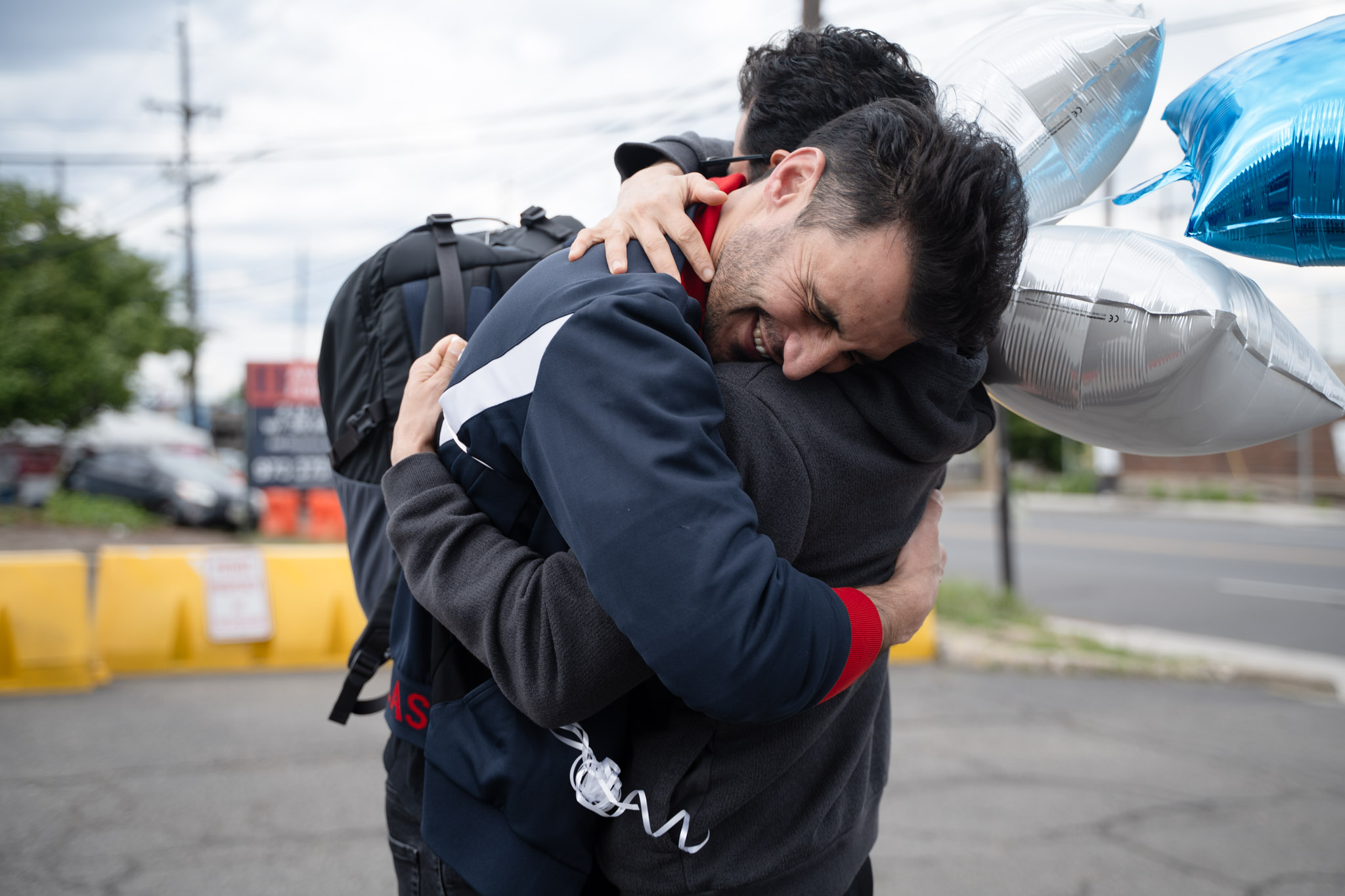
Mojtaba hugs a friend outside of the Delaney Hall Detention Center in Newark, New Jersey. Henry Craver
Mojtaba and Rachel Marandett had spent months exhausting every legal avenue to secure his release from ICE detention, hitting wall after wall. For the Iranian asylum seeker and his AFSC attorney, the struggle felt endless. Then, this past April, they finally made a breakthrough. Responding to a federal habeas petition, a district judge ordered a bond hearing, shifting the burden of proof onto the government.
To keep him in detention, the Department of Homeland Security—which oversees ICE—now had to prove with clear and convincing evidence that Mojtaba was either a danger to society or a flight risk. They couldn't. With the government's case falling flat, the immigration judge had no choice but to grant his release.
But freedom came with a crushing caveat. The judge set the bond at $35,000—a staggering, impossible sum for a man who had been locked up since his first day in the United States, with no family, no savings, and no safety net. Mojtaba and Rachel were demoralized.
Across the country, immigration bonds have shot up. The average cost has risen from $6,500 in 2025 to $7,500 earlier this year. In the New Jersey circuit, the change is even more dramatic: $6,000 to $10,000. This bond inflation coincides with a rise in habeas petitions — federal court challenges arguing that a person is being unlawfully detained and should either receive a bond hearing or be released immediately.
With immigration courts now far less likely to grant relief under the Trump administration, attorneys have increasingly turned to the federal courts via the habeas petition. But even when a federal judge orders a bond hearing, it falls to the immigration judge to set the amount.
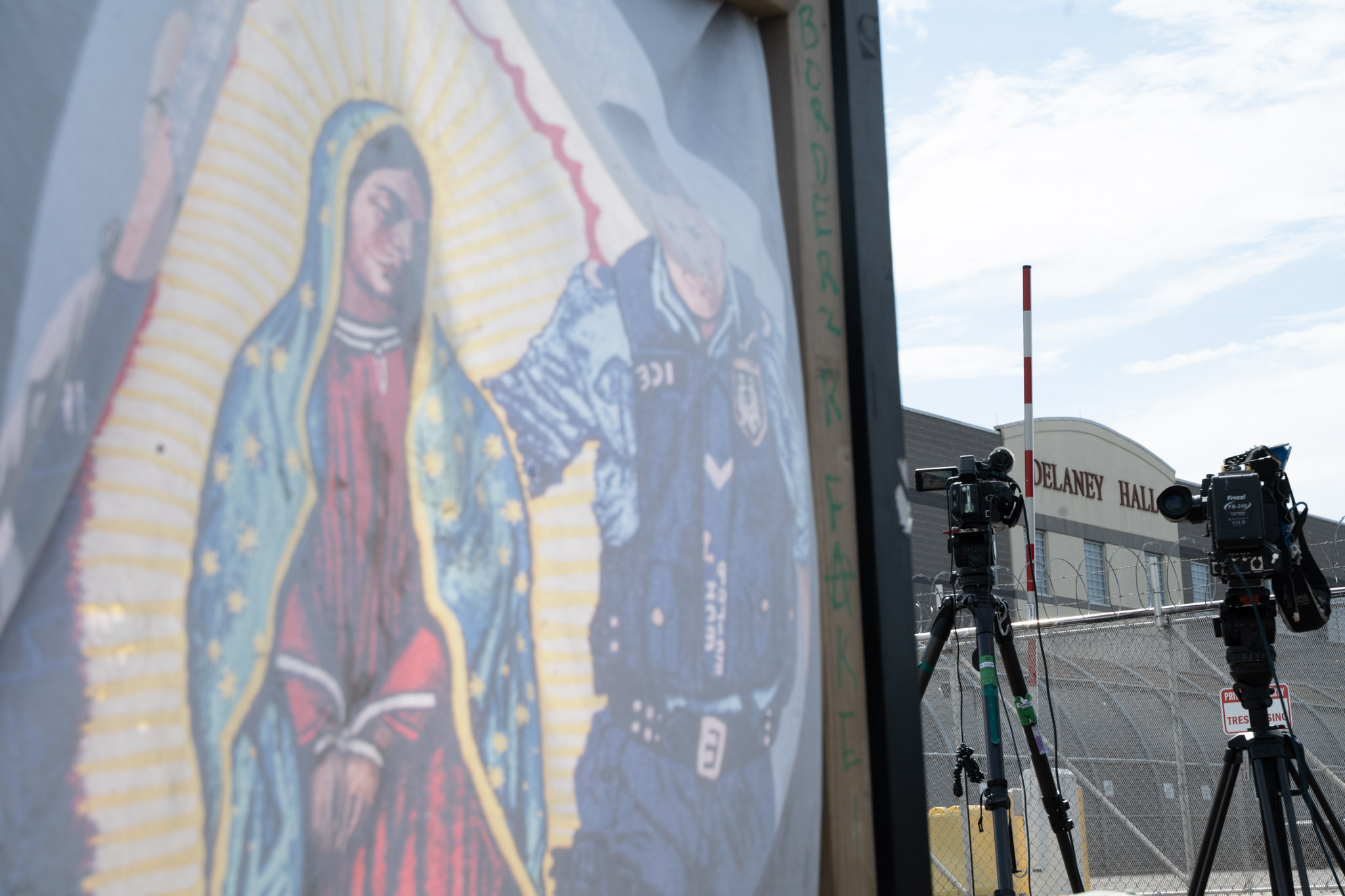
Henry Craver
Mojtaba had already been detained for 17 months when his bond was set at $35,000. It was another stinging setback in a multi-year pursuit of safety.
While still living in Iran in 2022, he’d joined the Women, Life, Freedom, movement, a massive wave of popular protests sparked by the death of Mahsa Amini that demanded women's rights and broader political freedom. Shortly after, government agents began harassing Mojtaba. His store was ransacked, and he was abducted and tortured on multiple occasions.
In 2024, fearing for his life, Mojtaba fled the country. He entered the U.S. through Mexico in late 2024 and turned himself over to Border Patrol agents to start asylum proceedings. Initially detained in Texas, he had no access to legal counsel and struggled to navigate the complex asylum process on his own.
In mid-2025, however, he was transferred to the Delaney Hall detention center in Newark, New Jersey. There, he qualified for free legal help under a state program that funds legal services for immigrants facing deportation, the Detention and Deportation Defense Initiative. AFSC NJ Immigrant Rights Program is a primary provider for the initiative.
Having a good lawyer can make all the difference. Detained immigrants with legal representation are 10.5 times more likely to win their cases.
Rachel was indeed a qualified attorney, but raising $35,000 for a client’s bond wasn’t something she’d ever had to do.
“I've always believed in holistic representation,” Rachel says. “I do this work because I believe in my clients' humanity and resilience, and it's my job to fight alongside them to help them secure the safety and future they deserve. Raising $35,000 was never something I expected to be part of that work. But after everything Mojtaba had been through, I knew that once his bond was set, I would do whatever it took to secure his release.”
Rachel did what she could. She called every organization she knew of that paid immigration bonds. She set up a personal fundraising webpage that she shared with her entire contact list. And she urged local grassroots immigrant rights organizations and influencers to post about Mojtaba’s case on their social media accounts.
Rachel secured the $35,000 within a couple of weeks. The money came from the Envision Freedom Fund and First Friends of New Jersey and New York, along with over 100 individual donations from everyday people.
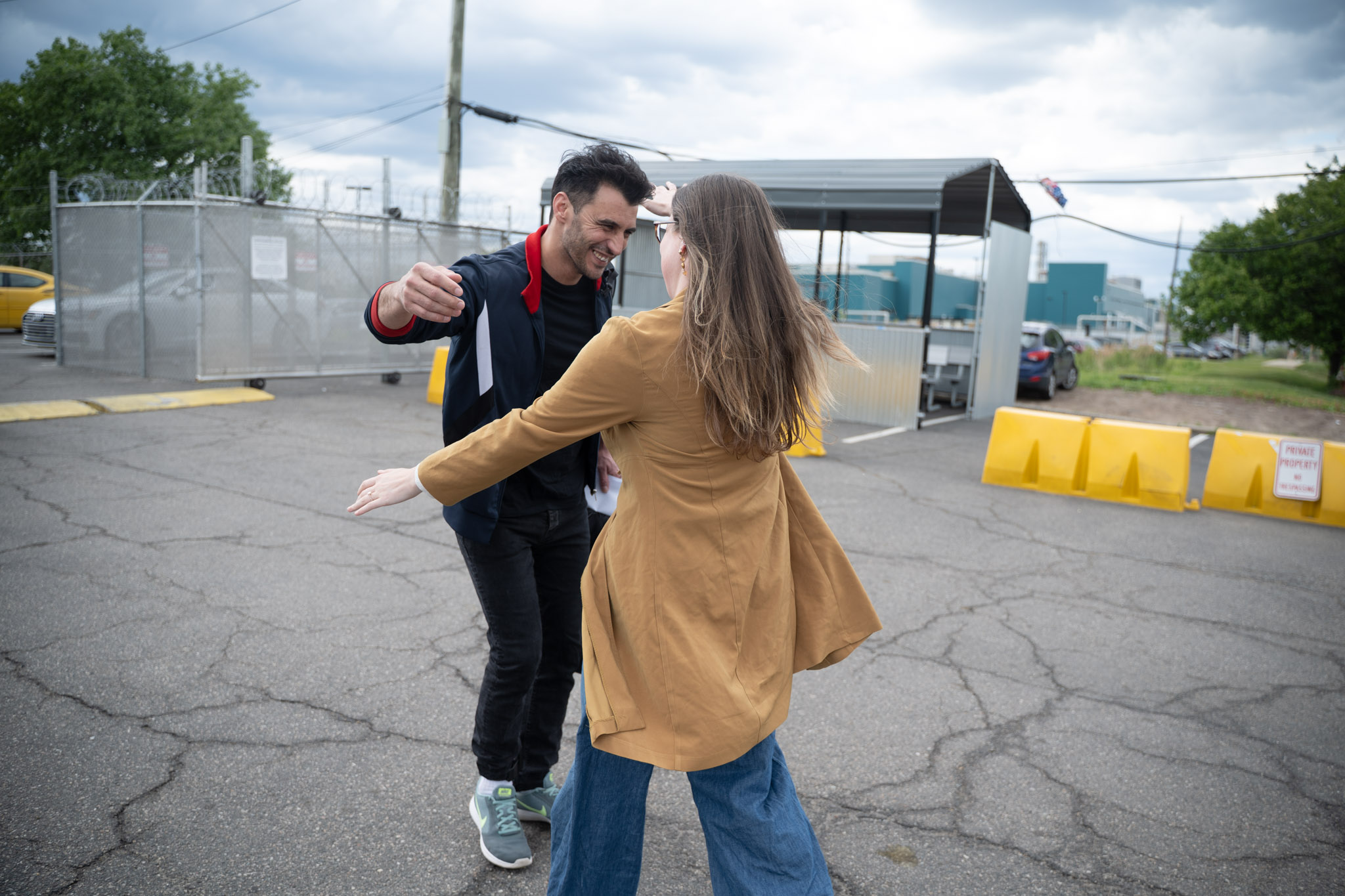
Mojtaba and Rachel run to meet each other upon his release from Delaney Hall. Henry Craver
On May 14, Mojtaba walked out of Delaney Hall. Rachel and one of the men Mojtaba had been detained with—who had been released a couple months earlier—were waiting for him outside the gates. They ran to meet each other and embraced. After 17 months, Mojtaba was finally free.
“It’s an incredible feeling,” Mojtaba says today. “It was such a long and dark road, but now I’m free and a whole new life is in front of me."
Learn more about AFSC's New Jersey Immigrant Rights Program.