Miramar Circle of Protection
Throughout the month of June, the Miramar Circle of Protection continued accompanying families at the Miramar ICE Field Office while documenting a sharp increase in concerns about detention practices and conditions inside the facility.
On Wednesday, July 1, the Miramar Circle of Protection held a press conference calling on elected officials to come to the Miramar ICE Field Office and witness firsthand the conditions that families, recently released individuals, and community advocates had been documenting for weeks. The following day, Congresswoman Debbie Wasserman Schultz responded to that call by conducting an unannounced oversight visit to the facility.
During her inspection, Congresswoman Wasserman Schultz reported finding approximately 150 people being held inside what is intended to function as a processing center rather than a detention facility. She described seeing about 70 men crowded into a holding area measuring roughly 15 by 15 feet, while approximately 40 women were confined in another room measuring about 7 by 14 feet. Each holding room contained only one exposed toilet in the corner with no privacy, forcing people to eat, sleep, and use the restroom in the same confined space. She also reported that people were sleeping on the hard floor, receiving only one refillable bottle of water and small microwaveable meals, and that showers were permitted only every other day. She described the conditions as "horrific" and said people were "packed in like sardines."
These findings closely matched the testimonies the Miramar Circle of Protection had been collecting from recently detained individuals and their families. Throughout the month, we continued receiving reports of people being held at Miramar for several days before being transferred to detention centers, despite the facility being designed primarily for short-term processing. Many of the individuals whose cases we documented had been arrested through local law enforcement collaboration with ICE under 287(g) agreements, including workers detained on their way to work, during workplace enforcement operations, and following routine traffic stops.
The congressional inspection brought long overdue public attention to conditions that families and advocates had been documenting for months. While this oversight was an important step toward accountability, immigrant families continue to face uncertainty, lack of information, and the emotional and financial consequences of detention.
The Miramar Circle of Protection remains committed to accompanying families every Wednesday, documenting conditions, amplifying community voices, and advocating for transparency, accountability, and the humane treatment of every person who passes through the Miramar ICE Field Office.
Support the Circle! If you’d like to support the Miramar Circle of Protection, you can donate here. Snacks, juices, and toys are always needed and deeply appreciated.
Florida policy
June was a rollercoaster of emotions and decisions for millions of immigrant families in the United States. The Supreme Court decided to:
Protect Birthright Citizenship: The Supreme Court held that children born on U.S. soil are considered U.S. citizens. The Trump Administration issued an executive order aimed at curbing birthright citizenship, so that only children born to individuals with a permanent immigration status would be considered U.S. citizens. The Supreme Court refused to buy the Trump Administration’s argument and held that the executive order was unconstitutional. But, the question of birthright citizenship continues to be hotly contested since the vote on the 14th Amendment extending to the children of immigrants without a permanent legal status was 5-4.
Give President Trump the green light to end Temporary Protected Status (TPS) for Haitians: The Trump Administration has tried to end TPS protections for seventeen countries, including Haiti and Syria. Florida is home to the largest population of TPS holders, specifically Haitian TPS holders. When the Trump Administration tried to end TPS for Haiti, advocates sued. However, we suffered a devastating blow: the Supreme Court held that federal courts generally lack authority to review unconstitutional challenges to the termination of a country's TPS. This decision affects over 1 million immigrants who have called the U.S. home for decades.
Allow asylum seekers to be turned away at ports of entry: The Supreme Court held that asylum seekers can be physically turned away at points of entry because they do not consider points of entry to be U.S. soil.
On the local levels, we are highlighting the persecution of undocumented students, the harms 287(g) agreements have created in our communities, helping with FIFA watch parties, and more.
In Florida, the Department of Education and the Board of Governors continue to try to end access to higher education for undocumented students. We are fighting alongside Florida Student Power Network to challenge the preconceived notions held by the Department of Education and the Board of Governors about undocumented students. On July 22, the Board of Education will meet. We will try to provide public comment. If you are interested, please email us!
When it comes to the city of Miami, we are urging the City Commissioners to exit their 287(g) agreement, which formally creates the poli-migra. We joined over 50 community members at the City of Miami Commissioner meeting and offered public comment on the harm caused by 287(g) agreements.
We won’t stop until we create a more just world where everyone can thrive. Public policies that intimidate and criminalize our families need to end, and instead, we must focus on public policies that help all our families access the resources we need.
Detentions in Florida
As anticipated, the state-run immigration detention camp in the Everglades dubbed "Alligator Alcatraz" finally officially closed in June; the last remaining detainees were transferred out by June 17. Over the following weeks, temporary structures were torn down and shipped out alongside site vehicles and machinery. On June 25, Florida Governor Ron DeSantis marked the end of the cruel and expensive performance with a speech declaring roughly 21,000 people had passed through the camp since it opened last July.
With an expected construction and operation cost of more than $1 billion, one analysis found the daily price of a bed at the camp to be around $3,500—more than twenty times the price ICE typically spends on detention space—and unfortunately likely the immediate reason for its closing, more than any concern about the harms inflicted on the people sent there. The fate of the state's corresponding facility in the north of Florida, the Baker Correctional Center, remains unclear, but for the moment continues to operate.
Just as the closure was completed, a short distance away down Highway 41, multiple wildfires caused the evacuation of all detainees from Krome North Service Processing Center in west Miami-Dade County over the weekend of June 19, including many who had only days earlier been transferred there from the closing Everglades camp. ICE was later forced to admit in court filings that people were sent to other facilities within and outside the state of Florida, including dozens of people with pending petitions for release under habeas corpus, whose removal from the district had been barred by court orders; and in many cases without notifying the families, their attorneys, or even the judges who had issued those orders.
DOJ attorneys for ICE have committed to identifying and returning those protected by the orders, but as of the end of June that process still seemed very much in progress, and only proves again the inherent danger of needlessly concentrating so many people for no good reason.
On June 23, in the case of Pablo Sequen v. Albarran in the Northern District of California, a federal judge found that multiple agency actions by ICE and the Executive Office for Immigration Review (the DOJ agency that administers immigration courts) taken in 2025 to permit mass arrests at immigration courts around the country were arbitrary and capricious, and expanded the court's prior local injunction (covering the since-closed San Francisco immigration court) into a nationwide vacatur of those policies.
Since May 2025, ICE agents had been coordinating with ICE prosecutors and immigration judges to detain people dutifully appearing at their immigration hearings, in order to place them into processes outside even the minimal protections of court proceedings, or simply to just use the suffering of detention to coerce them into giving up their cases. In Miami alone, AFSC's presence at court identified more than three hundred people arrested this way, and while in recent months some have been able to finally secure release through habeas corpus petitions and favorable federal court rulings, the vast majority of those targeted appear to have been removed from the country by the scheme.
Though arrests continued right up until the week of the ruling (since the judge's order was entered and the policies vacated), ICE agents have not again been seen at the immigration courthouse, and ICE attorneys have confirmed they are no longer seeking dismissals of cases they would have a week earlier. With some evidence from other courts that ICE may try to evade or defy the judge's prohibition on those arrests, we will continue to monitor compliance in Miami.
Starting in May but really spreading in June, many immigration courts around the country began seeing some group hearings—commonly called "master calendar hearings"—balloon far beyond any reasonable size, sometimes cramming more than 150 people into a single session only scheduled for an hour or two. Often those hearings were previously scheduled months or years in the future, before being moved forward with short notice, seemingly in the hopes of catching people unaware and causing them to miss hearings, which can result in automatic removal orders.
In Miami, where large court dockets have always been more common, they have so far avoided the most condensed crowds by spreading the increase over more time slots in both the morning and afternoon, over more judges, and by moving the cases of people with lawyers directly to future hearings on the merits of their cases; nevertheless, there have been many judges hearing upwards of 140 cases in a day, and overall an increase in the total number of people in the building, causing long lines to enter, and more frequent confusion as to which of the twenty-five courtrooms people are supposed to go.
We have seen multiple sessions in the last several days end after hours of hearings with respondents remaining, only then finding out they misunderstood staff's direction to their hearing, and that missing their scheduled hearing has resulted in an order of removal in absentia.
 Photos: Valeria Maldonado/AFSC
Seeds of Resistance Youth Program
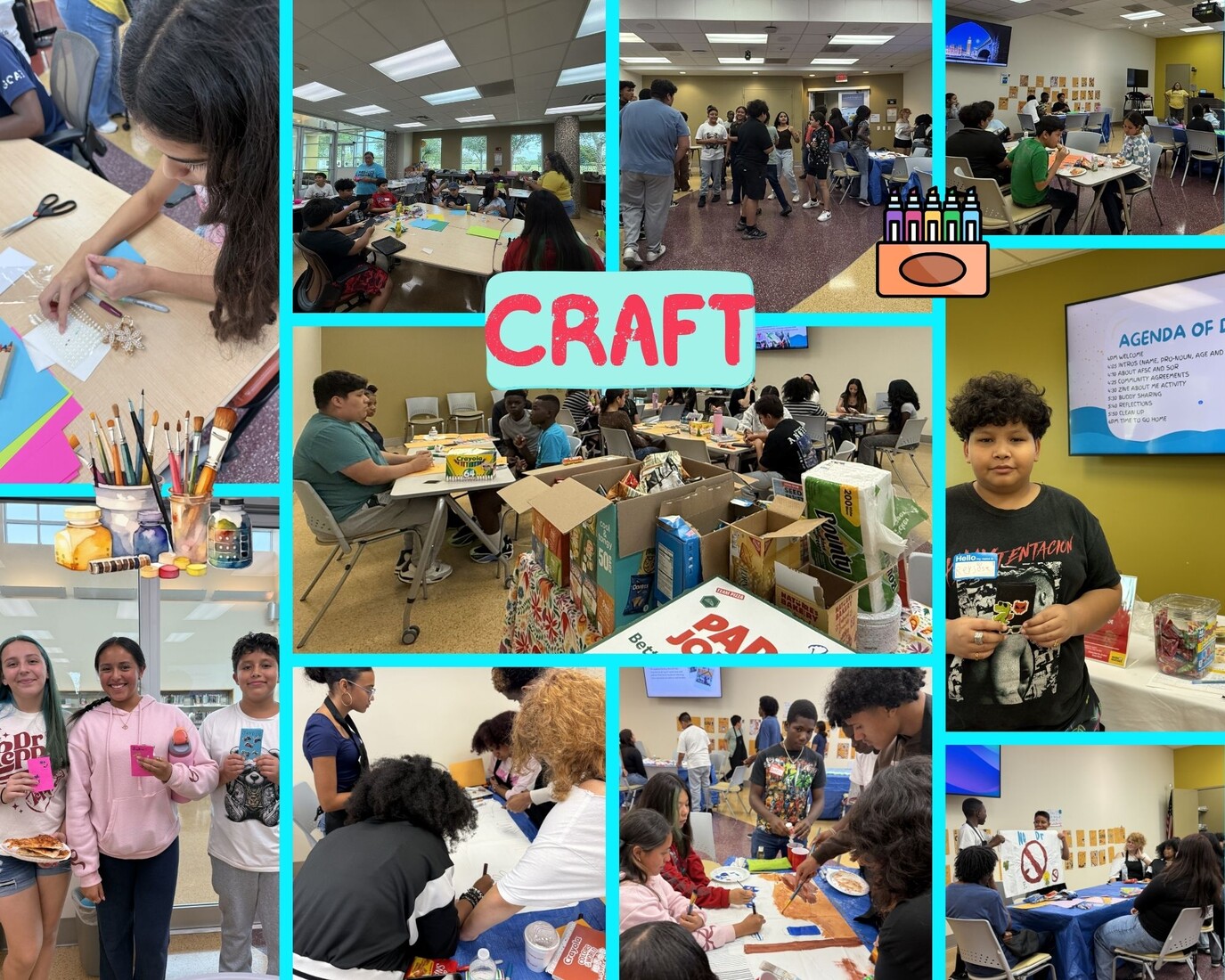
During June we launched the Seeds Power Hub at the Naranja Branch Library, an eight-week summer program where youth in high school and early college come together to heal, connect, and step into their power as leaders. Through weekly art workshops, healing circles, civic education, and storytelling, participants explore their voices, build community, and develop the skills to create meaningful change.
This isn’t just a program, it’s a movement. Throughout the program, youth deepen their understanding of activism and community organizing, preparing to become leaders, all while earning community service hours and enjoying shared meals in a supportive space.
By the end of the program, youth take center stage in a powerful, youth-led creative showcase, celebrating their growth, stories, and vision for the future. From there, they continue forward as leaders using their voices and actions to shape public narratives, influence policy, and fight for lasting protections for their communities.
For example, in week four, participants dove into the detention pipeline, explored the importance of activism, and learned key strategies for community organizing. They learned about the closure of the Homestead Child Detention Center as a powerful example of what collective advocacy can achieve. Inspired by this, youth designed bold campaign banners reflecting the movements they want to lead in their own communities turning knowledge into action.
Learn more about AFSC Florida and sign up for updates.