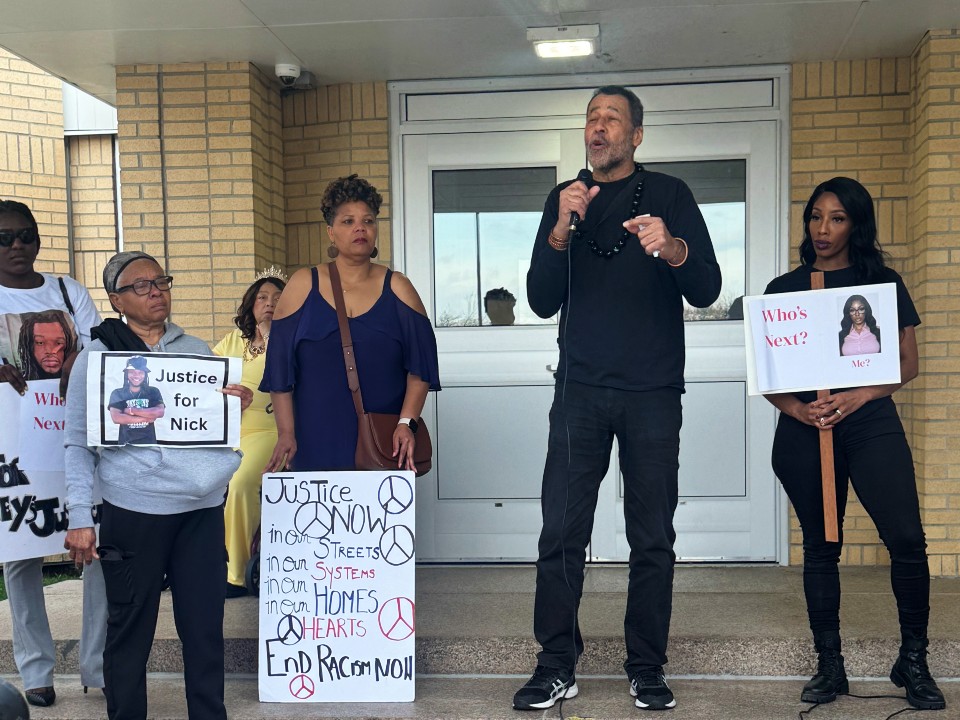
AFSC staff have helped family and community members organize monthly "Justice for Nickenley" rallies in Manchester.
Across the country, communities are pushing back against the expansion of federal immigration agents into our neighborhoods, workplaces, and public spaces. Violence by U.S. Immigration and Customs Enforcement has sparked deep concern about civil liberties, due process, and the reach of state power into people’s everyday lives.
We are right to be alarmed. But there is another question we must ask: Where is the same urgency when lives are taken by local police?
The expansion of immigration policing and the use of force by local law enforcement are connected. Both involve the power of government institutions to profoundly, and sometimes fatally, impact people’s lives. And both are shaped by systems that often operate with limited transparency and accountability.
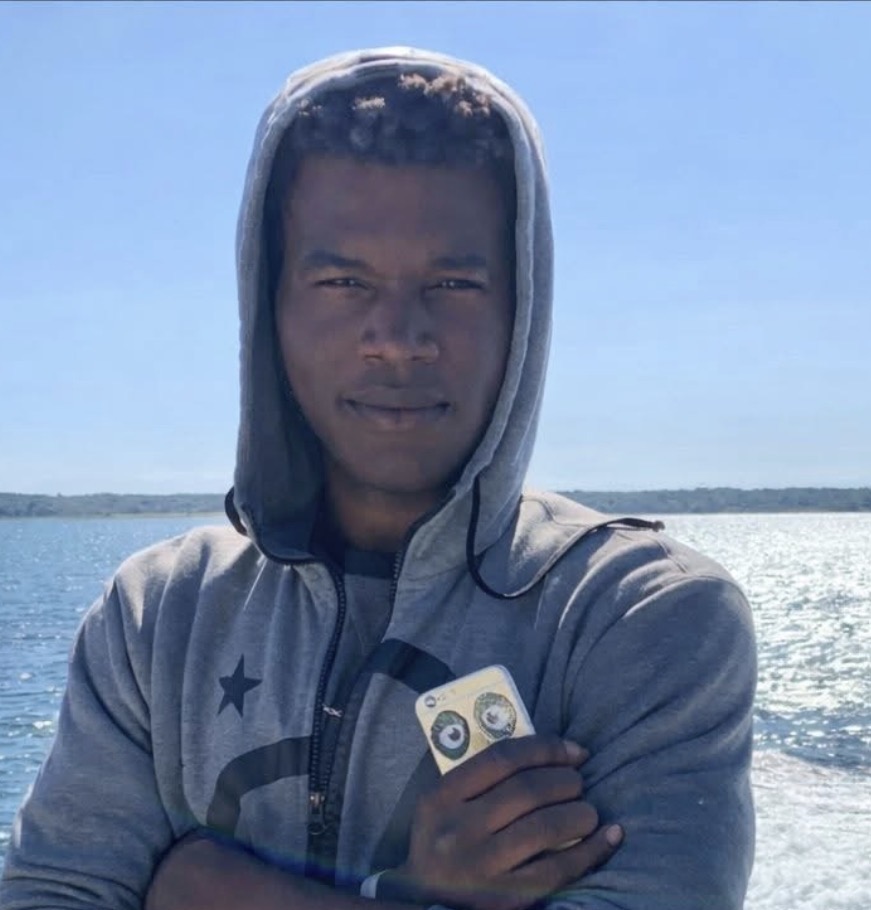
In December 2025, a young unarmed Black man named Nickenley Turenne was shot and killed by three police officers in Manchester, New Hampshire. The incident began with a report of a suspicious vehicle and ended with the use of deadly force. For Nickenley’s family and community, the moment the shooting occurred was not the end of the story. It was the beginning of a long and painful search for answers.
Why did this happen? What decisions were made in those final moments? Were there opportunities to de-escalate the situation before lethal force was used?
These are human questions. They come from families grieving someone they love and communities trying to make sense of how such tragedies occur.
And yet, too often, cases involving police use of deadly force and other violence move slowly through systems that feel distant and opaque, if they move at all. In New Hampshire, investigations into shootings involving police officers are typically handled by the New Hampshire Department of Justice, which determines whether the use of force was legally justified.
For families seeking transparency, that process can feel painfully long.
It raises another difficult question. Why do some crises produce immediate answers and national outrage, while others linger quietly for months without clarity or accountability?
Earlier this year, the fatal shootings of Alex Pretti and Renee Good by federal immigration agents in Minneapolis drew national attention and fueled widespread protests. By contrast, Nickenley Turenne’s killing has gotten little media attention beyond New Hampshire. Even though he was unarmed and pinned down on his stomach when police shot him. The difference is not in the severity of the loss, but in how the public is called to respond.

In December 2025, Nickenley Turenne was killed by police in Manchester, New Hampshire.
Nickenley was one of 300 Black people killed by police nationally last year. Across the country, Black people were 2.6 times more likely than white people to be killed by police.
This is not about comparing suffering or minimizing the seriousness of violence by immigration agents. Communities can care deeply about multiple forms of state violence at the same time.
For generations, Black communities have lived with the reality that encounters with law enforcement can escalate in ways that prove deadly. Cases like Nickenley’s are not isolated events. They reflect a broader history of racialized policing and limited accountability—one in which Black communities have rarely been able to trust that the systems supposed to protect them actually will.
In recent years, that trust has been further challenged by the erosion of police oversight itself. After the police murder of George Floyd in 2020, some cities and states agreed to modest police reforms, including community oversight boards. But today, many of those reforms have been rolled back. Florida and Tennessee have established bans on local cities setting up police oversight boards.
Under the Trump administration, the U.S. Justice Department has canceled consent decrees and investigations of abuses in Minneapolis, Louisville, Phoenix, Memphis, Oklahoma City, and San Francisco. In several cities that do have police accountability commissions, such as San Jose and Charlottesville, police have simply refused to turn over records that the commissions are legally authorized to review for investigation.
In Berkeley, California, two veteran members of the police oversight board resigned in frustration in January, noting “Over 84% of Berkeley voters established and empowered the Police Accountability Board, but their will has been ignored and the advances they envisioned have often been subverted.”
Less than two weeks later, the Berkeley City Council also fired the director of police accountability, Hansel Aguilar. His dismissal shook police oversight officials across the country. “We were shocked,” said Tonya McClary, who directs Philadelphia’s Citizen Police Oversight Commission (and is an AFSC board member).
Another force also continues to shape public perception: copaganda. Copaganda refers to media and other narratives that emphasize police heroism while minimizing scrutiny or systemic critique. Through television, news coverage, and social media, policing is often framed through a lens that centers danger and heroism—while leaving little room for deeper examination of accountability, policy failures, and alternative systems without police to create community safety for all.
The result is a public narrative that can make meaningful oversight appear unnecessary or even threatening. But accountability is not hostility. Oversight is not punishment. Oversight is the foundation of public trust. When communities have independent mechanisms to review police conduct, when investigations are transparent and timely, and when policies are shaped through community participation, trust grows. Without oversight, unanswered questions deepen harm.
That is why community organizations across the country are working to ensure that police oversight remains a central part of public safety. AFSC has long worked to address the harms of policing, mass incarceration, and racial injustice. Through community partnerships, research, and advocacy, AFSC works alongside impacted communities for policies that center dignity, accountability, and transparency. This work includes supporting campaigns for stronger civilian oversight, advocating for data transparency in policing practices, and helping communities understand the structures that shape policing in their states.
AFSC also provides analysis that helps people see the broader systems at play, so that communities are equipped with the knowledge needed to advocate for change.
The goal is not just to understand these systems, but to transform them. Across the country, communities are exploring new models of safety that move beyond punishment and toward prevention, care, and accountability rooted in community well-being. This includes investments in mental health response teams, violence interruption programs, restorative justice practices, and other approaches that address harm without relying on law enforcement.
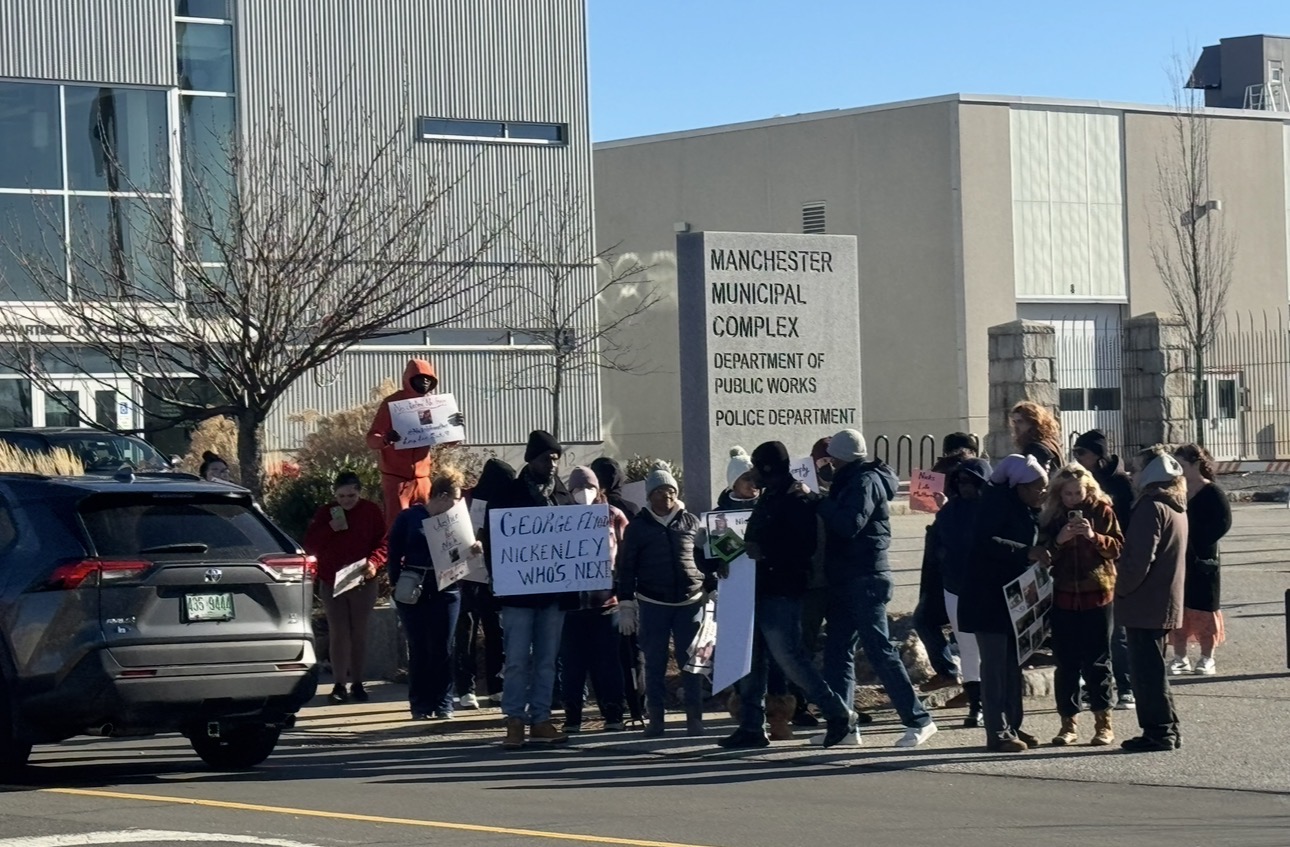
An action calling for police accountability in Manchester, New Hampshire.
These conversations can feel daunting. Systems of power are complex, and change often moves slowly. Yet history reminds us that meaningful reform rarely begins inside institutions alone. It begins with communities asking difficult questions and refusing to accept silence as an answer.
In New Hampshire, the death of Nickenley Turenne is one of those moments that calls for reflection. AFSC staff are accompanying his family and holding monthly “Justice for Nick” rallies in Manchester to keep his name alive.
His death demands that we ask whether the systems meant to protect communities are operating with the transparency and accountability that justice requires. It asks whether investigations move with the urgency that families deserve. And it reminds us that every life lost deserves more than a passing news cycle.
Behind every investigation is not just a case file. There is a family, a community, and a life that matters.
Public attention on federal immigration enforcement is understandable and necessary. But racist, unaccountable policing has been killing people in our communities long before this moment. It will continue unless we meet it with the same urgency. And most decisions about policing are made at the local level.
Justice is not measured only by the policies that we debate nationally. It is measured by whether communities believe that the truth will be pursued with integrity, whether oversight is protected rather than weakened, and whether the lives of those most impacted are valued as much as any other. And it is measured by whether we are willing not only to ask these questions, but to work together toward answers.