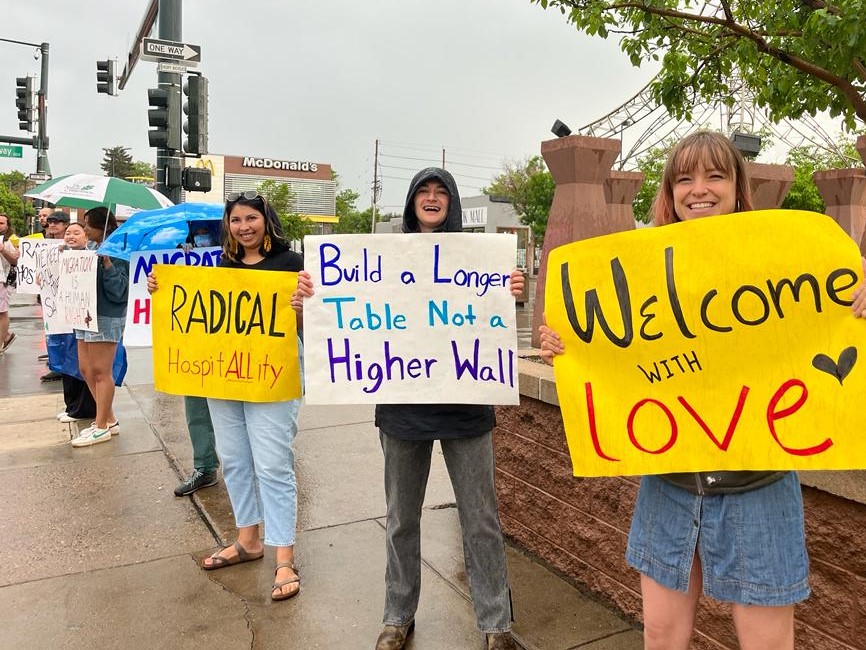

In May, ICE agents raided a restaurant in San Diego's South Park neighborhood, arresting several workers. But neighbors and patrons spontaneously began to protest ICE’s presence, forcing agents to retreat in their vehicles. Photo: Pedro Rios/AFSC
The United States should welcome immigrants with dignity and ensure their rights are respected. Regardless of where we came from, all people should have the opportunity to build a good life and pursue citizenship in the U.S.
But today, the U.S. is moving in the opposite direction. Since taking office, President Donald Trump has enacted immigration policies that are tearing apart families and neighborhoods, disrupting communities, and creating a culture of fear.
As a Quaker organization, AFSC’s work is led by our belief in the inherent worth of all individuals. We join with people across the country who recognize that immigrants make our communities stronger. Together, we are mobilizing against the Trump administration’s anti-immigrant agenda—and calling for an immigration system that is welcoming, dignified, and just.
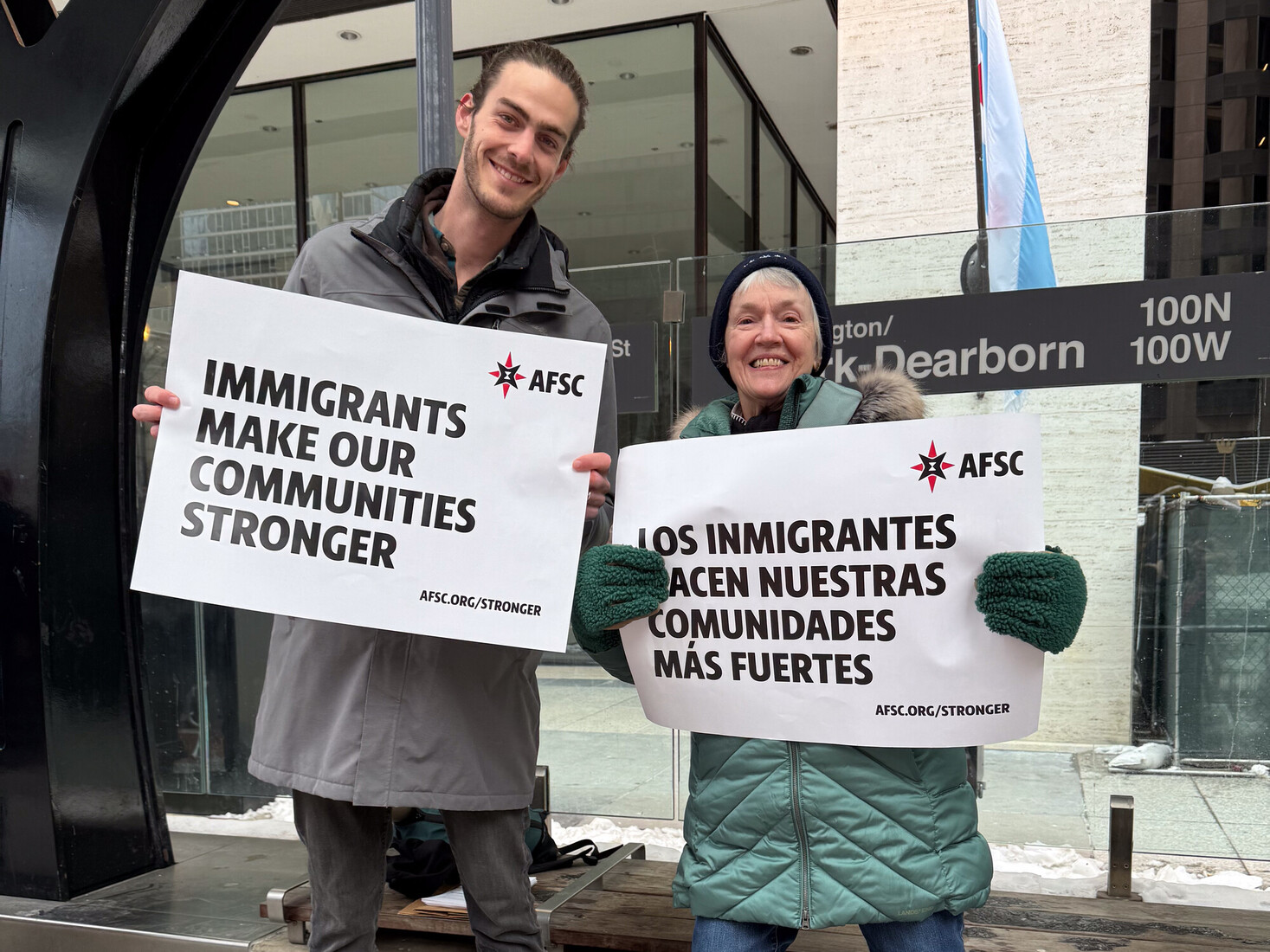
Here’s what you need to know about the Trump administration’s efforts to target immigrants:
DETENTION AND DEPORTATION
Expanding deportations
The Trump administration is vastly expanding deportations nationwide, with more than 390,000 deported in his first year in office. Immigration and Customs Enforcement (ICE) has been instructed to meet a quota of 3,000 arrests per day. Violent raids and arrests are being carried out at workplaces and communities across the country. People, including children, are now being detained in front of schools, at immigration court, ICE check-ins, and community gathering spaces. Images of ICE agents in masks, breaking car windows, grabbing people, and spraying tear gas at protesters, have become commonplace.
Expanding the inhumane detention system
Immigration detention has massively expanded since January 2025, with daily detention populations now over 60,000 people. Immigrants are detained under inhumane conditions in makeshift camps, former military bases, private prisons, and federal prison facilities. Many operate without adequate monitoring or accountability, as government oversight offices have been shut down. During Trump’s first year in office, at least 32 people have died in ICE custody.
Conducting raids in schools, hospitals, and other sensitive areas
The administration has ended a long-standing policy that discouraged ICE officers from entering or making arrests in schools, hospitals, places of worship, and other sensitive areas. Protected spaces where people seek help, worship, study, and exercise their basic civil rights, could now be targets for ICE raids.
Gutting the immigration court system
Approximately 100 immigration judges have been fired across the country—even as deportation cases surge. This includes judges at the Board of Immigration Appeals, where immigration court cases may be appealed. This deliberate gutting of the court system denies due process to millions already forced to wait in limbo for months or years.
BLOCKING IMMIGRANTS FROM THE U.S.
Shutting down the U.S.-Mexico border
The administration has closed the Southern Border to asylum seekers. Trump also declared a national border emergency, allowing him to deploy more troops to the area and redirect funds to further militarize border communities.
In addition, the administration shut down U.S. Customs and Border Protection’s CBP One mobile application. The app had previously allowed immigrants to schedule appointments at ports of entry—the only pathway to safely seek asylum. The administration has also reinstated the “Remain in Mexico” policy, which requires asylum seekers to wait in Mexico until their U.S. immigration court hearings.
Suspending refugee admissions
Trump suspended the refugee program for all countries except for white Afrikaaners from South Africa. Thousands of refugees who had already been approved for admission—some already in transit to the U.S.—have been stranded in countries around the world. That includes hundreds of Afghans who assisted the U.S. during the war in Afghanistan and now fear for their lives.
Following a December 2025 shooting of National Guard troops, reportedly by an Afghan national, the administration halted all visas for Afghan nationals indefinitely. It also paused all asylum decisions, regardless of nationality.
Implementing a new travel ban
The Trump administration has expanded on the racist Muslim and African ban implemented during its first term. Currently, nationals from 19 countries are barred from entering the U.S.: Afghanistan, Burkina Faso, Chad, the Republic of the Congo, Equatorial Guinea, Eritrea, Haiti, Iran, Laos, Libya, Mali, Myanmar, Niger, Sierra Leone, Somalia, South Sudan, Sudan, Syria, and Yemen. The ban also applies to people with travel documents issued by the Palestinian Authority.
Partial travel restrictions have been imposed on people from 20 more countries: Angola, Antigua and Barbuda, Benin, Burundi, Cote d’Ivoire, Cuba, Dominica, Gabon, The Gambia, Malawi, Mauritania, Nigeria, Senegal, Tanzania, Togo, Tonga, Turkmenistan, Venezuela, Zambia, and Zimbabwe.
Ending the Diversity Visa Lottery Program & Family Reunification Parole
The administration has ended the Diversity Visa lottery—a program that annually brought 50,000 immigrants to the U.S. from countries with low immigration rates. Since 1990, the Diversity Visa program has opened doors for immigrants from countries that otherwise have few pathways to the U.S., particularly African countries.
The Trump administration also ended the Family Reunification Parole program, which allowed residents with family from Colombia, Ecuador, El Salvador, Guatemala, Honduras, Haiti, or Cuba to petition for their loved ones to join them. The sole purpose of the program was to reunite families.
STRIPPING LEGAL STATUS
Revoking temporary legal status for over 1 million people
The Trump administration has canceled temporary legal status for over a million immigrants in the U.S., placing them at risk for deportation. Targeted programs include:
- Temporary Protected Status (TPS)
TPS is a provision under which the government protects people from deportation from certain countries afflicted by natural disasters, war, or other dangerous conditions. To date, the administration has ended TPS for people from Haiti, Venezuela, Afghanistan, Ethiopia, Myanmar, Somalia, and Cameroon. Many have lived in the U.S. for decades and built lives here. The administration’s decisions are being challenged in the courts as families and communities face being torn apart.
- CHNV (Cubans, Haitians, Nicaraguans, Venezuelans) Parole Program
The Trump administration shut down a program that had allowed over 500,000 people from Cuba, Haiti, Nicaragua, and Venezuela to live and work legally in the U.S. The CHNV program let people from these countries come to the U.S. if they had sponsors and passed background checks, giving them two years of protection.
- Student visas
The administration has revoked the visas of hundreds, possibly thousands, of international students in dozens of states. Many students with visas—and even green cards—have been arrested, detained, and either deported or threatened with deportation because of their political speech, particularly in support of Palestinian rights.
Denaturalizing U.S. citizens
The administration has announced plans to take away citizenship from 100 to 200 naturalized citizens per month. Denaturalization is a rare process that can be used when there is evidence of fraud in the naturalization process. Since 2017, only 120 denaturalization cases have been brought nationwide. Only federal courts can strip a person of their citizenship. The administration’s quota is an attempt to strip citizenship on a much larger scale.
Attempts to end birthright citizenship
Through an executive order, the Trump administration is attempting to revoke citizenship from some U.S.-born children of immigrants. This right is protected by the 14th Amendment of the Constitution. More than 20 states have filed suit to challenge the order and uphold this fundamental right. More than one federal judge has already temporarily blocked the executive order, calling it “blatantly unconstitutional." The case will now be heard by the U.S. Supreme Court, with arguments likely in spring 2026.
TACTICS TO CONTROL AND SILENCE
Creating a nationwide registry to target immigrants
As part of a new nationwide registry, immigrants as young as 14 are now being forced to turn over personal data and fingerprints to the federal government or risk being jailed indefinitely. People who aren’t citizens are now required to carry proof of their registration at all times, enabling racial profiling and civil rights violations.
The registry echoes racist registration systems from our past. The U.S. government forced people of Japanese, German, and Italian descent to register during World War II before sending many to internment camps.
Invoking the “Alien Enemies Act”
The Alien Enemies Act was previously used during World War II to force people into internment camps. Now, Trump is using the act to deport people without due process, violating their constitutional rights. Although the use of this law continues to face legal challenges, the administration has already sent hundreds of people to El Salvador and other places outside the U.S., where they remain incarcerated in inhumane conditions.
Targeting local government and nonprofits
The Trump administration is trying to use punitive measures—including withholding federal funds—against sanctuary cities, states, and other localities. These are jurisdictions that have declared that their local law enforcement and other institutions will not collaborate with ICE to deport community members.
The administration has also directed federal prosecutors to investigate and bring criminal charges against state and local officials who refuse to cooperate with ICE. This tactic has also been used to threaten nonprofits that serve immigrant communities, stripping them of funding to provide vital community services.