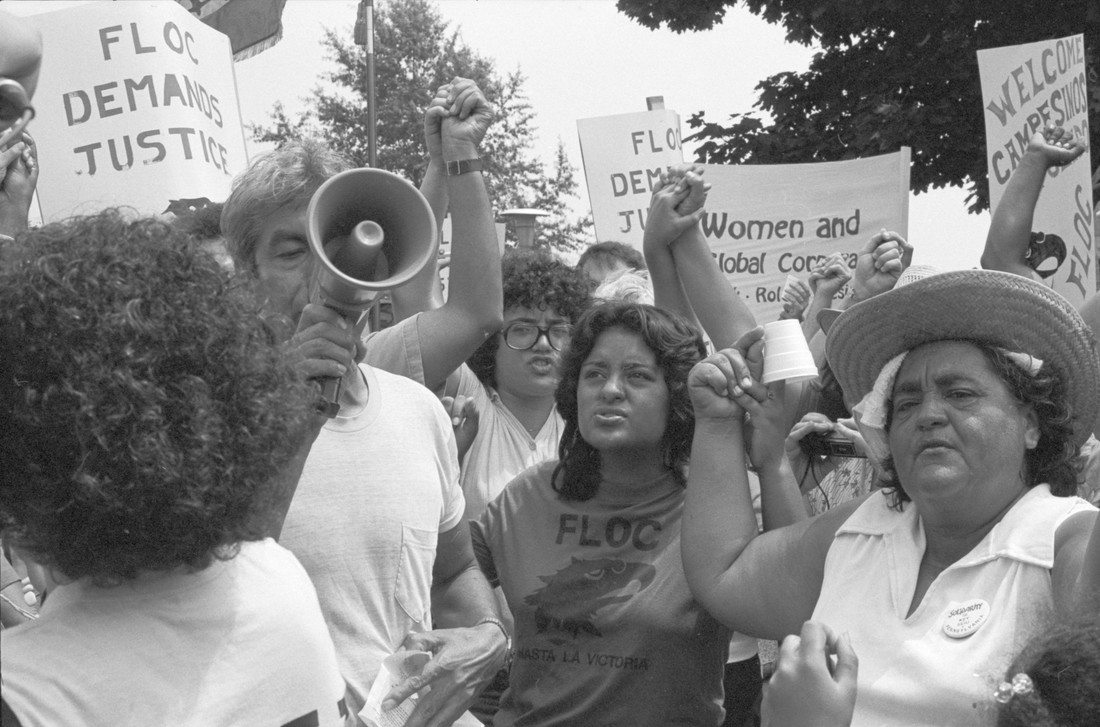
Farmworkers organizing in Philadelphia. Photo: AFSC Archives
May 1 is celebrated around the world as International Workers Day, a time to honor the struggles and achievements of the labor movement.
Ironically, May Day has been less observed in the United States than in other countries, despite its U.S. origins. But that has begun to change in recent years—and we invite you to be part of that change.
The struggle for workers’ rights has always been about human dignity. It’s about ensuring all people—regardless of background—have access to good jobs, food, housing, and health care. It’s about treating all people with respect in the workplace and beyond. These demands are as relevant today as they ever were.
First, some history. May Day was born in the context of the long struggle over something basic: how many hours a day could bosses demand from working people. In the early days of the Industrial Revolution, it was not unusual for workers of all ages and genders—including children—to work 16 hours per day, under dangerous conditions, for poverty wages. Economies benefited the powerful, not everyday people.
In 1884, the Federation of Organized Trades and Labor Unions—a precursor to the American Federation of Labor—issued a proclamation. It declared: “Eight hours shall constitute a legal day’s labor from and after May 1, 1886.” Workers rallied behind the popular slogan, "Eight Hours for Work, Eight Hours for Rest, Eight Hours for What We Will!"
Thousands of workers walked off the job. But that was only the beginning.
Chicago was the epicenter. On May 3, police fired on peaceful striking workers at the McCormick Reaper Works Factory, killing at least two workers. The following day, protesters gathered at Haymarket Square to demonstrate against the killings. As the rally wound down, police showed up in force and ordered the group to disperse. An unknown person threw a bomb. Gunfire followed. When the smoke cleared, seven police officers and several civilians were killed, while dozens of others were injured.
In the aftermath, labor and radical organizations experienced a wave of repression. Martial law was declared. Labor leaders were rounded up. Labor newspapers were shut down.
Eight men suspected of anarchy were arrested on conspiracy charges. Of these, four people—August Spies, Albert Parsons, Adolph Fischer, and George Engel—were executed by hanging. Louis Lingg died by suicide before the sentence could be carried out. Samuel Fielden, Oscar Neebe, and Michael Schwab were imprisoned, though eventually pardoned.
It is the consensus of historians that none of these men were responsible for the bombing. Dyer Lum, a friend of those executed, wrote at the time that the eight “dared to defend their beliefs when tried for an act, of which it was openly admitted they were not personally guilty.”
In 1889, the Second International—a loose federation of social democratic and labor organizations—designated May 1 as International Workers Day. They wanted to commemorate the Haymarket tragedy and the broader struggle for an eight-hour day. It stuck.
That was only one episode in a long saga of struggle, with advances and retreats in the face of opposition from political and economic elites. Over the decades, the U.S. labor movement has made enormous progress. It has won better wages, benefits, and safer working conditions—while also supporting public policies to protect workers and marginalized communities. These weren’t just labor victories. They represented progress toward an economy that works for all people, not just those at the top.
Unfortunately, the movement has been under constant attack since the early 1980s. Corporate interests, politicians, and others have promoted fear and hatred over solidarity. Those attacks have intensified in recent years.
Meanwhile, many communities still lack adequate access to food, housing, health care, and education. Even as governments spend billions on war, corporate tax breaks, and systems of repression. The collective struggle to ensure all people have what they need to thrive continues to be as urgent as ever.
For over a century, AFSC has supported workers, and we continue that work today.
More people in the U.S. are reclaiming May Day as a day to celebrate workers’ rights. This year, May Day Strong, a coalition of hundreds of organizations, including AFSC, is calling for a May 1st day of action. We urge people to rally, march, and strike to support an agenda that includes taxing the wealthy to put working families first. We are speaking out against war and ICE in communities. And we are demonstrating against authoritarianism and in support of democracy.
Join our coalition by taking the Workers over Billionaires pledge today. Commit to action this May Day and beyond.
It’s time to show up.