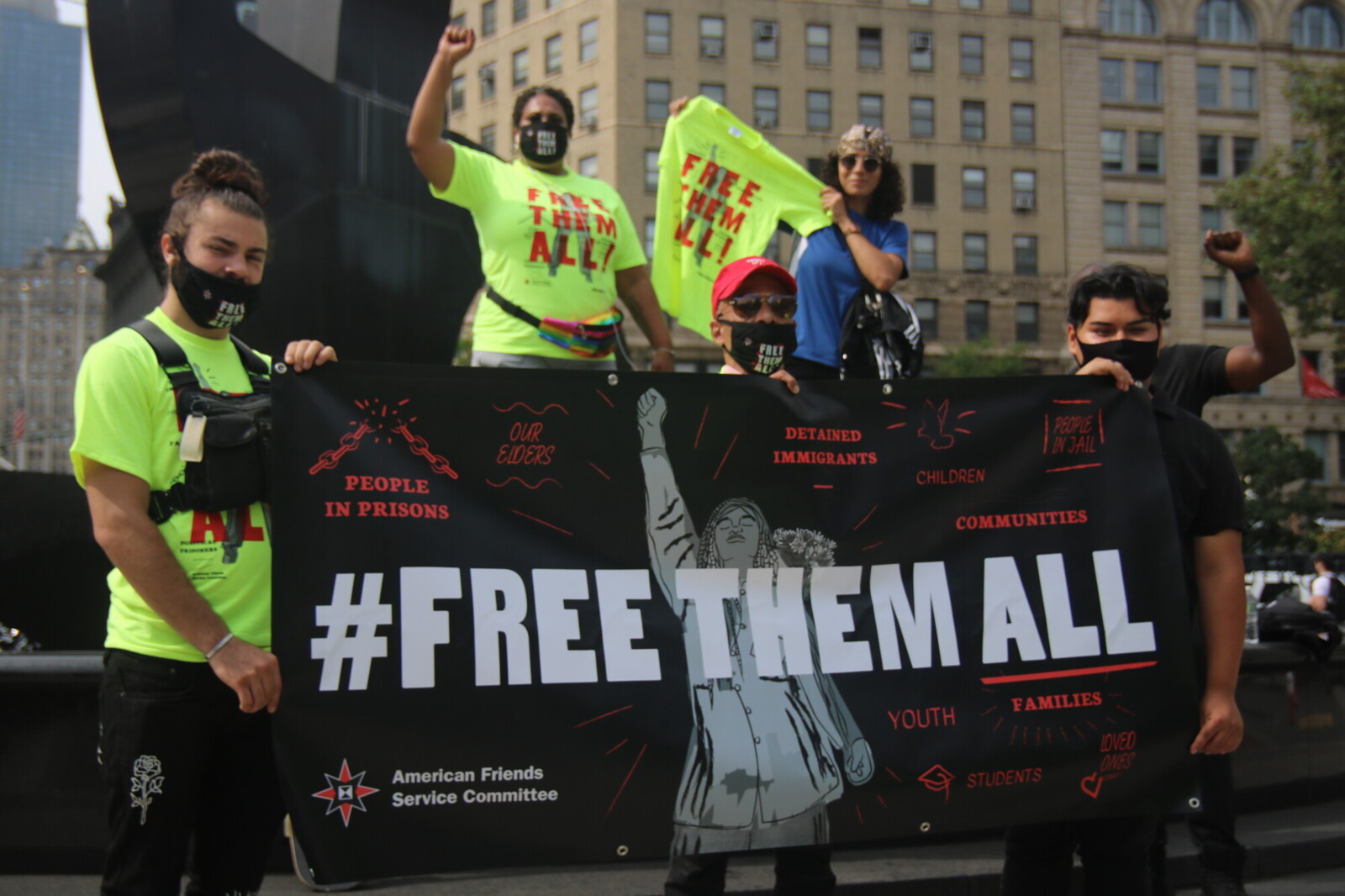
A #FreeThemAll action in New York City. Echoes of Incarceration
On June 19, 1865—more than two years after President Lincoln signed the Emancipation Proclamation—word finally reached Galveston, Texas that slavery had been abolished. For more than a century, people have celebrated Juneteenth as the end of slavery in the U.S. It seems fitting that we celebrate abolition not on the day a document was signed, but on the day that the message was delivered.
As today’s abolitionists know all too well, intentions and proclamations mean nothing until they start impacting people’s actual lives. The 13th Amendment was ratified six months after Juneteenth, outlawing slavery “except as a punishment for crime.”
More than 150 years later, the U.S. is keeping nearly 2 million people in cages in jails, prisons, and immigration detention centers across the country—disproportionately Black people and other people of color. When systems of community-based punishment—such as probation and parole—are included, the total number of people under correctional control in the U.S. grows to over 5 million.
AFSC has been calling for an end to imprisonment for decades. Today, it is long past time for us to end our reliance on criminalization and retribution in the U.S.—and adopt transformative alternatives rooted in healing and human dignity.
AFSC's “North Star” guides our work toward abolition. It identifies seven guideposts on the path ahead. I invite you to read it to learn more.
The U.S. has the highest incarceration rate in the world but still has incredibly high rates of gun violence and sexual assault. Our government warehouses millions of people while doing little to stop harm or help survivors of violence and communities heal. The U.S. spends $445 billion annually to keep people in cages, according to the Prison Policy Initiative. That diverts funds from essential services and community-led programs that address the root causes of violence.
That crisis has only deepened under the Trump administration. The number of people locked up in the U.S. has been fueled by the Trump administration to expand immigration detention. ICE detention has reached a historic high of 70,000 individuals—an increase of more than 80%.
The cruelty extends beyond detention. The Trump administration has also resumed and expanded the use of the federal death penalty. That includes broadening the methods by which the government is authorized to kill.
There’s a growing acknowledgment that prisons are a problem, not a solution. But many people find it difficult to imagine a different path. It would be far easier to tweak the system around the edges, to seek freedom only for a chosen few. But it is reform —not abolition—that worries me.
We’ve had prison reform in the U.S. for almost as long as we have had prisons. In 1829, the first prisoners were brought to Eastern State Penitentiary—a prison built with the guidance of the Philadelphia Society for Alleviating the Miseries of Public Prisons. The Society, led in part by several prominent Quakers, championed the use of long-term solitary confinement. They believed that the penitentiary model was far more humane than the overcrowded, unsanitary conditions in the jails of the time.
Today, we know that long-term solitary confinement is a form of torture. Sadly, it’s still commonly used throughout the U.S.
I work for a Quaker organization headquartered in Philadelphia, less than two miles from the Eastern State Penitentiary. As I read through the dozens of letters from people in prison sent to our offices every week—many writing from solitary confinement—it is impossible not to feel the palpable and unending pain wrought by well-intentioned reforms.
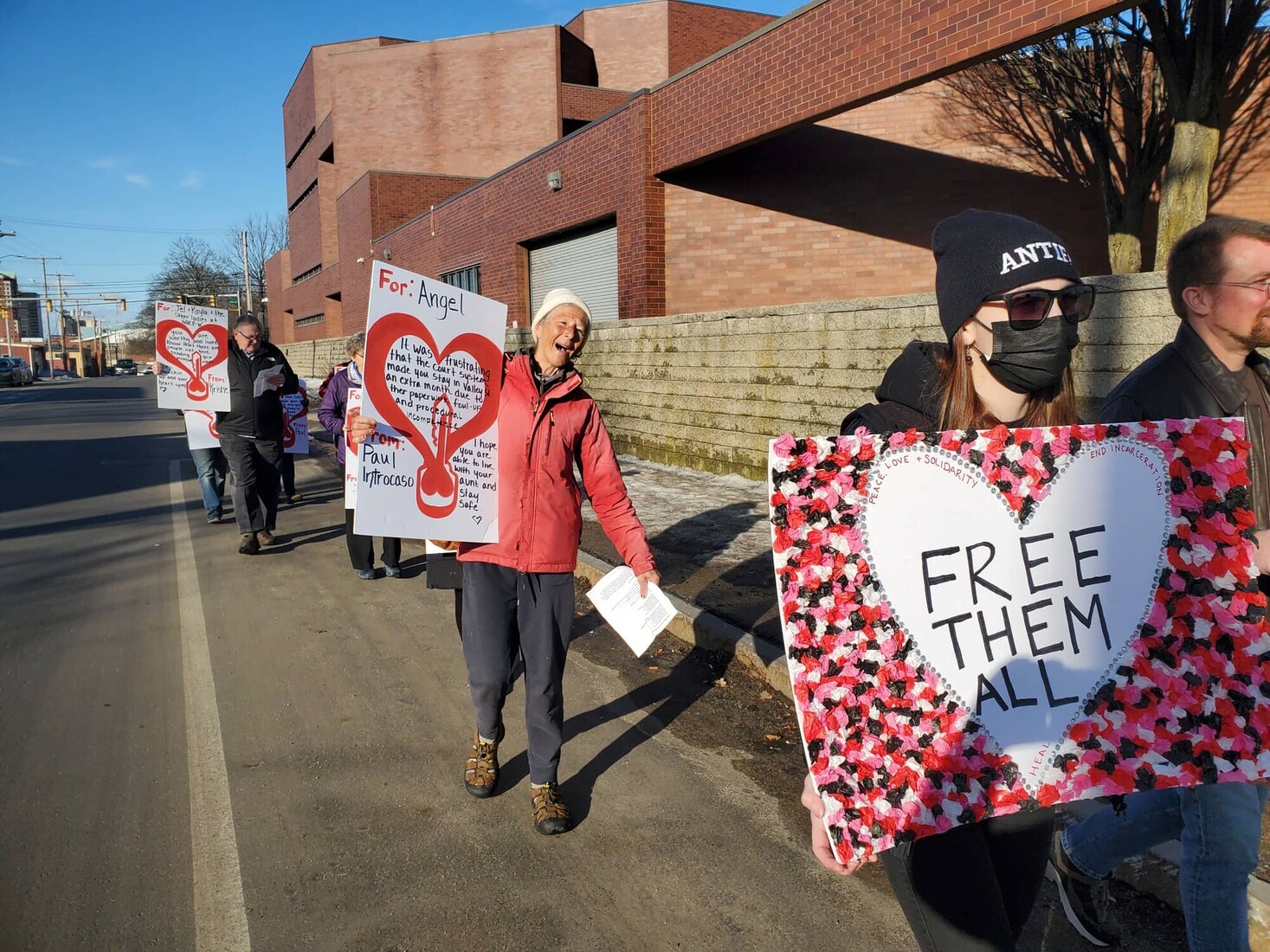
Free Them All action in New Hampshire. Maggie Fogarty/AFSC
I often hear from men incarcerated in the Attica Correctional Facility, located in my home state of New York. Attica was the site of one of the largest prison uprisings in history. Nearly 55 years ago, the men of Attica declared to the world, “We are men, we are not beasts and will not be treated as such.”
These words are a fitting indictment of America’s racism and America’s prison system—the living legacies of slavery. Many of the men I work with in Attica speak of the same fears and hopelessness that permeated the plantation fields of the antebellum South.
I am reminded of one of the world’s most famous abolitionists, Harriett Tubman. When speaking to a women’s suffrage convention in 1896, she said, “I was the conductor of the Underground Railroad for eight years, and I can say what most conductors can’t say—I never ran my train off the track and I never lost a passenger.”
In today’s abolitionist movement, we lose “passengers” every year, many of whom are tireless advocates for freedom who nevertheless die behind bars. But to leave anyone behind on purpose—to say that some people are incapable of transformation or unworthy of human rights and freedoms—is unthinkable.
At the time she gave this speech, Tubman was living in Auburn, New York—home to the Auburn Correctional Facility, another of the country’s oldest prisons. It is located just two hours east of Attica. Just six years before she gave this address, Auburn became the site of the world’s first execution by electric chair. It was billed as a reform—the “humane” alternative to hanging.
On this Juneteenth, I join those calling on all of us to take up the unfinished struggle of the original abolitionists. The dangers of simply reforming the policies of the present are too great. The system continues to expand—more detention, more executions, more people under correctional control—costing hundreds of billions of dollars every year.
It is time to unequivocally abandon the idea that putting human beings in cages or in bondage can somehow serve society.
We may not know exactly what a world without cages and shackles will look like, nor do we know exactly how to get there. But it is past time to stop building solitary cells and death chambers simply because we refuse to believe something else is possible. Our communities and our futures deserve better, and together we can get there.