
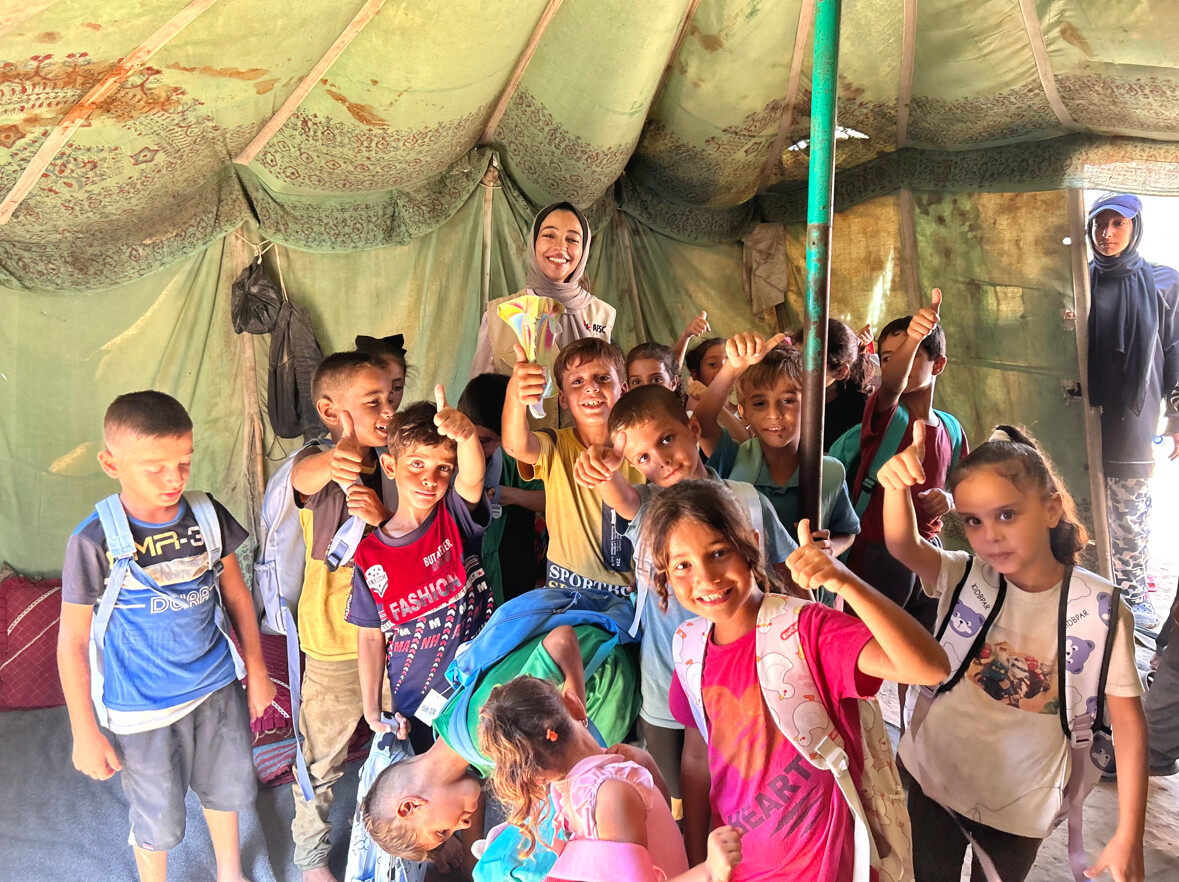
The author, Serena, with children in Gaza. Photo: AFSC
Since 2022, Serena has worked with AFSC in Gaza. Over the past two years, she has helped provide lifesaving humanitarian aid to hundreds of thousands of displaced Palestinians facing genocide. At the same time, she lived the same reality as those she served—bombings, repeated displacement, and unimaginable loss.
In December, Serena was able to leave Gaza for a master's scholarship in Rome. Such scholarships are one of the few reasons the Israeli government allows Palestinians to leave Gaza.
In this essay, Serena shares her story and urges us all to keep standing in solidarity with Palestinians in Gaza.
Before the genocide began, I was working on youth-focused programming with AFSC in Gaza. We engaged young people from Palestine, Jordan, and Lebanon in dialogue, leadership, and community action, giving them a shared space beyond borders to come together and talk about how to contribute to their communities.
But when the genocide began, everyone’s role on our team shifted. There was no meaning to do anything but help people. My work became lifesaving assistance. This transition was overwhelming, but it was also the reason I kept going. My work was the reason I woke up every day. In a way, it became healing for me, even as we witnessed fellow humanitarian workers being killed while doing their job.
On seeing children learn again
What made me feel most proud was being able to help children resume their learning after being deprived of education for two years. In the middle of destruction, AFSC is providing temporary learning spaces where children can learn, be among friends, and experience moments of normalcy.
Watching children arrive early, eager to learn, and not wanting to leave made me happy. For the first time in two years, I saw children carrying school backpacks—not water containers, not firewood, not waiting in line at aid distribution sites.
On the women I met
The women I met in Gaza often left me speechless. Many were fleeing their homes while pregnant, caring for children, living with disabilities, without access to basic medical care or hygiene supplies.
I hate to describe these women as “superheroes” or to call what they had “strength.” That language hides the truth that they should never have been forced into those conditions.
Those women were providing love while their hearts were breaking, warmth while they were freezing, food in the middle of starvation. They were also providing emotional support while they themselves needed it the most.
On distributing food
The hardest part of my work was distributing food. I hated it—not because of the work itself, but because food should never be something to be distributed. It's a basic human right. I, myself, was hungry. To see other starving faces and to organize these distributions was unbearable.
One time, we distributed food at U.N. schools in Al Bureij camp. It was located in a “red zone” where schools don’t usually receive aid. We risked our lives to distribute hot meals—and the next day, the school was bombed. People were killed in the same place where we had distributed aid. I was completely devastated. Like everything we were doing was suddenly erased.
You can offer food, but you can never really offer safety. This tension is something I’ve carried with me.
Holding onto joy
Despite everything, there were moments of joy in Gaza. My wedding on Nov. 27 was one of the days I will hold in my heart forever. It was the first gathering where both my family and my husband’s family could come together after two years of separation. My friends and my cousins told me thank you for giving us a reason to wear dresses, high heels, and makeup again.
Another deep pride was my brother passing his high school exams. I don't know how he did it, when passing the exam is a huge achievement under normal circumstances.
And then there was the day in January 2025 when we were allowed to return home during the first ceasefire. People were running to their homes—crying and dancing at the same time, hugging family members, neighbors, and strangers.
That ceasefire was broken just two months later in March. But these moments were a reminder that even in the darkest times, a light insists on continuing.
On leaving Gaza
It’s almost impossible for anyone to leave Gaza. There are only three ways the Israeli government will allow it: emergency medical treatment with a health visa, a scholarship to study outside of Gaza, or family reunification with a family member outside. But many people are denied these permits. People die waiting to be granted permission to leave Gaza for urgent medical attention.
Nothing shattered me the way leaving Gaza did. Saying goodbye to my family and my home was more painful than any bombing or displacement. We were evacuated on short notice. I cannot forget my parents’ crying faces, telling me not to look back and to find a better future. I left not knowing whether I would see them or Gaza again.
The journey from Gaza to Rome was unbelievable. We were escorted, passing through Rafah in the West Bank. I looked around, seeing houses, electricity, cars. After living among rubble in Gaza for so long, it felt unreal to me, like something was wrong.
Arriving in Rome
My friends who had been able to leave Gaza told me it was going to be hard, but I didn’t expect it to be this hard. The first night, I couldn't sleep—no bombs or drones in the sky.
Everything suddenly became so easy—getting food, access to water, being able to go to the market and just buy what you needed. I felt like I didn't deserve this.
Every day, I discover a new layer of trauma I didn't know I was carrying. When I hear an ambulance, I wonder if they’re rushing to get someone from under the rubble. Are they bombing here, too?
The family I’m staying with is lovely. They spend every weekend in another city, but the first time I had to pack, my body resisted. I realized I hated packing and unpacking suitcases. That was because, over two years, I was forced to pack and unpack, eleven times, moving from one place to another. When I told them, they understood. In a bit of humor, their daughter hid all the suitcases in the house so I would feel safe.
I also have survivor's guilt. In Gaza, it felt shared. Now it feels lonelier and heavier. How am I supposed to smile and enjoy life while my people are drowning?
Leaving Gaza made me feel weak to the point that I’m sick. My body doesn’t accept that I’m out. I hate that I had to leave for my future, but I will always carry Gaza with me wherever I go.
What I ask of you
What hurts me the most is seeing people going on with their lives normally with my own eyes. So I felt like all I wanted to do was scream in the streets, telling everyone, “Do something! My people are dying!” It feels like people are starting to forget the genocide in Gaza, while the situation is actually getting worse.
Silence is dangerous. We need to keep pressure on politicians to change their policies to hold Israel accountable. We must demand that the Israeli government end the blockade on Gaza, so food and other lifesaving humanitarian aid can enter. Construction materials must be allowed in so people can build houses instead of staying in tents forever.
Gaza doesn't need only attention—it needs commitment. Solidarity from people around the world must be loud, uncomfortable, and continuous. We are beyond the point of what is at stake—our lives and our future already depend on action for freedom and justice.