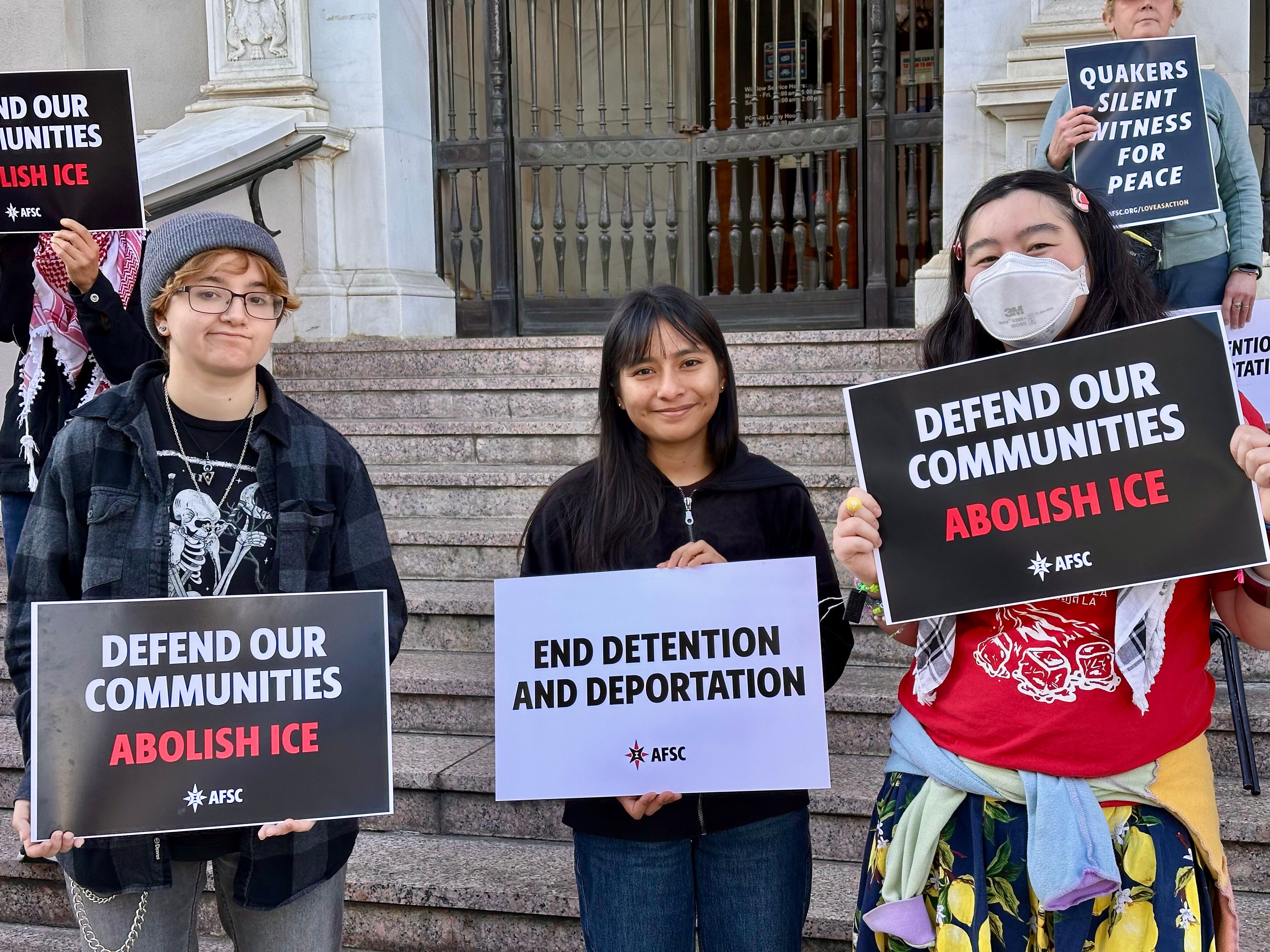
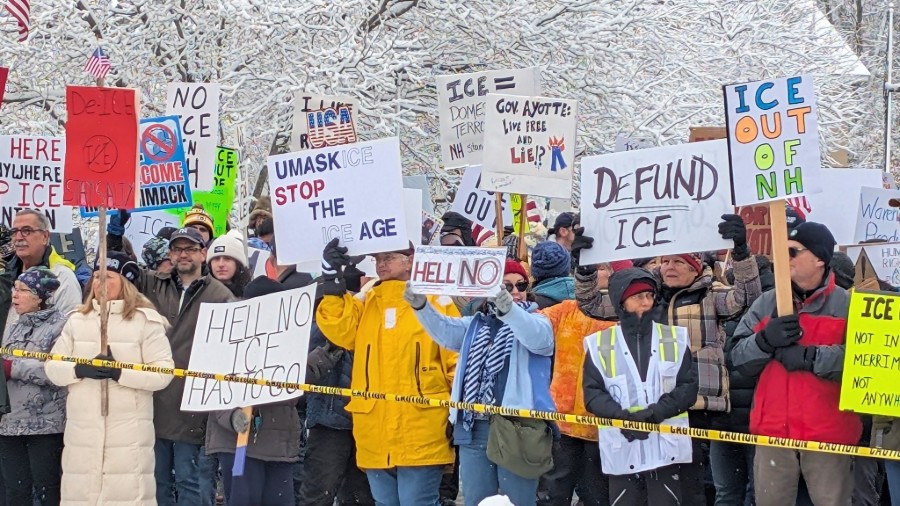
Community members protest the proposed ICE warehouse jail in Merrimack, New Hampshire. Kim Herdman Shapiro
On Christmas Eve, signal threads were lighting up with alarmed messages from fellow activists across New Hampshire. The Washington Post had just reported that the Trump administration was planning to convert warehouses across the country into Immigration and Customs Enforcement (ICE) facilities.
The small town of Merrimack, New Hampshire, was on the list. We were shocked.
But just days later, a robust campaign was taking shape, buzzing with constructive concern and a shared sense of urgency.
No one belongs in a cage. As a Quaker organization, AFSC opposes all forms of detention and incarceration. People should be able to stay with their families and communities as they navigate the immigration system. Their rights and dignity should be respected.
There is no justification for locking people up, especially in warehouses never designed for human habitation. AFSC joined residents in Merrimack and across New Hampshire, along with community organizations and grassroots networks, to stop that from happening.
Two months later, the ICE warehouse jail was canceled. It was the result of the collective efforts of residents, activists (new and seasoned), elected officials, and longstanding organizations.
Here’s how we made it happen—and what other communities can take from it.
A plan to warehouse tens of thousands
The Washington Post story revealed that the Trump administration’s plan would allow ICE to hold tens of thousands more immigrants in warehouses across the country. It represented one of the most aggressive expansions of immigration detention in recent memory.
The warehouse model is especially alarming. Many of these facilities would be run by private, for-profit prison companies with documented records of deaths, abuse, and neglect. Others would be run by ICE, with an equally appalling track record of violence and disregard for human life. They would have no accountability to local communities. They would effectively function as concentration camps.
In New Hampshire, AFSC and partners have organized for decades in support of immigrant rights. We facilitate the statewide NH Immigrant Rights Network, which coordinates advocacy for humane immigration policies at the federal, state, and local levels. We run a visitation program for detained immigrants at Strafford County jail, and coordinate supports for vulnerable community members. We advocate to end collaboration between ICE and local law enforcement. And since the start of the Trump administration, we have opposed government contracts to detain immigrants at county jails, organized and trained rapid response networks, and joined residents to protest deportation flights out of Pease Airport.
When the news of the Merrimack facility broke on Christmas Eve, there was already an organized base of people ready to respond. Over the subsequent weeks, many hundreds more stepped forward to join the effort.
A town mobilizes
Merrimack is a small New England town of about 26,000 people. Its political demographics reflect those of the broader New Hampshire — closely divided, independent-minded, “live free or die” country.
This grassroots campaign created an opportunity for the people of Merrimack to take the lead. They had the backing of their state representatives, including Rep. Wendy Thomas, who was among the first public officials to denounce the plan. Residents statewide amplified the vocal opposition of Merrimack residents. The campaign drew in residents who had never been involved in anything like this before.
The campaign was coordinated through interconnected Signal groups that sprang up almost overnight. The organizing was decentralized, fast-moving, and entirely community-led. Organizations and networks like AFSC, Indivisible, NH 50501, ACLU, and the Granite State Organizing Project offered support and amplified the opportunities for action.
Residents flooded town officials with calls and emails and leveraged personal contacts. They got the issue onto the agenda of an upcoming town meeting. That first meeting drew about 1,200 people—extraordinary for a town this size. Community members filled the hall and spoke one after another, urging officials to do everything in their power to “put sand in the gears” of the project. Not a single voice rose in support.
Town officials united in opposition. They began pressing members of Congress to act. New Hampshire’s congressional delegation put out public surveys. They generated thousands of responses from across the state. Regional and national media also picked up the story, amplifying the campaign far beyond New Hampshire, and connecting our effort to campaigns in other states where more ICE warehouse jails were planned.
The grassroots campaign was led by Merrimack residents and supported by other New Hampshire residents, activists (new and seasoned), elected officials, and longstanding organizations. Photo: KT Brown
AFSC’s longstanding commitment to active nonviolence helped ensure demonstrations remained peaceful and safe. Through the New Hampshire Peacekeeper Project, hosted by NH Peace Action, we train community members in active nonviolence. There are now over 130 trained peacekeepers regularly deployed to demonstrations across the state.
Their presence in Merrimack was essential. When I arrived at the first protest, it was clear the town was unaccustomed to public demonstrations. I was struck by the rows of police cars, barricades, and officers in vests. The school across the street had canceled after-school activities. The Catholic church had closed its parking lot.
Our peacekeeper team leaders had met in advance with organizers, town officials, and local police to prepare. What could have been a volatile situation instead remained exactly what we intended: a peaceful, powerful expression of community values.
Pressure reaches the governor
Gov. Kelly Ayotte was always going to be a critical pressure point in this campaign. When the story broke, she said it was the first she had heard of it. But an ACLU public records request showed otherwise. Her state Department of Natural and Cultural Resources had been in communication with the U.S. Department of Homeland Security (DHS), which oversees ICE, for weeks. The head of that state department resigned in the fallout. During a congressional hearing soon after, ICE Director Todd Lyons also acknowledged that his department had been in direct contact with the governor.
With a gubernatorial election on the horizon, the pressure mounted. Ultimately, Gov. Ayotte traveled to Washington to meet with DHS directly. When she returned, she announced that the Merrimack facility would not move forward. The politics were complicated, but the outcome was not. In the end, the people of New Hampshire stopped an ICE facility from opening in our community.
What this victory means
The ICE warehouse jail in Merrimack is not opening. For the people who would have been detained there and their loved ones, this is a real win. It also proves something larger: detention expansion is not inevitable. Everyday people can stop these facilities.
For communities facing similar proposals, Merrimack shows the way. Build pressure from the town to the state to the federal level. Let residents lead. They have credibility no outside organization can match. As an established organization, support the grassroots activists and the offerings of skills, talents, and creativity by newly activated leaders. Use every argument: human rights, cost, environmental concerns, community character.
Across the country, other communities are stopping similar proposals from moving forward. This campaign shows what’s possible. And if it teaches us anything, it’s that we can—and must—win.