The Alameda County Sheriff proposes to keep hundreds of scattershot munitions in its arsenal. It should get rid of all of them.
The Alameda County Sheriff's Office (ACSO) has phased out several models of multiple projectile (scattershot) munitions, and reportedly did not use scattershot munitions over the last two years. We applaud this move to phase out some of these dangerous weapons. The UN Special Rapporteur on Torture, Amnesty International, and Physicians for Human Rights have all called for banning use of multiple projectile munitions by law enforcement, because they are indiscriminate and dangerous, with no added law enforcement benefit.
However, the sheriff 2025-2026 report on military equipment states that it still has 613 scattershot munitions. It should phase out these dangerous munitions.
ACSO says it will eliminate “Stingballs” but reports having 203 of them.
This grenade-style scattershot (Defense Technology #1087) delivers 25 rubber pellets as well as bright light and loud noise. The sheriff's report states that it has 203 of these munitions, an increase from 65 last year. On October 12, after publishing its annual report, ACSO said it is eliminating these Stingball munitions. That's good news! The Board of Supervisors should codify it formally by revoking authorization for these munitions. If the Board approves the report as it is, it will be authorizing continued use of these dangerous munitions.
ACSO proposes to keep 410 cartridge-style scattershots
The Defense Technology #6064 and #6098 are fired from a launcher. After being fired, the 40mm cartridge disperses three projectiles per shot. The three projectiles per cartridge are rubber or wood, depending on model number. ACSO proposes to keep 340 “multiple rubber baton rounds” (Defense Technology #6064) and 70 "multiple wood baton rounds” (Defense Technology #6098) - both increases from last year, when it had 43 and 24, respectively.

Jennifer Tu/AFSC
ACSO already has over 14,000 single-shot projectiles.
The Alameda County Sheriff has hundreds of scattershot munitions and more than 14,000 single-shot projectiles.
According to its annual reports on military equipment, ACSO hans't used scattershot munitions in the last three years, but last year used single-shot projectiles in 17 incidents, including for "compliance" and "damaged munitions" (??). It also used "flashbangs" 35 times.
ACSO has 13,000 "Pepperball" projectiles and over a thousand 40mm single-shot projectiles, in multiple models, that deliver a teargas payload. It doesn't need scattershot "baton" munitions.

Magali Ruer / AFSC

Magali Ruer / AFSC

Magali Ruer / AFSC
The Sheriff’s use policy for "less lethals" (impact projectiles) is dangerously broad. We need a policy that protects the community.
The Alameda County Sheriff’s policy for “less lethal” weapons allows the use of a wide array of single-shot and scattershot munitions, with and without chemical agents. ACSO's use policy lists a few specific situations as examples in which "less lethal" use would be permitted, and also permits unspecified situations not listed. The only limitation listed in the use policy is that when used for "crowd control," use must comply with the 2021 California state law that limits police violence in crowd situations.
This broad use policy is especially concerning in light of the Sheriff's request to acquire 25 "Pepperball" launchers and 6,000 rounds. The Pepperball launcher has a hopper of 160 rounds that can all be fired from a single launcher in under three minutes. In comparison, the Sheriff's existing launchers use 15-round magazines.
The Sheriff's Use of Force Policy (G.O. 1.05) authorizes "less lethals" when someone doesn't comply with orders, and actively resists complying with orders. This raises questions about when use may be authorized and considered reasonable:
- The use policy lists "Self-destructive individuals" as a potential situation in which "less lethal" weapons are authorized. If someone is engaging in self-harm and doesn't comply with orders, would the Sheriff's Use of Force Policy permit firing a "less lethal" at them? The Sheriff's "Less Lethal" Policy (G.O. 1.21) notes that targeting the head or neck would be authorized to prevent death or serious bodily injury, would that permit firing a 40mm projectile at the head of a person engaged in self-harm and not complying with orders?
- If a loved one of the person engaging in self-harm refuses to comply with an order to leave, does the Use of Force Policy authorize firing a "less lethal" at them?
- The use policy notes the weapons are authorized "to protect life and property" and to "control non-compliant persons". If a young person is defacing property and runs away when ordered to stop, would policy authorize shooting them with the "less lethal"?
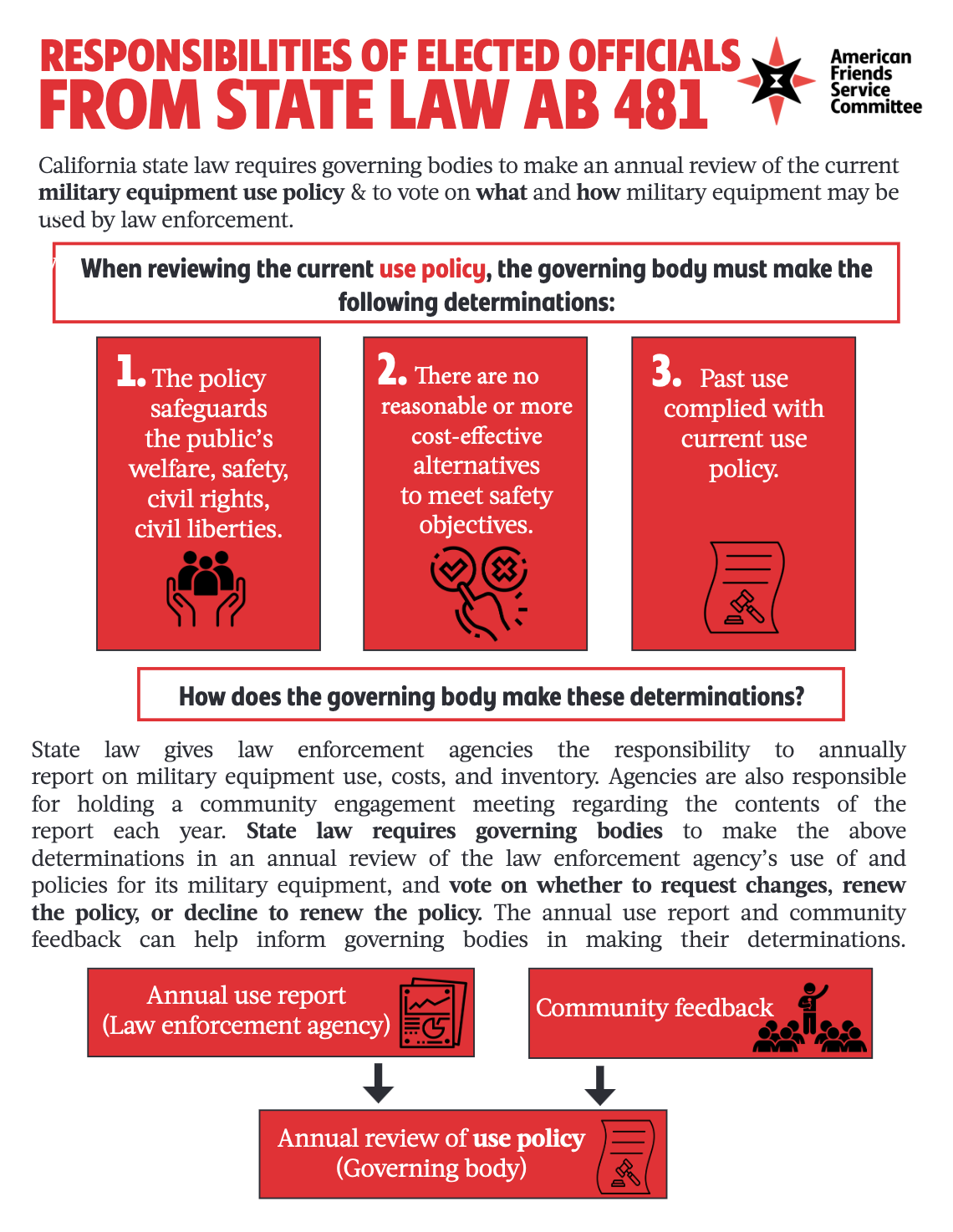
Other ACSO policies limit use of these weapons in the jail, and individual officers' discretion may as well. However, state law AB481 requires governing bodies to review use military equipment policies at least annually, and to only approve a policy that will safeguard the public's safety, welfare, civil rights, and civil liberties. This policy fails to meet that standard -- but could, with the addition of a few guardrails:
Unless it is to defend against a threat to life or serious bodily injury to any individual, prohibit the following:
- Firing on a person who is experiencing a mental health crisis
- Firing on a person who may be a minor, elderly, or pregnant
- Firing on a person who may not understand spoken commands
- Firing on a person who is not complying with officer commands
- Firing on a person who is close enough that a projectile may have an increased risk of death or serious bodily injury
This addition to the "less lethals" use policy would provide some basic protections for public safety, welfare, civil rights, and civil liberties, while allowing ample room for officer discretion.
Thursday October 22 10:30am: Take action with us!
Please join us on Thursday October 22 at 10:30 am and give a two minute public comment to ban scattershots and to change authorized uses for projectile weapons to better protect our community.
You can participate via zoom or in person at the Board of Supervisor's Public Protection Committee. This is the second of two items on the agenda.
In person:
Board of Supervisors Chambers, 5th floor
County Administration Building
1221 Oak Street, Oakland, CA 94612
NOTE: there is a security screen (x-ray) to enter the building
Via MS Teams: https://teams.microsoft.com/meet/237604917362156?p=XdzISyd3I13DDsb1OP
You can also write to BOS Public Protection Committee members Supervisors Marquez and Miley, as follows:
Supervisor Elisa Marquez <Elisa.Marquez@acgov.org>
Sup. Marequez Public Safety staff: Brenda Gomez <Brenda.Gomez@acgov.org>
Supervisor Nate Miley <Nate.miley@acgov.org>
Sup. Miley Public Safety staff: Darryl Stewart <darryl.stewart@acgov.org>