On January 3rd, 2026, the United States attacked Venezuela and kidnapped President Nicolas Maduro. US officials claim that the attack killed about 75 people, while Venezuelan officials claim it killed 100.
As suggested by the United Nations’ Secretary General, this act of aggression was likely in violation of the basic “rules of international law,” including “the prohibition of the threat or use of force against the territorial integrity or political independence of any state.” Their concern that this attack represents a “dangerous precedent” which could be used to justify virtually any foreign invasion has been echoed by numerous national governments around the world, including Brazil, Denmark, Indonesia, Malaysia, and Spain.
The response of the international community to the US attack on Venezuela is of great importance to peace around the world. Because this intervention was a flagrant violation of international law, a failure to condemn the attack undermines the world’s ability to consistently condemn other illegal acts of aggression.
The Prime Minister of Slovakia made it clear that if international law doesn’t apply to the United States government, then it also cannot apply to others, such as the Russian government: “Either the use of American military force in Venezuela will be condemned and be consistent with attitudes to the war in Ukraine, or, as usual, remain pharisaical.” While the European response to the US intervention was quite divided, Iceland’s Foreign Minister agreed: “No nation has the right to violate international law…”
As an organization committed to peace, we at the American Friends Service Committee have clearly stated our belief that the attack on Venezuela was an “unjustified, illegal, and unprovoked act of war” which “revitalizes a long history of U.S. violence and imperialism against nations and people in Latin America.” It is crucial for people around the world to come together to resolve their differences without violence or coercion, and to clearly state that diplomacy and cooperation is the only path towards a lasting global peace.
Below is a tracker of how more than 180 countries, territories, and major international bodies have reacted to the US attack on Venezuela. This tracker collects various statements made by these governments and bodies along with the context in which the statements were made, and then roughly categorizes each as either “Critical,” “Mixed/Neutral,” or “Supportive” of US actions. A map displaying each country’s approximate position is also available in the second tab of the spreadsheet.
Because these are simplified categories which can sometimes flatten the nuance of a particular country’s response, a source is provided for the information used to determine a country’s placement, and readers are encouraged to look into other statements made by a given government for further context.
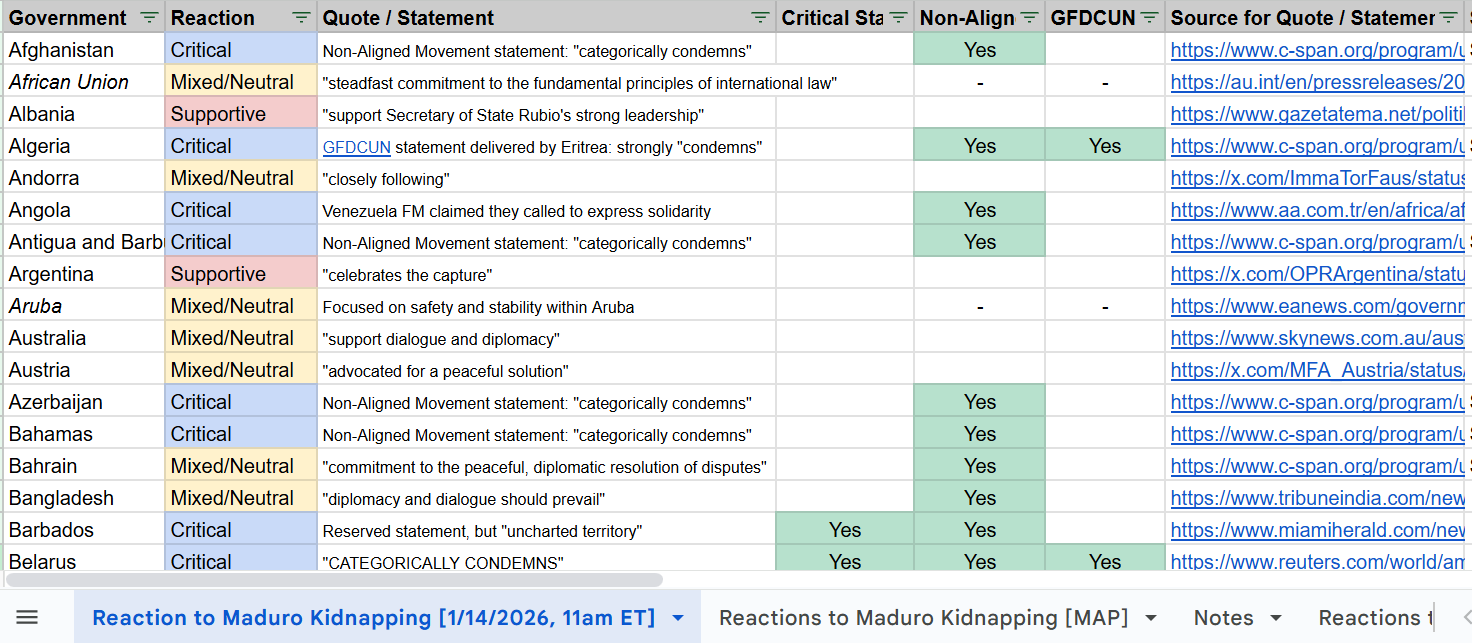
As of January 14, 2026, 117 parties have taken a “Critical” approach to US actions, 46 have taken a “Mixed/Neutral” approach, and 25 have taken a supportive approach. Most “Critical” parties are categorized on the map as “Passively or Mildly Critical,” as they have so far allowed the international groupings they participate in to take a position for them. However, 37 of the “Critical” parties are categorized as such because of their own statements on the matter, 30 of which are strong and direct enough to be classified as “Vocally Critical.” These numbers are likely to change over time.
Methodology
Countries are categorized primarily on the content of official statements made by heads of state, foreign ministries, UN representatives, and other government officials. “Critical” statements speak negatively about US intervention and its implications. “Mixed/Neutral” statements either do not address the specifics of the situation or fail to take a clear position on US intervention. “Supportive” statements either explicitly defend US intervention or otherwise suggest that US actions were legitimate. Each government’s category is also affected by context outside of its statement(s), including its position on related US military activities in the region, its preexisting relationships with both the US and Venezuela, the geopolitical alignment of its current government, and its membership in specific international organizations.
Two international groupings at the United Nations– the Non-Aligned Movement (NAM) and the Group of Friends in Defense of the Charter of the United Nations (GFDCUN)– made statements which were strongly critical of US actions during the UN Security Council meeting on January 5, 2026. All member states of these groupings are considered “Critical” by default, but those member states with additional context suggesting otherwise have been reclassified accordingly. See the “Quote / Statement” column for more details.
For the map, categories are identical to the tracker with the exception of splitting the “Critical” group into those that are “Vocally Critical” (those with statements directly opposed to US intervention) and those that are “Passively or Mildly Critical” (those with statements that made mild and indirect criticisms, or those who have not made a critical statement but are members of one of the two UN groupings that has).
The date of the most recent update to the tracker can be found both at the end of the title for the “Reactions to Maduro Kidnapping” tab. If you see something on the tracker that you believe to be a factual error, a misrepresentation, or an oversight, feel free to email it to me at bheinz@afsc.org for review.