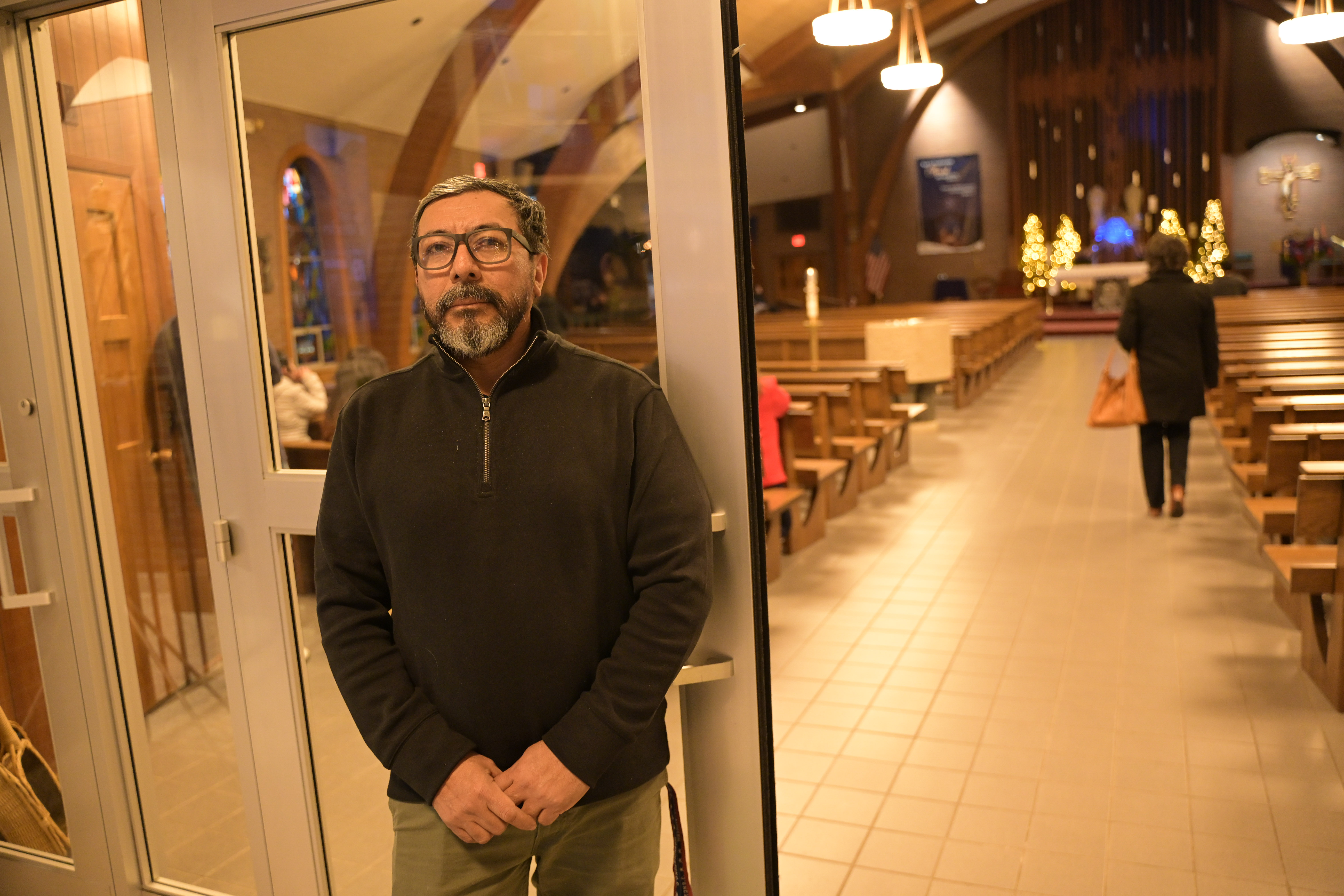
Daniel at the Catholic Church that he’s attended and volunteered much of his time to throughout his time in New Jersey. Henry Craver/AFSC
After losing his job due to political turnover, Daniel immigrated from Honduras to the U.S. in 1995 to build a better future for himself. Obtaining TPS transformed his life, allowing him to work with dignity and build a career. Today, Daniel is now 55 and has lived in the U.S. for over 30 years. But with the Trump administration attempting to end TPS for Honduras, Daniel could lose everything he has worked for.
Here Daniel shares his story.
I was born in Honduras, in a rural area where Indigenous Lenca communities have lived for generations. I grew up there, studied, and worked. I earned my degree as a public accountant and commercial auditor. I did everything I was supposed to do. But even with an education, there were no real job opportunities. In Honduras, politics controlled everything—when one party came into power, they gave jobs to their people and fired everyone else.
That’s what happened to me. I lost my job after an election, and I couldn’t find any decent work. Around the same time, the person who had raised me passed away. So, I was 25-years-old and I felt like I had no stability or future.
Friends told me they could help me come to the United States. Leaving was not easy. I never imagined abandoning my country, my roots, my family. But necessity forced me to leave.
The journey was hard. I crossed Guatemala and Mexico, passed through Chiapas, and was transported hidden under vehicles and inside a trailer packed with hundreds of people. At one point, we nearly suffocated because there was no air. Someone had to cut the tarp open so we could breathe. Later, in Texas, the border patrol started chasing the truck that was transporting us. The coyotes yelled at us to jump out, so we did. The border patrol kept chasing the truck, leaving us lost in the middle of the desert with no supplies. We went four days without food or clean water. We drank stagnant water from puddles just to survive.
When I finally arrived in the U.S., I came with nothing but the will to work. I found a job quickly, but life was hard. I didn’t speak English. At my first job, no one spoke Spanish. I went hungry because I didn’t understand that I was allowed to eat during my shift. That experience forced me to learn English through total immersion.
Emotionally, it was devastating. I had gone from working in an office in Honduras to doing physical labor, alone, far from my family. My first Christmas here was especially painful. The separation, the loneliness.
From 1995 until 1999, I lived in the U.S. with constant fear. Every day I worried about being detained or deported. I trusted God, but the fear never left. Everything changed when Honduras was designated for TPS after Hurricane Mitch. For the first time, I could breathe.
TPS transformed my life. I was able to work without issues. I could open a bank account instead of paying fees just to cash checks. I found better jobs with benefits—health insurance, vacation days, stability. I worked for large companies in cafeterias and building maintenance. I built a career.
I have now lived in the United States for over 30 years—longer than I ever lived in Honduras. This is my home. I love this country deeply because it gave me peace, opportunity, and community. I have a church here, friends from many countries, and a sense of belonging. I volunteer constantly—serving meals, helping shelters, cleaning public spaces, decorating my church for Christmas and Easter. I believe in giving back. Gratitude means action.
When I was finally able to travel back to Honduras using TPS after 18 years, it was beautiful and painful at the same time. I saw my family, my roots—but I also realized that my life is here now.
Everything changed again when Donald Trump was elected. The rhetoric alone took away our peace. We were painted as criminals, as ignorant, as less than human. The threat of losing TPS became real. Since then, we have lived with constant anxiety.
Now, with TPS once again at risk, I am living in limbo. My job depends on my work permit. My employer knows I’m a good worker, but without TPS, I could lose everything overnight. I’m 55 years old. I’m close to retirement. What happens to my pension? To the taxes I’ve paid for decades? To the life I built?
I used to take the train to Manhattan and take long walks through the city. I don’t go anymore because I’m worried about ICE. My life is reduced to a simple routine: home, work, church. I am always cautious.
Losing TPS would mean losing stability, dignity, and safety. It would mean returning to the shadows after decades of contributing openly. For many other TPS holders, it would mean losing their families—parents separated from U.S.-citizen children. I’ve seen families decide to leave out of fear, taking their children who were born and raised here to countries they don’t know, where they don’t even speak the language.
TPS holders are workers, business owners, parents, church members, taxpayers. We have been fingerprinted, vetted, monitored for years. We have nothing to hide. We deserve the chance to stay.