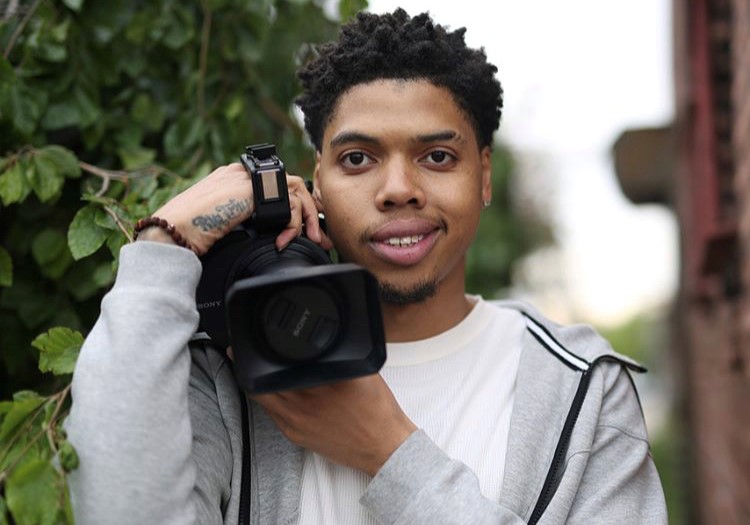
Kharon Benson, a youth leader with AFSC, shared his experience as a child of an incarcerated parent during the people's forum
When the United States withdrew from the Universal Periodic Review (UPR) process in November, it sent shockwaves through the global human rights community. The UPR is a mechanism of the U.N. Human Rights Council and is one of the most important tools for holding governments accountable to international human rights standards.
Every four years, countries undergo a peer review of their human rights record. The process relies not only on government reports but also on testimony and documentation from community and human rights organizations.
AFSC has long been a leader in this work, participating in UPR reviews of the United States as far back as its first in 2010. Ahead of its scheduled fourth review this year, AFSC contributed to human rights reports on issues such as the right to food, immigration, and other systemic human rights concerns. AFSC submitted its own standalone report focused on an issue where we have deep experience: the human rights abuses surrounding the incarceration of women in the United States.
Our report shows how the U.S. falls short of its international human rights commitments when it comes to women in prison and their children. It points to violations of Article 5 of the Universal Declaration of Human Rights, which says no one should face torture or cruel treatment, and Article 25, which promises special care for mothers and children. These rights are ignored when women experience sexual abuse, are shackled during childbirth, or denied basic mental health and reproductive care.Transgender women face even harsher conditions, often placed in men’s prisons and refused gender-affirming healthcare.
The report also notes that the U.S. isn’t living up to the Nelson Mandela Rules, which set global standards for humane treatment in prisons. Under the UPR process, the U.S. has pledged to protect these rights, but the reality—rampant abuse, lack of health care, and family separation—shows a clear gap between promise and practice.
Our message is simple: the system needs major changes to respect dignity and human rights. Read AFSC’s shadow report here.
On Aug. 28, 2025, the U.S. announced it would not participate in the UPR process—a first in the history of the mechanism. The implications were profound. Communities lost a critical channel to report abuses internationally. Diplomats and U.N. member states were left without direct engagement, creating a troubling “radio silence” on the human rights situation in the United States. And globally, the withdrawal undermined the universality of the UPR, setting a precedent that could embolden other nations to opt out of accountability on their own human rights record.
For communities across the U.S., this withdrawal was more than a disappointment. It was a silencing of voices that have fought for decades to expose systemic abuses—from mass incarceration and racial discrimination to immigration detention and economic inequality. And for the rest of the world, it raised a troubling question: What is really happening inside the United States?
Rather than accept this silence, AFSC and our partners acted quickly. We knew that grassroots voices still needed to be heard—not just within the U.S., but globally. As part of a collective, we helped organize and sponsor The People’s UPR, an alternative venue for truth-telling and testimony.
On Oct. 23, 2025, hundreds of people gathered at the Church Center for the United Nations in New York City, just steps from U.N. headquarters. Thirty directly impacted individuals stood before an audience that included delegates from U.N. member states. They shared their stories of human rights abuses and offered needed recommendations for change. They spoke of injustices that have long plagued this country and of the intensified harm caused by authoritarian policies under the current administration.
One of the most powerful moments came when a youth leader from AFSC took the floor. Kharon Benson spoke about his life as a child of an incarcerated parent. He shared his personal story, drawing attention to the challenges of parenting from prison. He also shared his work as a videographer, highlighting the harsh realities faced by incarcerated women. In his closing, he offered valuable suggestions, including protecting children during their parent’s arrest, making visits to parents in prison more accessible, and replacing a system of retribution and punishment to one of restoration and healing.
In addition to supporting Kharon bringing forth his testimony, AFSC also played a key role in preparing delegates for this moment. Working with the Southern Poverty Law Center, the U.S.-Canada Human Rights Cities Alliance, and the Quaker U.N. Office, we organized a delegate prep session before the event. This space allowed first-time speakers and seasoned practitioners to learn, share, and build community.
The U.S. withdrawal from the UPR has left the world without a direct line to American officials. For many countries, this is alarming—not only because of what it signals about U.S. accountability, but because it deprives them of accurate information beyond media headlines. The U.N. Human Rights Council has postponed the U.S. review until November 2026, but the Trump administration’s refusal to engage—and its broader disengagement from the U.N.—means we must keep up the pressure. AFSC will continue to push for U.S. re-engagement, amplify grassroots voices through alternative forums, and work with global partners to ensure human rights abuses in the U.S. are not ignored.