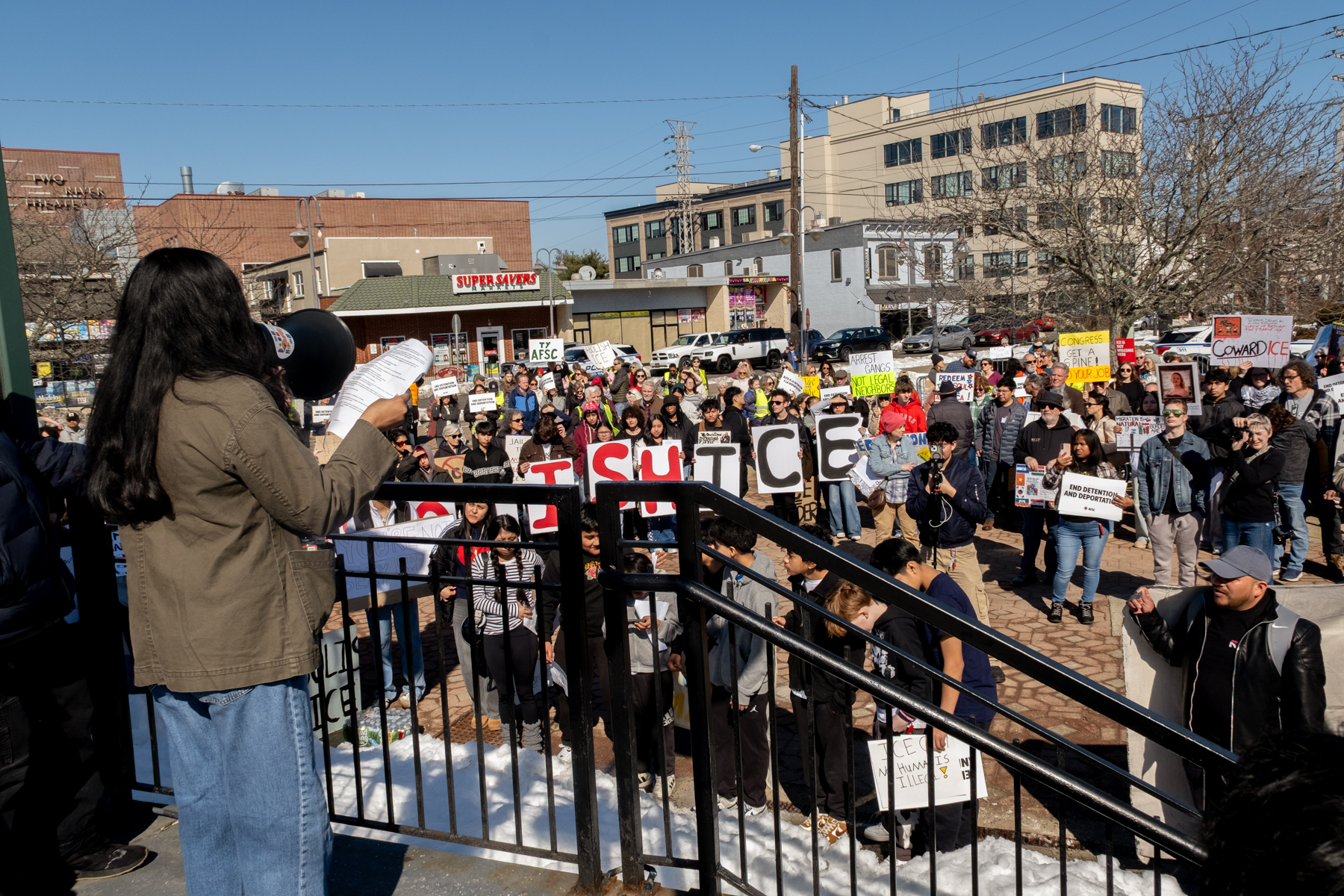
Julie Flores-Castillo speaks at a recent youth-led march for immigrant justice in Red Bank. Nina Rothberg
On a cold February morning, hundreds of young people gathered at the Red Bank train station in New Jersey for a youth-led march for immigrant justice. They marched down Monmouth and Broad Streets to Riverside Gardens Park, chanting, carrying handmade signs, and stopping to hear speeches and testimonials from young people whose families have been directly targeted by ICE. The march was organized by local high school students alongside AFSC New Jersey, Resistencia en Accion, Cosecha, El Pueblo Unido, Climate Revolution Action Network (CRAN), Semilla Roja, Somos Orgullosos Latinos (SOL), and UndocuRutgers. It was a powerful response to a wave of ICE arrests in Red Bank and surrounding towns, leaving many children without their parents.
Helping guide the march was Julie Flores-Castillo, AFSC New Jersey's youth organizer. Julie grew up on the west side of Red Bank in a mixed-status Mexican American family. She has been part of the immigrant rights movement since her father was deported when she was 14. Now 22, she is helping a new generation of young people find their voice.
We sat down with Julie to talk about her background, her work, and what she sees ahead.
You grew up in Red Bank. Can you talk about what that community was like and how it's changed?
I was born and raised in Red Bank, and I still live here. My background is Mexican American, and growing up on the west side, I was really immersed in the immigrant community. My parents were among the first Mexican immigrants to arrive in Red Bank. When they got here, there were no Mexican or immigrant-owned businesses on Shrewsbury Avenue, which is now this whole immigrant business district. They tell me stories about how hard it was navigating a new country. The town wasn’t that welcoming back then, but it's changed a lot—in a very good way.
The borough now puts announcements out in English and Spanish, on social media, online, everywhere. And a lot of that comes down to intentional leadership — peoplelike our deputy mayor, Kate Triggiano, who actually did outreach to residents, who showed up even when there were language barriers, who made sure that even people who can't vote know that they're wanted in their own community. When my mom knows the names of council members from our borough's outreach efforts, that means something.
How did you first get involved in immigrant rights work?
Immigration was always personal because of my family's situation. But it wasn't until my freshman year of high school, when my dad was deported, that everything shifted.
That happened in April 2018. A few months later, I went to visit him in Mexico, and when I came back, there was a rally in Red Bank to protest the family separation crisis under the first Trump administration. It was the first action I ever attended. I didn't talk to anyone. I barely knew what I was doing there.
That fall, I met Itzel Hernandez, an organizer with AFSC. She invited me to spring lobby weekend in D.C., where AFSC sends young people every year to advocate for different issues. I was 15, she called my mom to make sure it was okay, and I went. It was my first time really traveling anywhere. I shared my story in a meeting with Sen. Menendez's chief of staff. It was the first time I'd ever spoken publicly about what happened with my dad. And I just kept going from there.
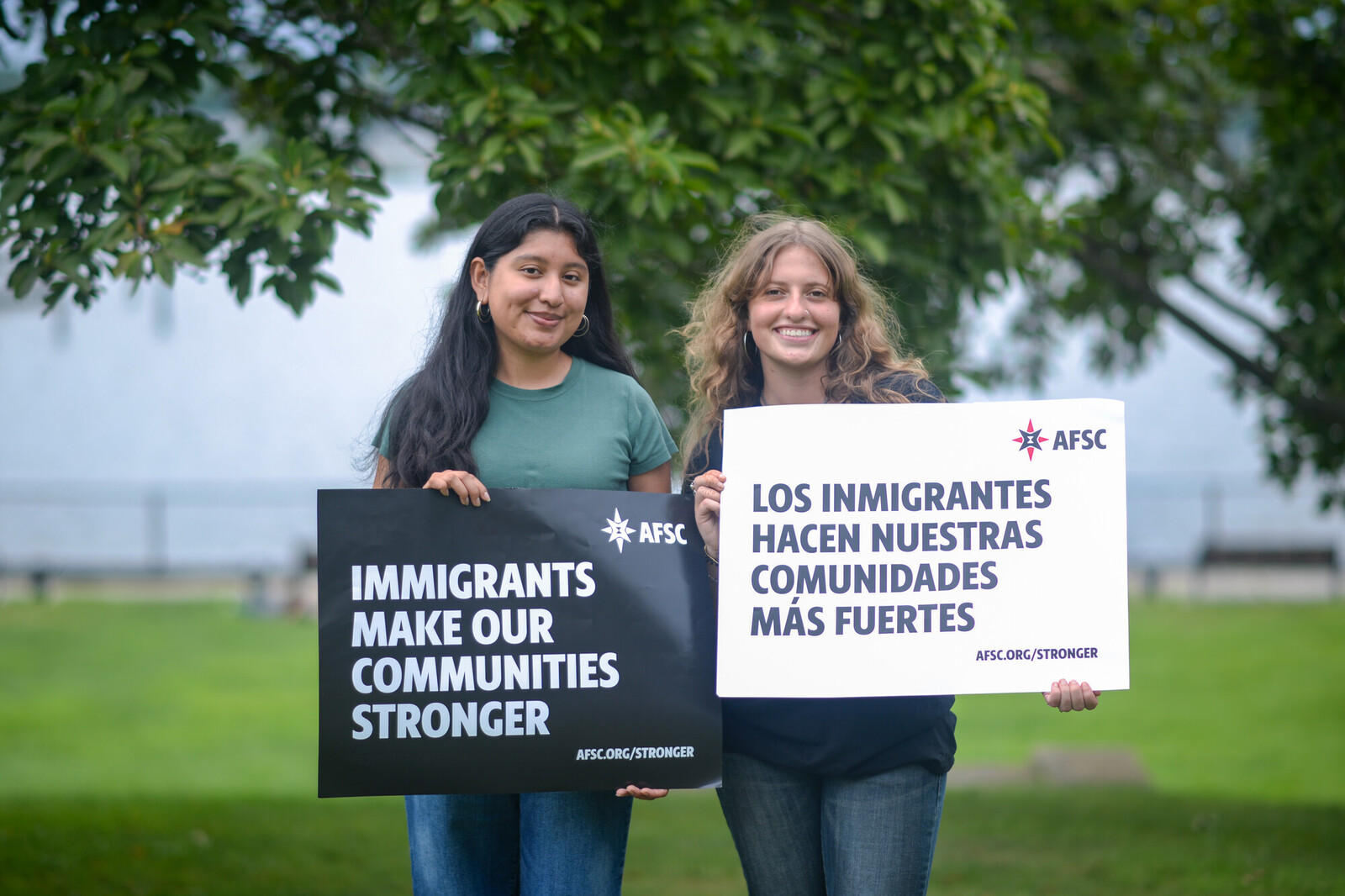
Julie Flores-Castillo and Nina Rothberg in Red Bank. Nathaniel Doubleday
Tell us about this most recent march. How did it come together?
It actually started with this Google form I came across on Instagram—just asking other young people in Monmouth County: Are you interested in organizing an anti-ICE protest? I wanted to know who was behind it, and eventually I got connected to one of the kids who had shared it early on, and he added me to a group chat with about 20 students.
I set up a Zoom call with them right away. I asked whether they wanted to keep it local or go bigger. As soon as I mentioned that I could connect them with other youth organizations across the state, they said: let's make it big. So we did. I helped them with the permit application for the march, drafted talking points, planned a poster-making party, organized satellite events, and did weekly check-in calls with each of them individually.
The thing I'm most proud of is something one of the students said to me when I dropped off flyers at his house. He said: "I'm really glad you didn't take control." He told me he was worried an adult would come in and take over. And I said, that means everything to hear—because that's exactly what I'm trying not to do. The march was their idea. My job was just to help it flourish.
What role do you think immigrant youth play in this movement right now?
In organizing for immigrant justice, youth have always been the most vocal. The sit-ins, the encampments, the walkouts—it's always young people who take the boldest action. Even the DACA (Deferred Action for Childhood Arrivals) program exists because young people did hunger strikes and sit-ins.They understood what was at stake for them personally, and they acted.
The students I work with—even the ones who were born here—they know what their families have sacrificed. They feel the impact every day. Their parents, their siblings, their neighbors have been affected. And right now, a lot of them have seen what happened in Minneapolis where federal troops were deployed and asking: could that happen here? That's a heavy thing to carry. But instead of retreating, a lot of them are saying, okay, then let's do something.
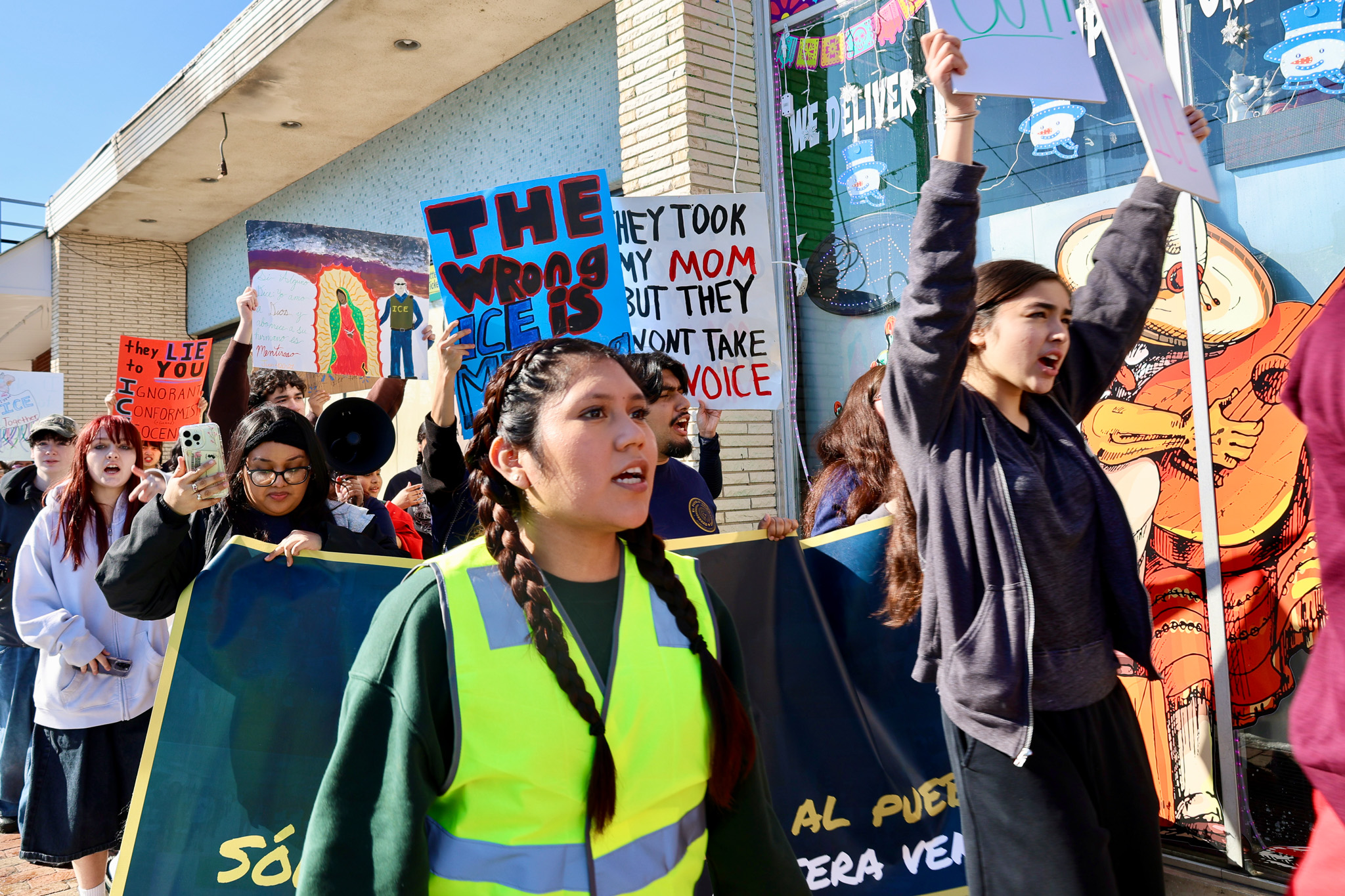
Protesters march through Red Bank. Nina Rothberg
What are the biggest challenges you see for immigrant youth in New Jersey?
Education is a huge one. About 3,000 to 4,000 undocumented students graduate from New Jersey high schools every year. Right now, community college is free, and state financial aid is accessible for all students regardless of their immigration status, if they have attended a public New Jersey high school for three years and graduated with their diploma. But we're already seeing the federal administration sue states over tuition equity laws, and states like Florida and Texas have caved. If that happens here, it doesn't just affect undocumented students — it affects all of us.
And then there's the mental health piece, which I don't think gets nearly enough attention. There are no real mental health resources specifically designed for young people who've had a parent detained or deported. That gap needs to be addressed. The oldest siblings, especially — they get parentified overnight. I went through it. I was 14, collecting letters of support for my dad's immigration case, going through bins of old receipts trying to prove how long he'd been in the country, making sure my younger siblings were okay. A lot of the students I work with are carrying that same weight right now.
What keeps you going?
Honestly? The students. One of the young women who spoke at the march—her aunt had been detained in the weeks leading up to it. I called her the night before to check in on her speech, and she started talking about the first time she went to spring lobby day in DC with us, how nervous she was, how she cried. And then she said: even after everything that happened with my aunt, I wasn't scared. I didn't want to hide. I wanted to do something.
When I was 14 and my dad was deported, I didn't have anyone. I didn't know who to call or where to go. If I can be that person for even one young person — or help build a team that can be that for many — then that's why I'm here.