AFSC
For decades, the Palestinian people have endured Israeli occupation. This occupation is enforced through violence, racist and discriminatory legal systems, forced displacement, movement restrictions, and systematic human rights abuses. The International Court of Justice has said that Israel is committing the crime of apartheid and that all states have an obligation to end these violations of international law.
Israeli, Palestinian, and international human rights organizations and legal scholars have made similar determinations. While global leaders fail to act, communities across the world are working to end apartheid from the ground up. The American Friends Service Committee (AFSC) worked to end apartheid in South Africa, and we are proud to be part of the Apartheid-Free Communities movement for Palestine today.
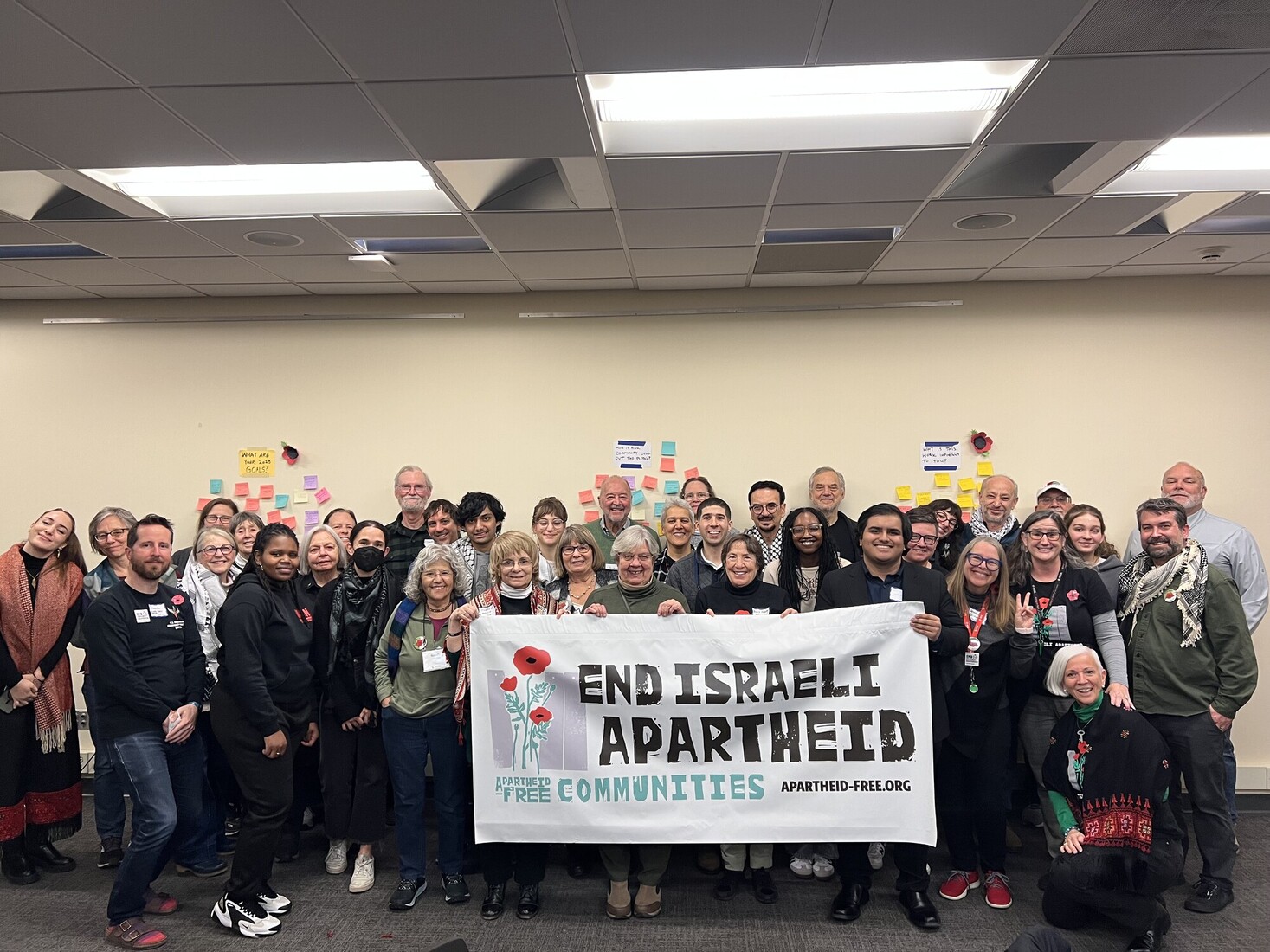
Over 1000 communities have taken the “apartheid-free” pledge, committing to cut ties with Israel’s apartheid regime against Palestinians and to oppose all forms of racism, bigotry, discrimination, and oppression. These 1000+ groups represent over a million constituents and include congregations, faith communities, solidarity organizations, non-profits, student organizations, veterans’ groups, businesses, and municipalities.
Every community has a role to play to ensure a future where all people are treated with human dignity. With the support of hundreds of faith communities, including Christian, Jewish, Muslim, Buddhist, Hindu, and multifaith communities throughout North America, the Apartheid-Free Communities network is working at the local level to end apartheid and to build a world where people of all faiths, ethnicities, and identities can thrive.
We applaud all the communities who have taken the pledge who are doing their part to end apartheid. We know that injustices do not happen in isolation – the weapons, money, and ideas used to perpetuate apartheid against Palestinians may originate in factories, investment portfolios, or political movements in our own backyards.
Anti-apartheid and anti-racist movements are never popular at the outset; it takes courage and perseverance to upend the status quo. The United States owes a great debt to all who worked to end Jim Crow in the U.S. and apartheid in South Africa, and everyone who is trying to cut ties with Israeli apartheid today.
When AFSC began working with anti-apartheid movements in the 1970’s, many viewed this work as highly controversial – especially because we focused primarily on how the U.S. government and businesses were supporting apartheid in South Africa, and we provided tools for college students, faith communities, and others to pressure their institutions to divest. By the time the apartheid regime finally ended in 1994, such work was not only a moral imperative, it had become normalized across broad swathes of society in the U.S. and internationally.
AFSC and its allies undertake apartheid-free work as a means of standing with the Palestinian people against the sustained and devastating human rights violations committed against them. Through our decades of humanitarian work and accompaniment with Palestinian and Israeli communities, we have witnessed these injustices firsthand.
As a Quaker organization, AFSC believes every person carries within them a divine Light, and all people deserve to live in safety and peace. We share a common humanity that means security for one group will never come at the expense of another. Antisemitism – violence and discrimination against Jews – is a real problem that must be strenuously opposed. But there is nothing antisemitic about opposing the policies of the Israeli government or the companies that enable human rights violations.
We believe in an intersectional approach to addressing antisemitism – one that finds common cause between oppressed people and works to rectify injustice, support self-determination, and brings justice for all. And we believe that multifaith and cross-sector initiatives like the Apartheid-Free pledge have an important role to play in this effort.
As Rev. Martin Luther King Jr. wrote in his Letter from Birmingham City Jail, “injustice anywhere is a threat to justice everywhere.”
Today the phrase is almost cliché, available on bumper stickers and tote bags. But King’s prophetic words did not emerge spontaneously into the consciousness of the public – it took action and solidarity to bring them from the jailhouse to the printing press to the people. In 1963, a draft of the letter was smuggled out of the Birmingham jail on scraps of paper. It made its way to civil rights leader Andrew Young, who brought it to Barbara Moffett, a longtime AFSC staff member. AFSC went on to print and distribute over 200,000 copies. Small, brave actions can and do add up to big changes.
After more than a century of activism and service, we are more certain than ever that it is the efforts of everyday people and communities that can bring about a just and peaceful world. Today’s anti-apartheid movement, and the Apartheid-Free Communities network, are beautiful examples of people carrying forward this legacy and building a better future for all.
###
The American Friends Service Committee (AFSC) promotes a world free of violence, inequality, and oppression. Guided by the Quaker belief in the divine light within each person, we nurture the seeds of change and the respect for human life to fundamentally transform our societies and institutions. We work with people and partners worldwide, of all faiths and backgrounds, to meet urgent community needs, challenge injustice, and build peace.