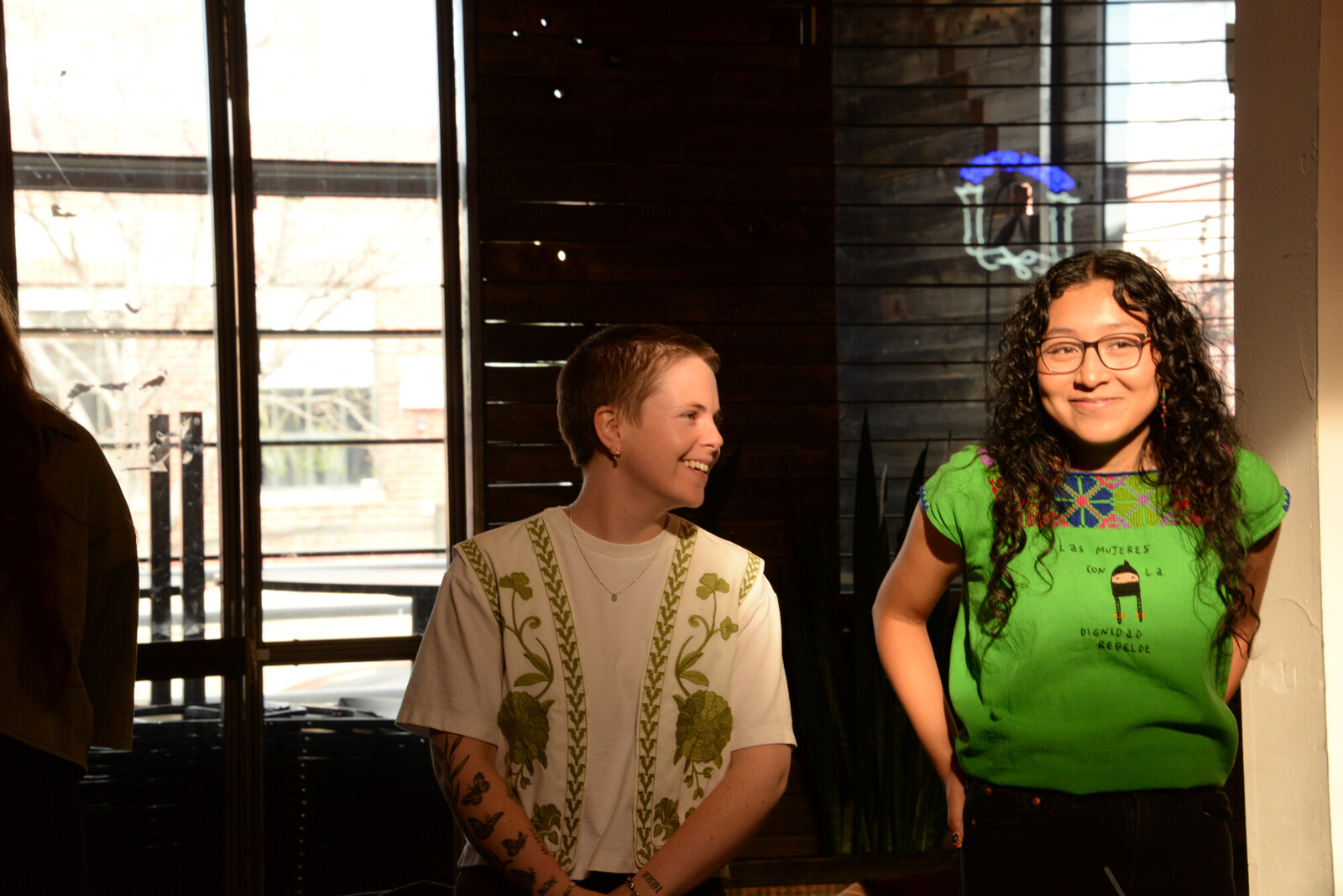
AnnaRose Craig (they/elle, at left) with fellow ELL participant Aide at the Community Care Day in Denver, November 2025 Jesse Saunders
In 2025, AnnaRose Craig (Arc), the Shut Down GEO Organizer with the AFSC Colorado Immigrant Rights Program, participated in AFSC’s ELL program. Over the course of eight months, ELL participants develop their leadership skills and deepen their commitments to social justice through in-person convenings, virtual meetings, and the completion of a community action project.
Applications for next cohort are open through March 8 to young people (aged 18-22) who have a relationship with an AFSC program, a Quaker Meeting/organization, or a Quaker college.
In this interview, Arc shares about their experiences.
What were your general impressions of ELL?
The main positive was getting to interact with people around the country of my age. It was a unique opportunity. Everyone had different levels of connection to AFSC; some attend Quaker colleges.
It was really inspiring to meet these people, and it made me feel less alone in the work I do. Most of the people I work with are older than me. I learned a lot from our group. They were critical thinkers who are also really open and honest.
In ELL, each person chooses a project to work on. What are some examples?
The people in Oregon did a really cool direct action/rally/protest near Salem. They’re super involved in immigrant rights work.
Another person made this incredible, very professional zine about harm reduction. They used art from their friend. It was a really nice piece of physical media.
Another interesting one was a panel in Philly of formerly incarcerated people talking about ideas of innocence and how that fits into -- and sometimes hinders -- abolition. They had some very different perspectives. Those three stood out to me.
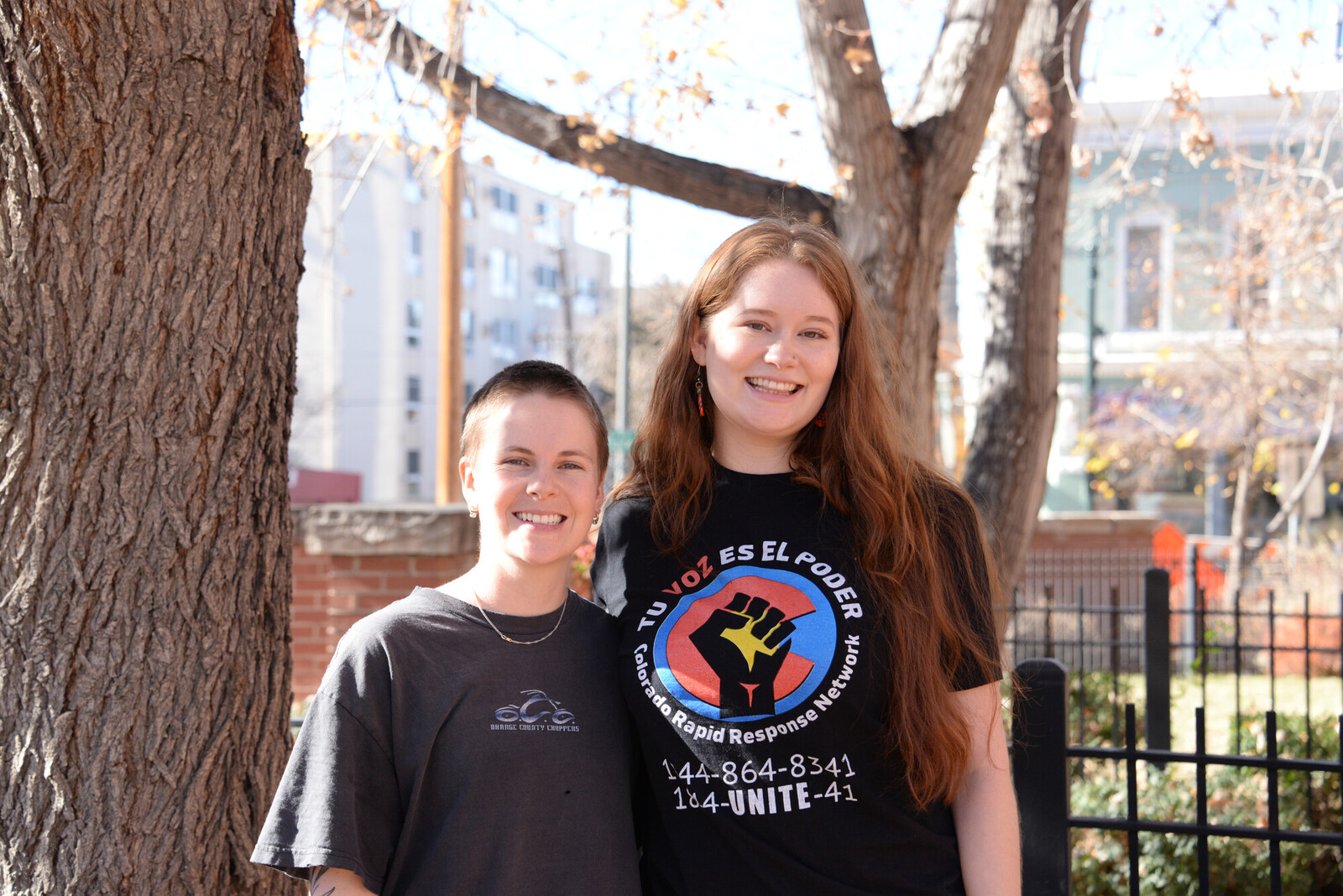
Arc, left, with their friend and project partner, Camila Jesse Saunders
What was your project?
I worked with my project partner Camila, who also lives in Denver. We hosted a Community Care Day last November, mostly aimed at people in organizing or people who are immigrants. Anyone feeling impacted by all the things happening. Everything was free at the event, which drew over 100 people over three hours.
We had acudetox, massages, and limpias. They are a sacred smoke cleanse in Mexican and Indigenous cultures that uses different herbs. We had a small group, guided discussion called a platica. As well as a bunch of art activities and live music.
At our space we had two rooms. We had the healers and service providers in the back and the music, art and social activities in front. People loved it. It was really cool to offer all of that completely free.
ELL provides a $1000 stipend for your project. You do an in-depth budget to show how you’re spending the money. We held it the weekend of the ELL convening in Denver, so the whole group was able to attend.
How did you get connected to Quakerism and AFSC?
Primarily though AFSC. My dad has some interest in Quakerism. He goes to Philly and West Chester pretty often, and he’s been to Quaker meetings.
I was connected to AFSC through a professor at college. I’d never heard of AFSC, but my professor knows [AFSC Colorado staffer] Jordan Garcia really well. I met Jordan on the first day of the encampment for Palestine at the Auraria Campus in April 2024.
I’ve been to a few Quaker meetings. I went to one in West Chester at this old Quaker school. And I’ve been to Mountain View Friends in Denver.
What interests you about Quakerism?
I don’t consider myself an explicitly religious person, but the values of Quakerism are very much in alignment with who I am. I remember learning that you can be an atheist Quaker, and I thought that was the most interesting thing.
I really like the lack of structure around that and how open it is. If these values are in alignment with who you are, that’s what matters. I grew up Catholic, so it’s very refreshing. Quakerism is much less strict.
I find it easy to incorporate Quaker values into my work and how I talk about my work. That’s not something I’d had before with an organized religion. The Quaker belief of seeing that of God in every person resonates a lot with me. It’s helped me navigate challenging conversations and relationships.
How would you describe your work with AFSC?
The Shut Down GEO campaign formally started in August 2024. We are a coalition of individuals and organizations made up of people who’ve been detained, people who have a loved one currently detained, and community members and allies.
We’re using a variety of strategies to close the detention facility in Aurora because the contract expires in October 2026. At that time, the Department of Homeland Security and GEO Group will have to write a new contract, and we’re hoping to prevent that.
Our campaign is explicitly abolitionist, so we’re pushing for the closure of this facility, and that all the people inside are released. Importantly, we’re pushing for the land to be returned to the City of Aurora, and that it be used for something that benefits the community and fulfils some of the needs they have.
When did you start with AFSC?
I started in this role in August 2025, but I started as an intern the year before, in June 2024.
What motivates you in your work? Why do you do what you do?
For my entire life, I’ve felt a deep empathy for the people around me. And also a deep feeling that there’s a lot of injustice. Before I worked at AFSC, I didn’t have a job that enabled me to organize. That was just something I did outside of my other obligations.
I do this work because I find it fulfilling. I often feel very hopeless and powerless, but I also have grown such an incredible community of people in the past two years. All of those relationships feel really intentional, and they inspire and motivate me.
My care for other human beings and all living beings is ultimately what motivates me. I’ve never accepted the notion that this is just the way things are.
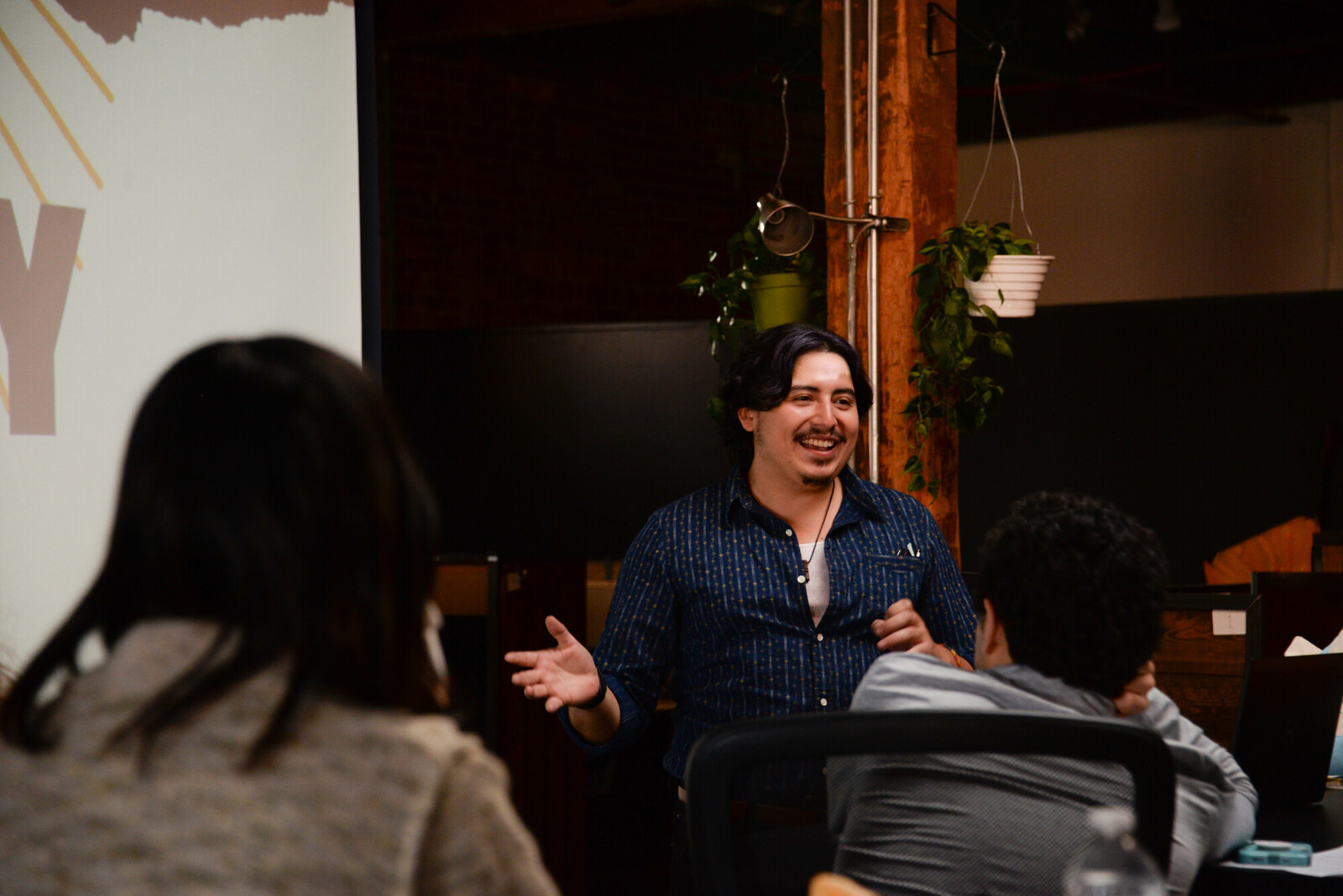
Julián Andaya, ELL Program Director, speaks at the ELL convening in Denver. Jesse Saunders