
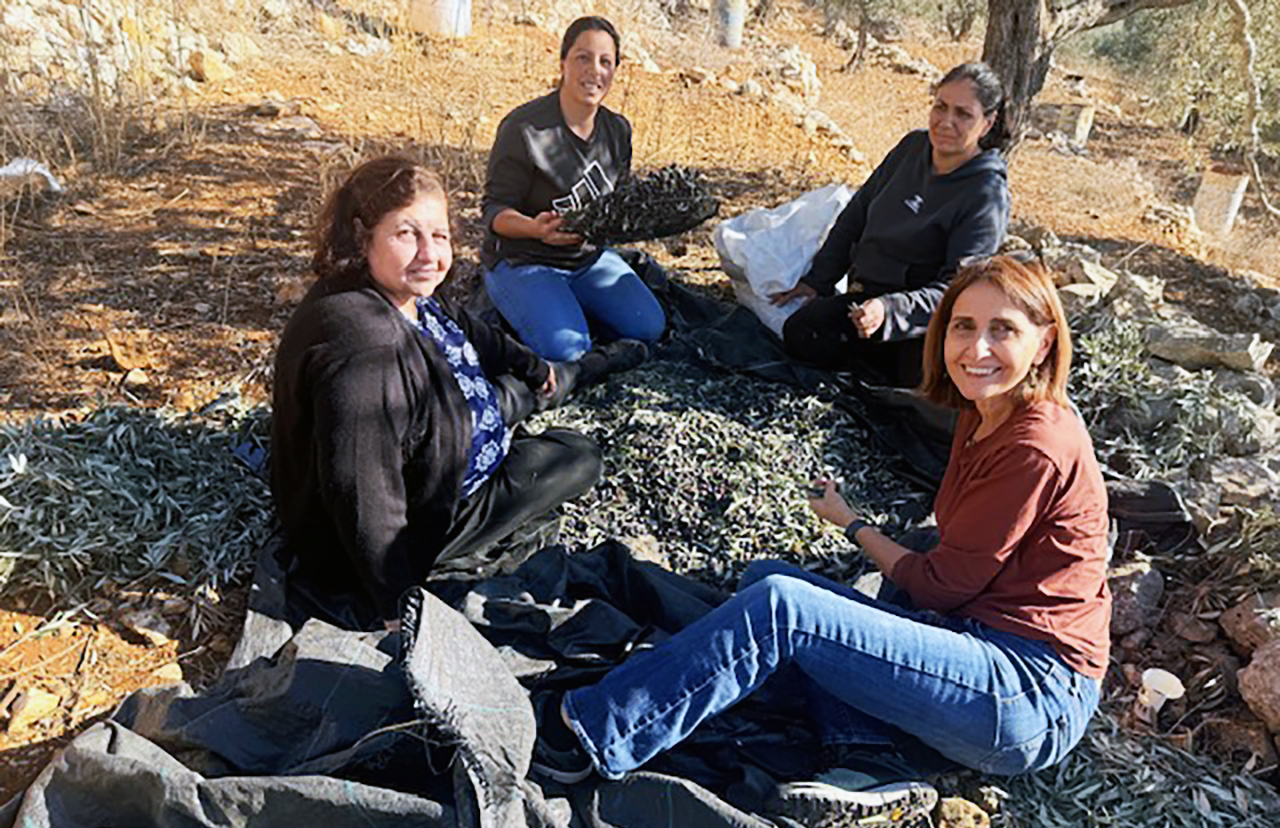
Joyce Ajlouny (right), AFSC's General Secretary, with Im Saleh (left) in the West Bank village of Aboud Joyce Ajlouny
Before we left Aboud, Im Saleh insisted on giving us a bottle of her precious olive oil, a huge jar of olives, a bag full of pecans, and, of course, some honey. She would not let us leave without them. That is what family and hospitality look like in Palestine: even when so much has been taken, you still send your guests home with something in their hands.
Lili Saleh, Im Saleh to all of us, has been part of my family for more than twenty years. She cared for our children while we were at work. She kept our house in order, and she held us together in ways we will always be grateful for. Im Saleh is family. Today we visited her and her family in the village of Aboud, twenty-some miles northwest of Ramallah, and heard what they have been living through.
The Salehs have owned this land and tended their olive trees for generations. Like so many Palestinian families, the olives and the oil are central to their livelihood. Ten years ago they built a structure for a chicken farm, and they keep bees too. It is a life made by hand, season after season, passed down from one generation to the next.
But they are no longer free to use their own land. One Israeli settler and his wife have built a makeshift dwelling on the hilltop overlooking it, and he decides who may harvest and where. He drew a random line across the land and forbade the family to gather anything beyond it, cutting them off from most of their olive trees. Almost every day he comes down the hill with his M16 assault rifle to torment them, to threaten them, to destroy what they have built. The Salehs told us that the Israeli military protects him and at times joins him in preventing them from harvesting their olives and accessing their land.
Saleh told me how happy he was when the YMCA gave him 40 olive saplings to plant and grow his orchard. He bought barrels to protect each one and watched, thrilled, as they began to grow. Then one day he found that the settler had snipped every single one with clippers, to make sure none would survive. The settler also brings his goats to graze on their land, and they strip the olive trees' low branches. Saleh showed me the branches, their ends dry and brittle where the goats had eaten them, and other trees that had not survived, nothing left but a dry branch. Im Saleh told us of the day the settler destroyed part of her chicken farm. When I walked past it, I saw the goats' droppings on the ground beside the structure, proof that they had been there.
Aboud is in the West Bank, part of Palestine. The scale of devastation there is not the same as the catastrophic destruction we have witnessed in Gaza, but Palestinians in the West Bank have endured decades of killings, military occupation, dispossession, imprisonment, land confiscation, home demolitions, and settler terror. Illegal Israeli settlements have continued to expand across the West Bank, confiscating Palestinian land under the protection of the Israeli military. What the Salehs are living through is part of that much longer history.
I know this story in my bones. It is nothing new, and still it sends a shiver down my spine. I know what it is to see your own land become a place you must ask permission to enter. I felt it again at the airport last week, entering my own country and needing the permission of my occupier to do so. And I know the particular ache of watching someone else draw a line through what is yours. For Palestinians, those lines have been drawn and redrawn for generations, through our land and through our lives.
And yet today, we harvested. The settler had left his hilltop for the day, and the family felt safe enough to go down to the trees. Saleh and Elias, with their wives Wadi'a and Mira, and Im Saleh, had to sneak onto their own land. Ziad, our son Nader, and I went with them. The children stayed behind. It was not safe for them.
For a few hours, we almost forgot the threat. Saleh and Elias used a special rake to comb the olives down from the branches onto wide tarps spread beneath the trees. We knelt over the tarps, sifting through the fallen olives, picking out the leaves and twigs, and filling our bags with precious black olives. We drank Arabic coffee under the trees and talked and laughed, remembering the stories of our children growing up. Im Saleh was on our case to get our act together and find brides for our sons. She wants to see them happy and settled; after all, they are like sons to her. It was pure joy.
And perhaps this, too, is what Palestinian steadfastness looks like. Not some romantic notion of resilience, not an endless capacity to absorb suffering, but the insistence on living. To return to your land. To harvest the trees your family has tended for generations. To drink coffee beneath them. To laugh. To tease your children about marriage. To keep planting, even after what you planted was destroyed. To refuse to disappear.
But here, even joy keeps one ear open. The family told us that harvests once meant food and picnics in the shade of the trees. Now they rush in and out for fear of being attacked. Again and again they paused mid-task to listen, to be sure a distant sound was not the one they dread.
Then, in the quiet between the branches, Mira told me why the fear runs so deep, and why the children stay behind. Last February, at four in the morning, Israeli soldiers came for her son, Qais. He was 15.
He was released two months later, having lost 17 kg. She said the worst part was not the lack of food. It was that they tortured him and beat him. He was released without charge or a fair trial.
I listened as a mother, and as a Palestinian. The settler on the hilltop. The Israeli military that protects him. The soldiers at the door. The line drawn through their land. For the Salehs, these are all part of the reality they live every day. Theirs is the story of so many Palestinian children and their families, living with dispossession, fear, and brutality that should never be ordinary, but has become part of everyday life.
And none of this happens in isolation. For decades, Western governments have helped sustain a system in which Israel has acted with impunity. I cannot separate what I witnessed today from that long history of complicity. There can be no justice without accountability, and without ending the policies and practices that have allowed this dispossession and brutality to continue.
Tonight, the olive oil sits on our table. I can't taste it without thinking of the trees beyond that line.
The next morning
The next morning, Mira sent me a message.
The family had gone down early again to harvest their olives. There, they were confronted by the settler woman, who was herding her goats, armed with an M16 and accompanied by the Israeli military. Her husband joined her later. She forced the family to leave.
“You are not Israelis,” she told them. “You are Palestinian. You do not belong here.”
On their own land. Beneath the olive trees their family has tended for generations.
And that was not all.
Before seven that morning, Qais had left home with his cousin in a service taxi to go to school. Then Mira received word that Israeli soldiers had taken him.
“My blood dried out,” she told me.
Israeli soldiers had set up a checkpoint at the entrance to the village and detained everyone in the service taxi. For the next couple of hours, Mira could do nothing but wait, not knowing what was happening to Qais or whether the nightmare of his arrest was beginning all over again.
Finally, the soldiers let them go. Qais made it home. He never made it to school.
I thought I had finished writing this story. But perhaps that is part of what I am coming to understand: these stories do not end. The injustice does not pause when the visitor leaves, when the photograph is taken, or when the words are written.
