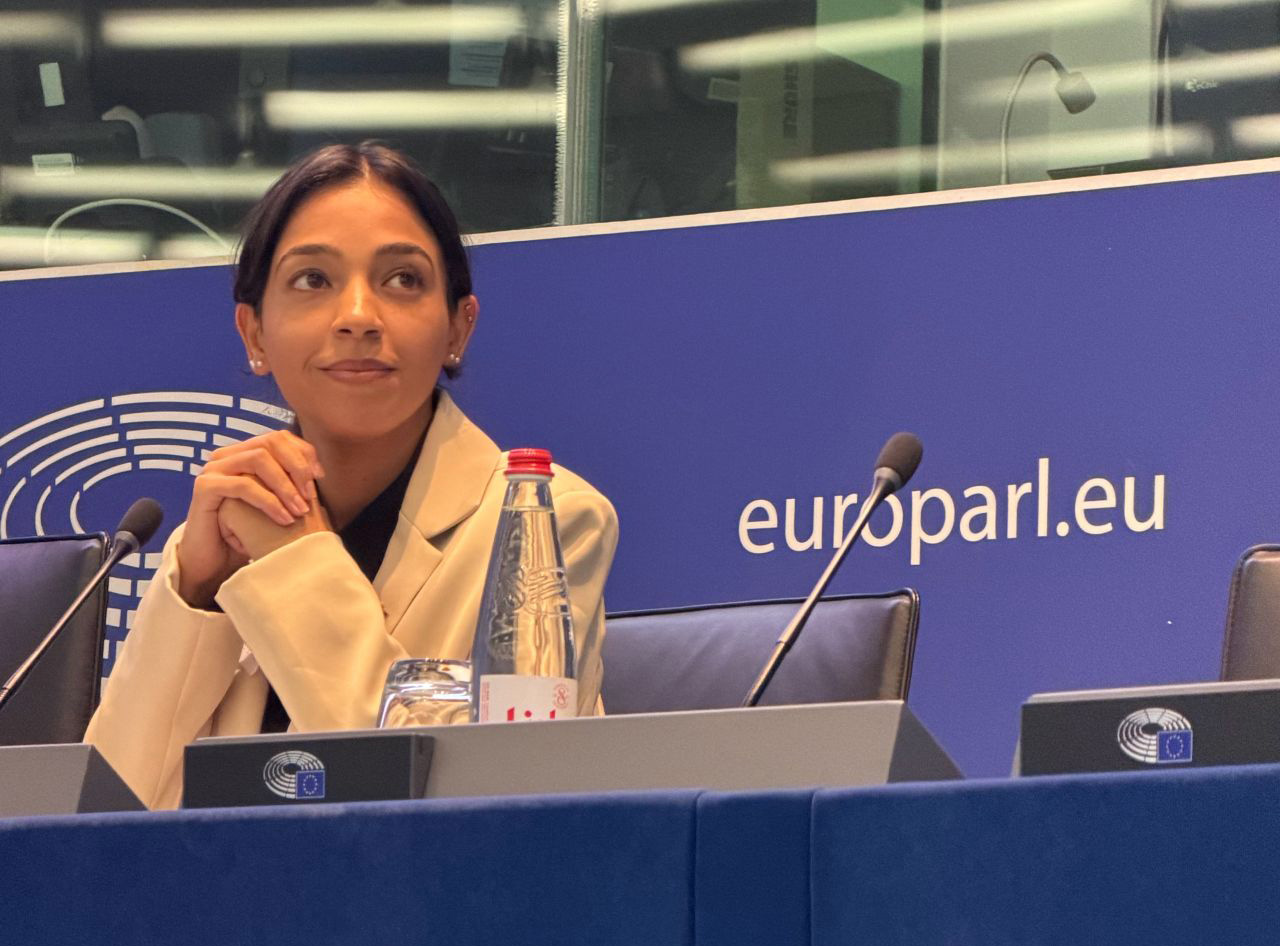
On Sept. 17, AFSC staff member Serena gave testimony to the European Parliament on access to education for Palestinian children. Watch the video.
This week, AFSC staff member Serena testified at the European Parliament on access to education for Palestinian children in Gaza. Since the start of the genocide, over 90% of schools have been damaged or destroyed. Hundreds of thousands of children have been deprived of formal schooling for nearly three years.
“They are children who want to learn, to live, to become something,” Serena said. Instead, they are forced to live from one minute to the next—thinking about the next meal, the next displacement, the next attack—denied the chance to imagine who they might become.
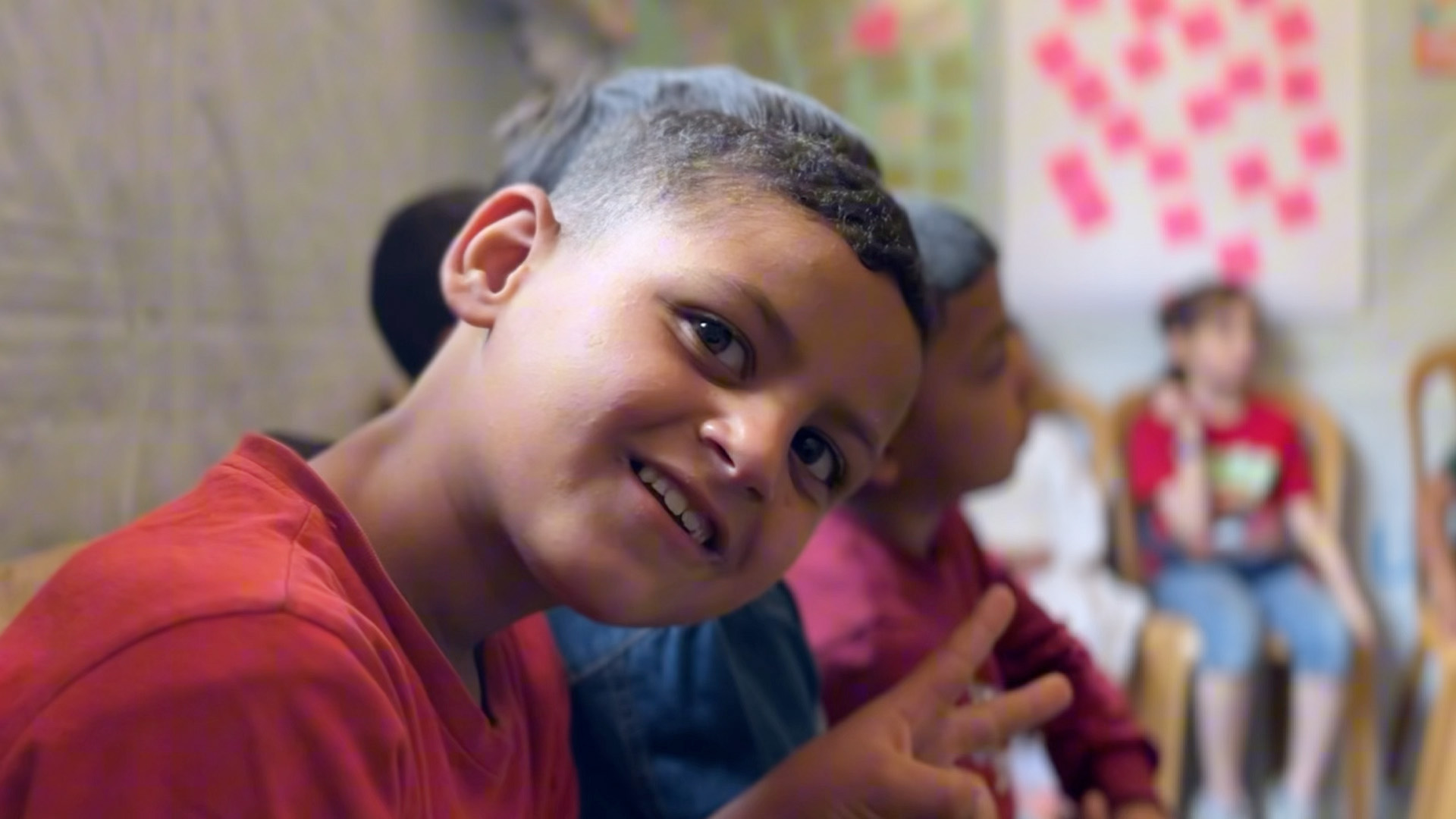
AFSC and partners have created five learning centers for children in Gaza, where children can learn, play, and receive psychosocial support. She brought their stories to Parliament and urged action.
“Use your power … to stop this genocide,” Serena said. “Let us rebuild what has been destroyed, starting with education.”
Watch Serena's testimony above.
Here are her written remarks:
Chair Boylan, honorable Members of the European Parliament,
Thank you for inviting me today.
I am standing here before you as a Palestinian woman, born a refugee in Gaza, the child and grandchild of refugees, who has lived through repeated displacements.
My name is Serena Awad. I am 27 years old, and 27 months of my life have been lived through genocide.
For the past three years, I worked in Gaza as an emergency relief officer with the American Friends Service Commitee, and I am now pursuing a Master’s degree in Rome.
In Gaza, 96 percent of schools have been damaged or destroyed. But I do not want to speak about numbers. If numbers alone were enough to change policies, what Palestine is going through would have been stopped long ago.
Today I want to speak about what is behind those numbers; what it looks like when an education system is destroyed, and students still try to learn, as the world looks away.
My own journey to continue my studies tells part of this story. When I was preparing my university application to study in Italy, Israeli tanks were only a short distance away from me. I felt as if I were racing against two things at once: the application deadline, and the Israeli tanks moving closer.
I kept asking myself: am I preparing for a future that could be taken away from me at any moment?
Today, I sit safely in classrooms in Rome, while my family remains in Gaza, living each day under constant threat.
I do not know if I will ever be able to return or see them again.
When I look around those classrooms, I think of the children in Gaza; children for whom a desk, or even a notebook became unfamiliar.
Palestinian society has always placed extraordinary value on education. Gaza had one of the highest literacy rates, reflecting how deeply learning has been embedded in Palestinian life.
Today, Israel is denying hundreds of thousands of children years of formal education. Gaza has been left with almost no functioning educational system. Children are forced to live from one minute to the next, thinking about the next meal, the next displacement, or the next attack. They are being denied even the chance to imagine who they might become.
With my AFSC colleagues, we succeeded in creating a learning place for children, but creating a learning space was never enough.
It would take days to list every obstacle we faced. Rather, I will focus on some of the things I personally witnessed.
- During famine, children arrived without having eaten, dizzy, unable to concentrate, and some fainted during class.
- In winter, rain flooded tents, while in summer children were trapped in extreme heat.
- We struggled to find the most basic materials – pencils, notebooks, and school bags –because Israel blocked them. I remember seeing children arriving barefoot, carrying
their notebooks in plastic bags because they had no school bags.
And still, they came.
One child said something to me that I will never forget. He told me: “This is the first time I stay in a line to enter a classroom and learn, instead of standing in a line for water or food.” For years, queues meant survival.
And this brings me to something that is inseparable from education: children’s mental health.
Many children in Gaza are trying to learn amid death, destruction, injury, repeated
displacement, and constant fear, while the relentless sound of Israeli surveillance drones and warplanes serves as a constant reminder that violence is never far away.
In our learning space, one girl told me her sisters had been killed and that rescuers pulled her from the rubble believing she was dead.
She was placed in a morgue refrigerator for hours, and when she woke up, she found herself lying beside her sisters’ corpses.
What struck me was how casually she told it, as if it was simply part of life. That is what prolonged trauma can look like in children. Sometimes it is a child calmly telling you – not screaming, not crying – about things no child should ever experience.
This is why in our education project we deliberately combined structured education, recreational activities, and psychosocial support. Children in Gaza cannot be placed in a classroom and expected to learn as if they had not experienced these traumas.
Simply having a routine mattered. Knowing that they would come to the same place, see the same teacher, and sit with other children. Doing something predictable gives them a small sense of stability and helps them feel like children again.
And yet, even in those spaces, we could not protect them from the ongoing genocide happening outside. Two children from our learning spaces, aged nine and ten, were killed.
Other children had their bodies mutilated. Imagine trying to include a child with an amputation in a tent classroom, without proper desks or chairs, leaving them sitting on the ground for hours.
So, when we speak about education in Gaza, we cannot simply say: the learning space exists, therefore the child has access. A tent is NOT an accessible classroom.
Yet, I am still not even close to describing everything.
56,000 children in Gaza saw one or both parents killed. That is not a number. It is a generation of children growing up without the one thing every child needs most: a parent who would normally wake them for school, register them for lessons, and help them feel safe.
There is another generation we cannot forget: university and secondary school students whose education has also been interrupted. My brother was one of them. He was trying to complete high school while we were running for our lives. He was injured twice during that period and yet continued studying. While the rest of us were thinking about clothes, documents and what we could carry, he always made sure to take one thing with him: his bag of books.
That bag moved with us from one place to another many times.
For me, it is a symbol of what Palestinian students have been trying to protect throughout history. For Palestinian society, education has always been an act of faith in the future, because education is one of the few things that could not easily be taken away from them.
But today, even that is being taken from them. Students who have received scholarships abroad, remain unable to go because of evacuation restrictions, visa barriers, or border closures. A scholarship means nothing if a student remains trapped behind a closed border.
And an education abroad should NEVER come at the cost of losing the right to return home and help rebuild.
This brings me to the question of resilience. Praising Palestinian resilience shall not mean accepting that children are studying in tents, hungry and traumatized.
Resilience should never become an excuse for political failure or a substitute for responsibility.
While preparing for today, I kept asking myself: What could I ask from people who hold political power and influence? I could ask you for more funding. But let’s be honest. You could fund a new school tomorrow. You could rebuild a university. But can you guarantee that Israel will not bomb it? Can you guarantee that the children or the teachers inside it, will be protected?
Today, the answer is no. Money cannot rebuild education while bombs continue to fall. The genocide continues because the world allows Israel to continue.
I recognize there are pressures. I know many people working inside institutions also feel frustrated, exhausted, and sometimes powerless. But what has been done is not enough.
Today, I am here to ask you to use your power, the power of this Delegation, the power of the European Union, to stop this genocide, and let us rebuild what has been destroyed, starting with education, and with a guarantee of safety.
The destruction of Palestinian education cannot be treated simply as an unfortunate consequence of military action. It goes far beyond destroyed schools and universities.
Teachers, students, and university professors have been killed. Israel’s deliberate and intentional destruction is intended to deprive an entire generation of the opportunity to learn, dream, and build a future of its own in Palestine.
With every teacher gone, Gaza loses years of educational memory. And we should remember that teachers are themselves grieving, forcibly displaced, and exhausted.
The children I have spoken about today are not statistics. They are children who want to learn, to live, to become something.
Will this institution leave this young generation alone to face the systematic destruction of our people’s existence and future?
Sometimes, it feels like we are pouring our hearts out, and nothing changes. That is why I am not speaking to you today only as a representative of an institution, but as a human being.
So, I ask you to act according to the values you believe in, and let your humanity guide you.
Thank you.