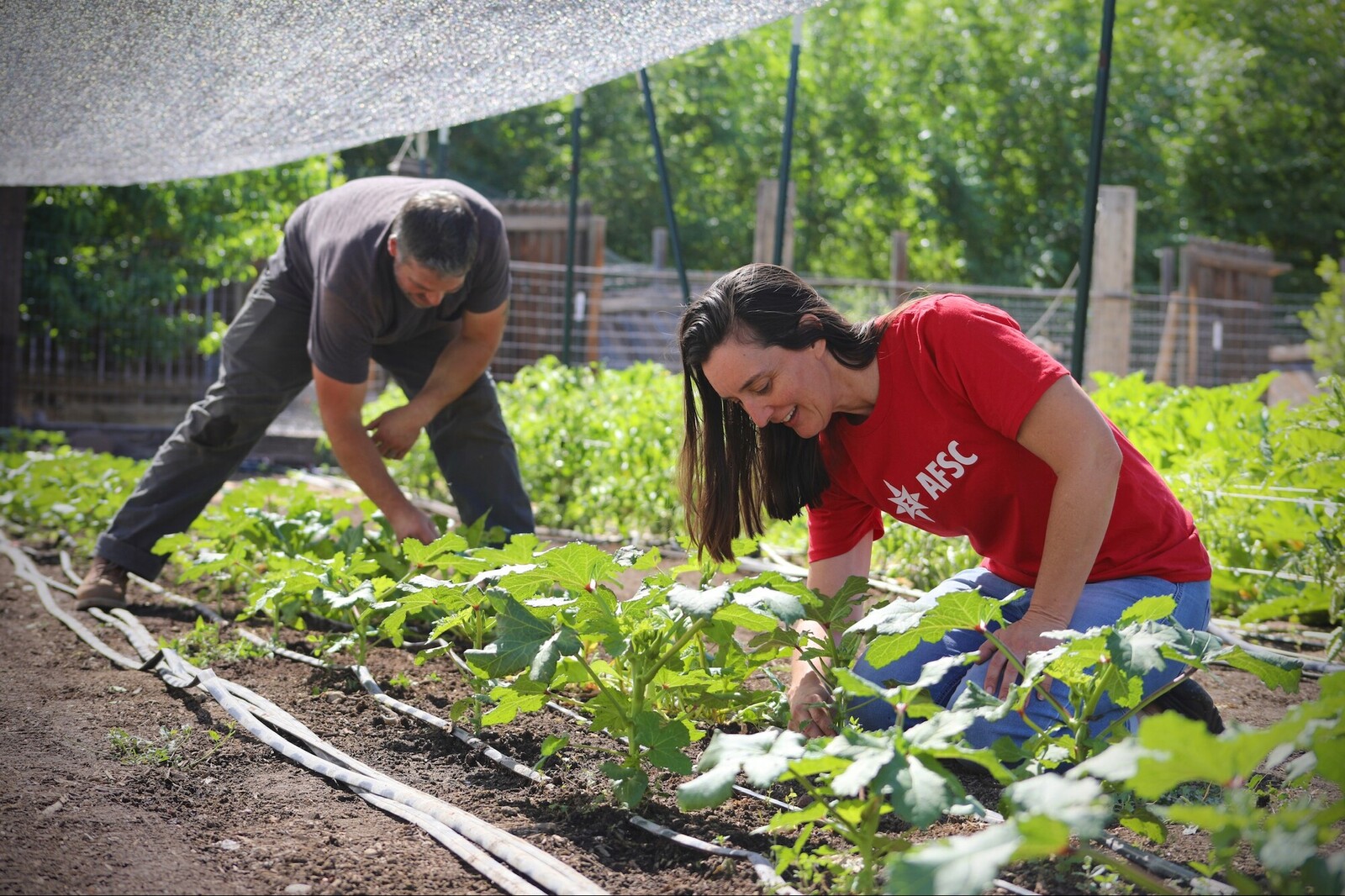
In New Mexico, AFSC supports local farmers working together to build climate resilience. Photo: Anni Hanna
In April, a group of AFSC staff and supporters embarked on a learning journey to Marrakesh, Morocco and the surrounding Atlas Mountains. For the five members of the delegation from New Mexico, this trip revealed a surprising degree of similarity between the southwestern United States and Northern Africa.
Despite being separated by 5,000 miles of land and sea, everyday people in both Morocco and New Mexico are facing the challenges of climate change head-on through activism that embraces climate justice in ways both big and small.
This was AFSC staff’s first trip to Morocco since our disaster response following a major earthquake in 2023. We were joined by members of the Global Diversity Foundation (GDF), an international organization that supports community-led initiatives among the Indigenous Amazigh people of Morocco. As we traveled together through the rural High Atlas mountain range, we witnessed both the lasting remnants of the earthquake’s destruction and the incredible resilience of the region’s inhabitants, whose traditional practices are often cooperative and sustainable.
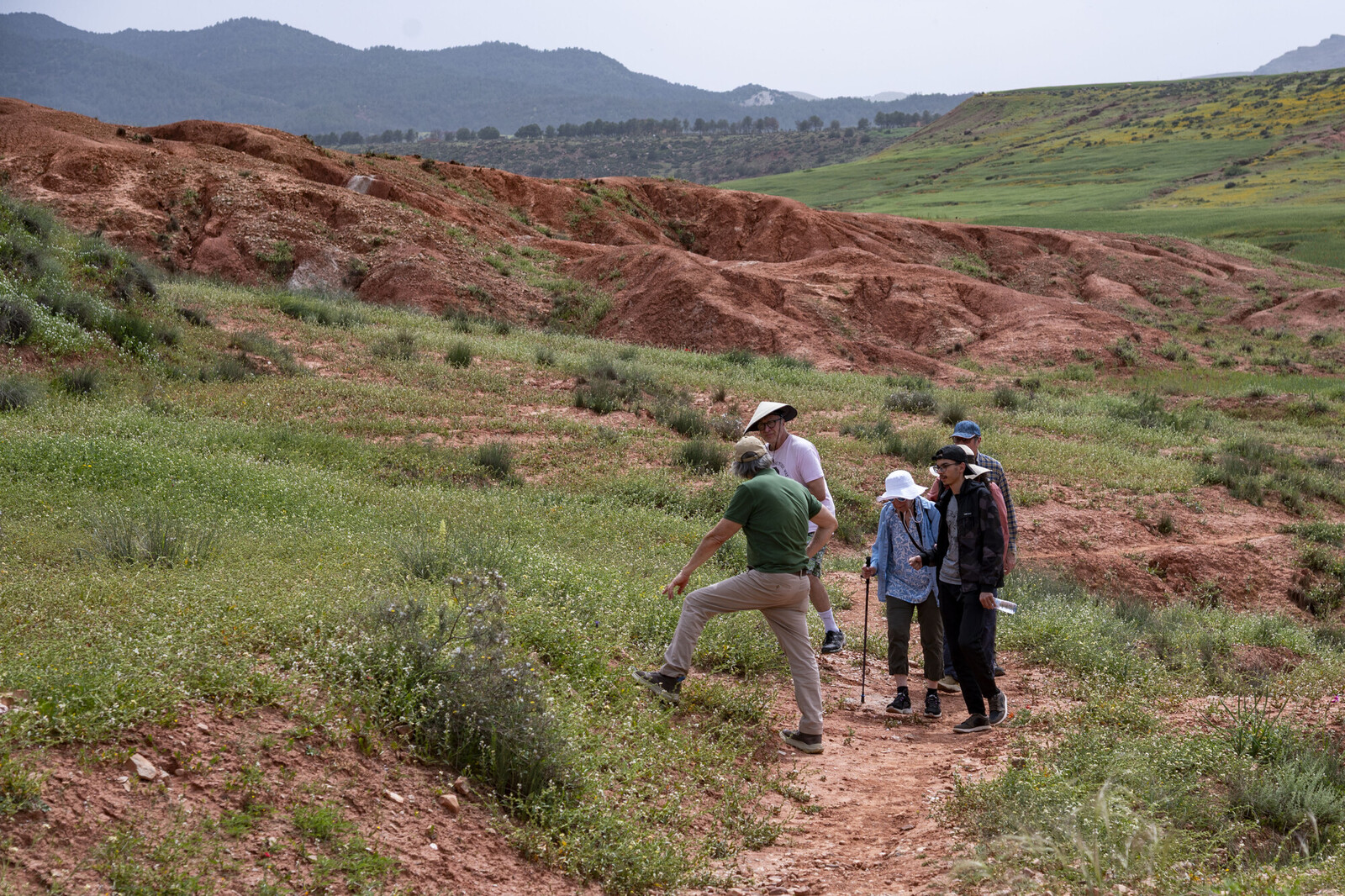
Earlier this year, AFSC staff and supporters traveled to Morocco to learn from local communities that have long embraced a shared responsibility for communal land. Photo: Cynthia Harris
The first similarity that AFSC’s New Mexican supporters noticed was the geography. Both Morocco and New Mexico share a dry and sunny climate, rocky desert landscapes, and an abundance of beautiful vistas. But we soon learned that the similarities ran deeper than geography.
Water democracy
When a New Mexican mentioned the word “acequia”—the name for New Mexico’s system of “water democracy” through which water resources are equitably shared among small farmers—the eyes of Moroccan farmers lit up with immediate recognition.
Though this practice was brought to New Mexico by Spain in the 17th century, it was first brought to Spain by Morocco in the eighth to 10th centuries, where it is still practiced today. Moroccan farmers were able to understand the term “acequia” because it came from the Arabic term “as-saqiya” (water conduit).
Across three continents and more than 1,000 years of history, this sustainable and egalitarian strategy for water distribution has endured as a vital tool for small-scale farmers.
Stewardship of natural resources
This was just the first in a long list of shared experiences. The Indigenous peoples of Morocco and New Mexico have long embraced a shared responsibility for communal land, rather than separating themselves into individual parcels of private property.
The 19 Pueblos of New Mexico hold around 200,000 acres of land that is collectively owned, managed, and used. Similarly, the Amazigh of Morocco maintain a system of pastoral “agdal” grazing lands, communally owned and governed by a council of elders from surrounding villages. Both systems have allowed Native peoples to sustainably manage their natural resources for centuries, without corporate control or rampant pollution.
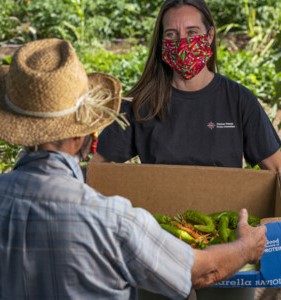
The people of the land in both places also share a commitment to cooperative rural development. AFSC has worked in New Mexico to support cooperative farm networks where small-scale farmers help one other through projects that benefit them all. Morocco has an even more advanced system of rural cooperatives, supported in part by the government’s National Human Development Initiative. This initiative supports economic development and community power under the ideal of “tiwizi,” an Amazigh idea similar to what we mean by “solidarity.”
Food systems and climate justice
How we grow and harvest our food is central to climate justice. It is connected to environmental issues through land use, biodiversity, chemical pollution, and the greenhouse gas emissions produced by agriculture. Our food systems are also connected to economic issues through food prices, access to healthy crops, farmworker rights, and the corporate power. Envisioning climate justice requires imagining what a healthy, sustainable, and prosperous food system could look like.
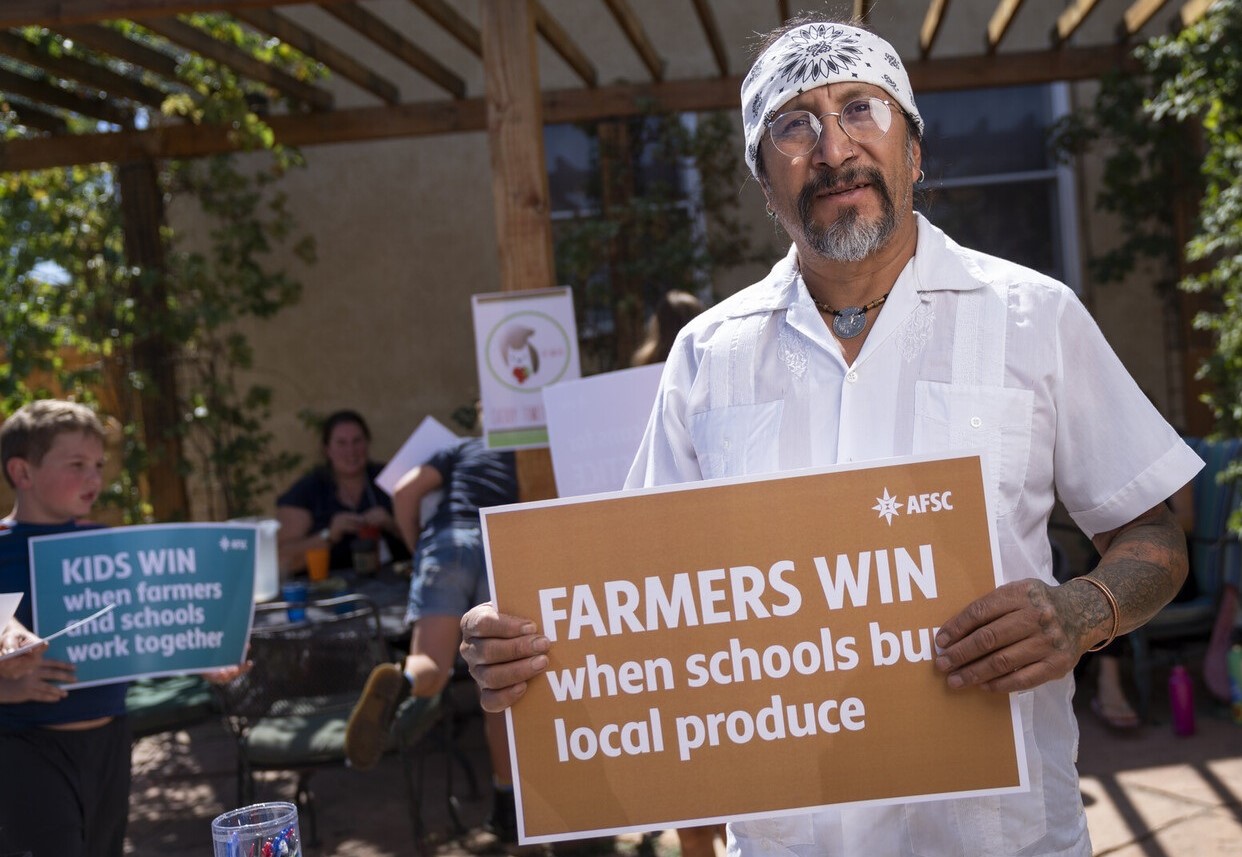
Small farmers and rural workers in New Mexico and Morocco are showing us some of the ways forward. Communal nurseries and seed exchanges have allowed farmers to preserve regional biodiversity and lower their costs by cutting exploitative corporations like Monsanto out of the process. Regenerative farming practices, including companion planting and diverse polycropping, can produce good harvests while preserving soil health for future generations. Cooperation between farms and schools can improve rural economies, provide fresh produce to hungry kids, and create stronger communities.
These are only a few of the win-win approaches that the people of both New Mexico and Morocco hold in common, proving that the struggle for climate justice stretches across time and space.
While lifestyle changes to reduce our individual carbon footprints are worthwhile, true climate justice asks more of us. It asks us to reevaluate our relationships with one another and with the natural world that sustains us.
What would a truly sustainable agricultural sector look like—one that provides healthy food to all, protects the earth, and is rooted in solidarity and community well-being? From Morocco to New Mexico, communities are already showing us some of the answers, clearing a path toward a brighter future.