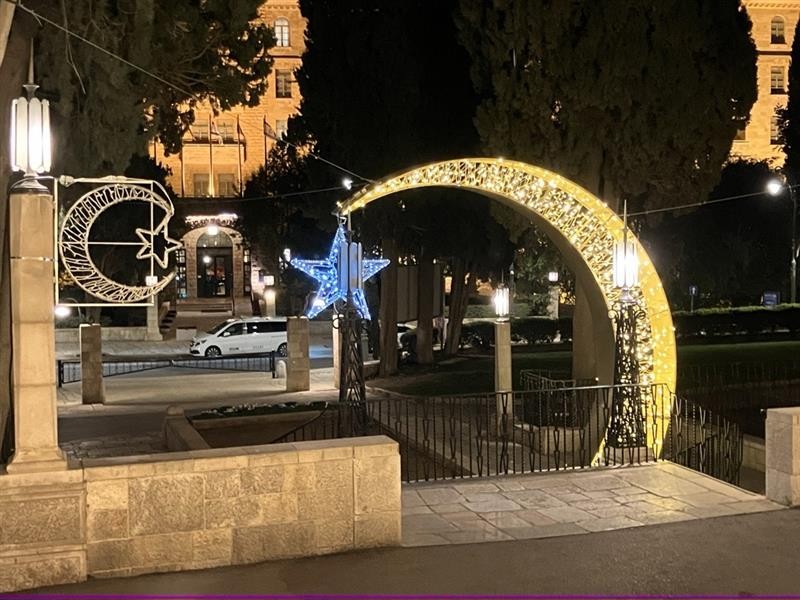
As Eid al-Fitr approaches, the holiday that comes after the end of Ramadan, Muslims complete a month of fasting from dawn until sunset, increasing their prayers and acts of worship. During this time, social gatherings and family visits also become more frequent, and conversations often revolve around joy, reunion, and celebration. And it is important for Palestinians because it is one of the occasions that they come from all over Palestine (Gaza, West Bank, Jerusalem, 48 lands) to pray together.
With excitement, the steps quicken toward Damascus Gate, one of the most important entrances leading to the Old City of Jerusalem. From there, the journey begins. History appears vividly in the massive ancient structure and in the stones of the Old City walls that have surrounded the area for centuries. Damascus Gate has never been merely a passageway; it has always been a living social space for Jerusalemites.
The wide steps of Damascus Gate have long been a lively gathering place for the youth of Jerusalem. Food vendors sell snacks here, and during Ramadan the area fills with signs of celebration. The square becomes a place where people sit, enjoy their time, sip tea, and exchange conversations. Meeting on these steps has long been a daily habit—a place where friends gather and share the small details of their lives.
From there, the walk into the Old City begins.
Upon entering through Damascus Gate, you encounter the vibrant markets of the Old City, filled with distinctive scents, sounds, and colors. Vendors display fresh fruits and vegetables, while the aroma of spices drifts from the small shops. Bright colors attract the eye, and the voices of merchants overlap as they call out to passersby and encourage them to buy. Lights hang from the ceilings of the narrow markets, and silver jewellery glimmers in the shop windows.
You continue walking through the ancient alleys until, from a distance, you begin to see the outlines of Al-Aqsa Mosque. Gradually the place reveals itself in its colors, and the closer you get, the clearer and larger its features appear. In that moment, you feel as if you have almost arrived. A smile forms on your face at the sight of its beauty and grandeur as you walk through Khan al-Zeit Market, while the sounds of the market slowly fade with every step that brings you closer to Al-Aqsa.
Then you reach Bab al-Silsila, one of the fifteen gates of the Al-Aqsa compound. You stand before the tall historic gate, admiring its beautiful Islamic architectural design. From there, you see people flowing toward the mosque’s courtyards, raising their hands in prayer. As you enter the courtyards, the feeling suddenly changes; the air becomes calmer, and hearts grow humbler. People gather closely together to pray at Al-Aqsa, performing the same rituals you do, standing in beautiful and orderly rows.
Like all Palestinians—and Jerusalemites in particular—we wish reaching the mosque could truly be this easy. But to understand the reality Palestinians face, the same journey must be repeated with different details.
Once again, the steps move quickly toward Damascus Gate. But before reaching it, you notice four surveillance rooms positioned on both sides of the entrance and inside it. Soldiers stand inside them, randomly searching young men. One of them might stop you and ask: Where are you from? Why are you here? The soldier then decides whether you are allowed to enter or not. Cameras surround the area in every direction, constantly monitoring the square and the movement of people.
During Ramadan especially, sitting on the steps of Damascus Gate is no longer as possible as it once was. Metal barriers are sometimes placed there, and soldiers ask people not to sit or gather on the steps that were once a place for meeting and conversation.
After entering through the gate, the markets remain the same in their smells, colors, and sounds—but life there is no longer what it used to be. Repeated closures and restrictions preventing many Palestinians from reaching Jerusalem have affected the economic life of the Old City. Small shop owners complain about the lack of customers, and some have been forced to close their stores after many years of work.
Temporary checkpoints also appear at the entrances of some alleys, where people are searched more carefully and their movement within the city is restricted. You might be stopped at any moment, searched, or questioned because of a simple word. The feeling of being constantly watched accompanies you throughout the journey.
You continue walking through the Old City until you once again begin to see the features of Al-Aqsa in the distance. The domes and trees appear as you draw closer, but this time the path is filled with cameras hanging everywhere. Soldiers are also heavily present throughout the Old City, creating a sense of unease; at any moment you may be stopped and asked to show your ID, explain why you are there, and say where you came from.
Finally, you arrive again at Bab al-Silsila—but the gate is not open as you imagined. A line of soldiers stands at a checkpoint in front of it, as is the case at most entrances to Al-Aqsa. You cannot enter the mosque courtyards without an identity check. A soldier asks where you came from and may also ask whether you are Muslim. Your entry is then recorded on a small device. The officer may return your ID and allow you to enter—or keep it until you finish your prayer.
Every year during Ramadan, these measures become stricter in East Jerusalem. Large numbers of police and soldiers are deployed, checkpoints increase, and random searches become more frequent. Since October 7, many Palestinians from the West Bank were no longer able to obtain permits allowing them to pray at Al-Aqsa.
With the outbreak of war with Iran on February 28, 2026, the Israeli government announced the closure of several religious sites in Jerusalem, including Al-Aqsa Mosque and the Church of the Holy Sepulchre, and banned gatherings during the war. Since then, many worshippers have not been allowed to enter.
These scenes are not repeated only during Ramadan, but during Eid as well.
For this reason, the dream has become very simple: that the road to Al-Aqsa could be a normal one—without barriers, searches, or fear. That people could walk from Damascus Gate through the Old City markets and reach the mosque easily, as they once did.
Until that dream becomes reality, some may sometimes find themselves simply looking at Al-Aqsa from afar… because reaching it has become harder than merely seeing it.