
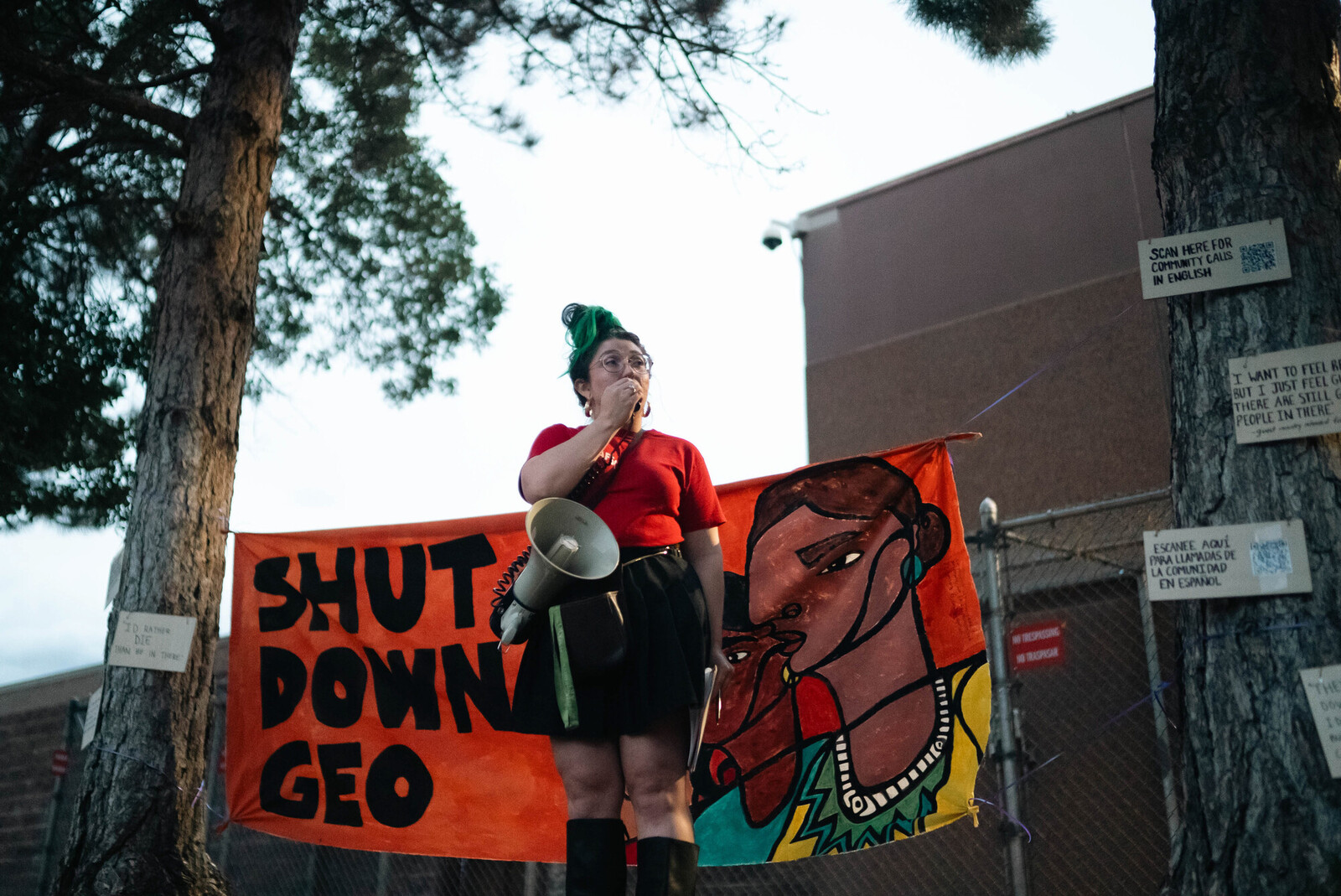
People gather at a vigil outside of the GEO immigrant detention facility in Colorado. Photo: Oscar Juarez
As a coordinator with AFSC’s Colorado Immigrant Rights Program, much of my work is accompaniment. I walk alongside people facing detention and deportation, and their families. I help people find lawyers, follow their cases, push for medical care, and keep their loved ones informed.
Many of the people I support are held at the immigration detention center in Aurora. It’s run by GEO Group, one of the largest for-profit prison companies in the country, under a contract with ICE. GEO profits from locking people up, and the people inside pay the price.
Through Not1More Deportation (Ni1Mas), an immigrant-led project of AFSC, I kept hearing stories of medical neglect inside GEO and of critically ill people being deported. One of our member leader’s loved ones died soon after being deported, and their death was never counted as a death in ICE custody.
In another example, ICE deported a man I was helping after he spent nearly five months in detention at GEO. For weeks afterwards, no one could reach him. He had become so sick in detention that, when he finally arrived in Guatemala, he basically crawled to an emergency room.
At the same time, our partners at Casa de Paz noticed a growing trend of ICE “patient dumping,” releasing critically ill people on the edge of collapse into hospitals. Together, N1Mas and Casa de Paz began pushing back, centering the experiences of people detained and released, and the knowledge of medical professionals.
Detention makes people sick. People inside face medical neglect. That’s why we’re doing everything we can to support individual releases, get people the care they need now, and end detention for good.
A public health emergency behind the walls
In June, health officials confirmed an active case of tuberculosis inside GEO. TB spreads through the air, is very difficult to treat and can kill if it isn’t treated.
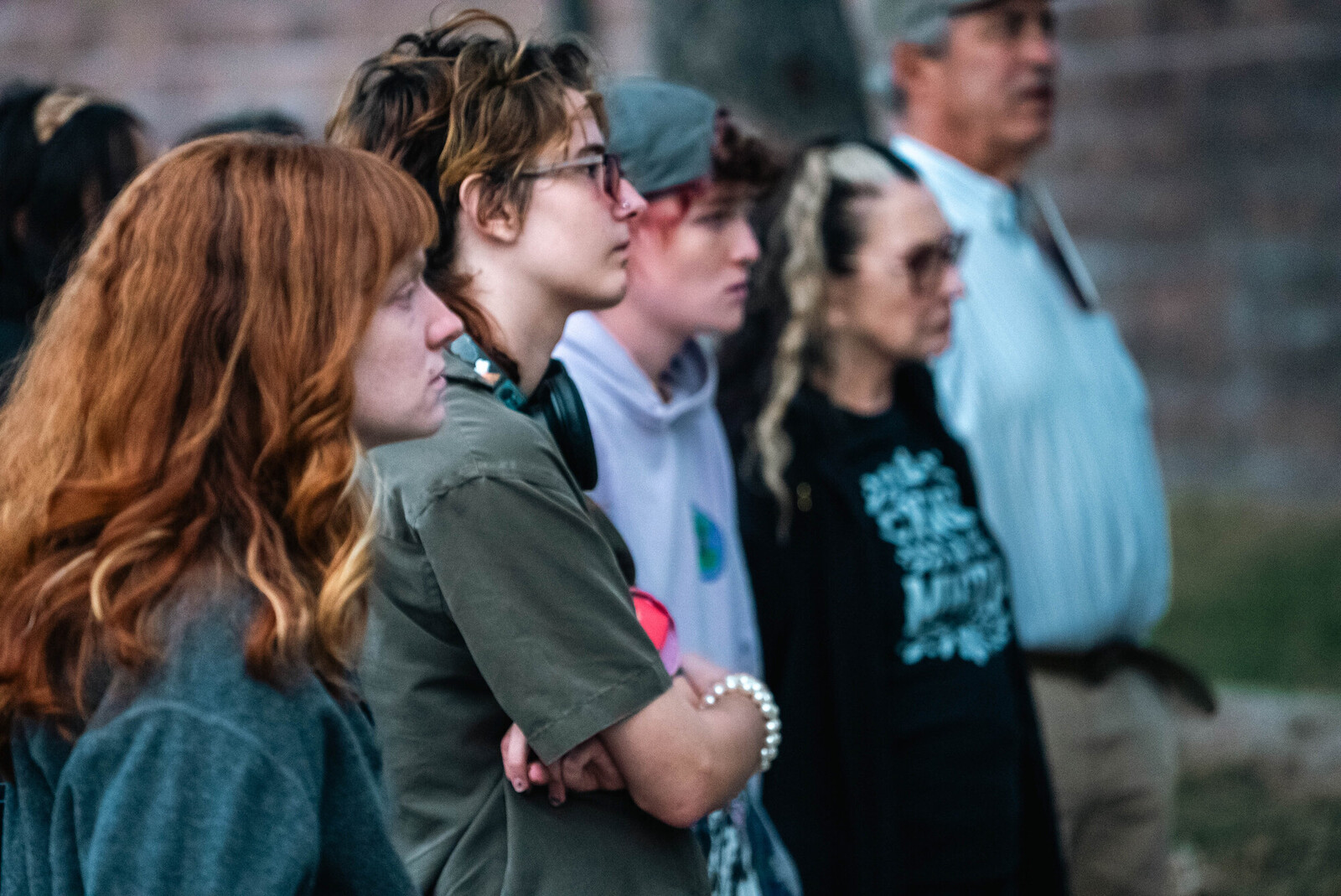
People gather at a vigil outside of the GEO immigrant detention facility in Colorado. Photo: Oscar Juarez
Colorado law requires public health officials to investigate cases like this and mandates access to facilities and records. But when local and state health agencies showed up, GEO and ICE refused to let them in. Meanwhile, people inside and their families told us they were being denied TB testing. Some said sick people were kept in the same spaces as everyone else. Others described being isolated in a wing with the air conditioning turned off.
A 78-year-old priest had TB symptoms for months and received little more than cough medicine. Another man has kidney failure and needs dialysis every few days. If he stays inside, and contracts TB, he could die.
TB doesn’t just stay behind GEO’s walls, either. Staff go home to their families every night, making this a public health emergency for all of us.
Healthcare professionals step up
N1Mas and Casa de Paz brought together a cohort of doctors and nurses who volunteer their time. They include Dr. Maureen Daly, a retired public health physician, and Holly Cheng, a public health nurse. More medical professionals joined as word spread about the group.
Their expertise made all the difference. Because they knew what proper TB care looks like under CDC guidelines, we could cite exactly what GEO was failing to do and move fast. They also review medical records of people in detention and write letters urging medical release, including for the man who needs dialysis.
Their voices have helped policymakers and the public understand the injustice, and they’ve been a key support for immigrants and their loved ones. At the height of the crisis, we organized a public action almost every week.
Pressing the state to act
Dozens of health and immigrant rights groups signed our letter asking Attorney General Phil Weiser to step in. His office pointed us to the Colorado Department of Public Health and Environment (CDPHE), which had the power to issue a public health order. That is a legal demand requiring GEO to share information and cooperate with an investigation.
We met with the governor’s office and CDPHE leaders, joined by Casa de Paz and a state senator who outlined the protections in Colorado law. Our medical experts pressed state officials on why they hadn’t used their power.
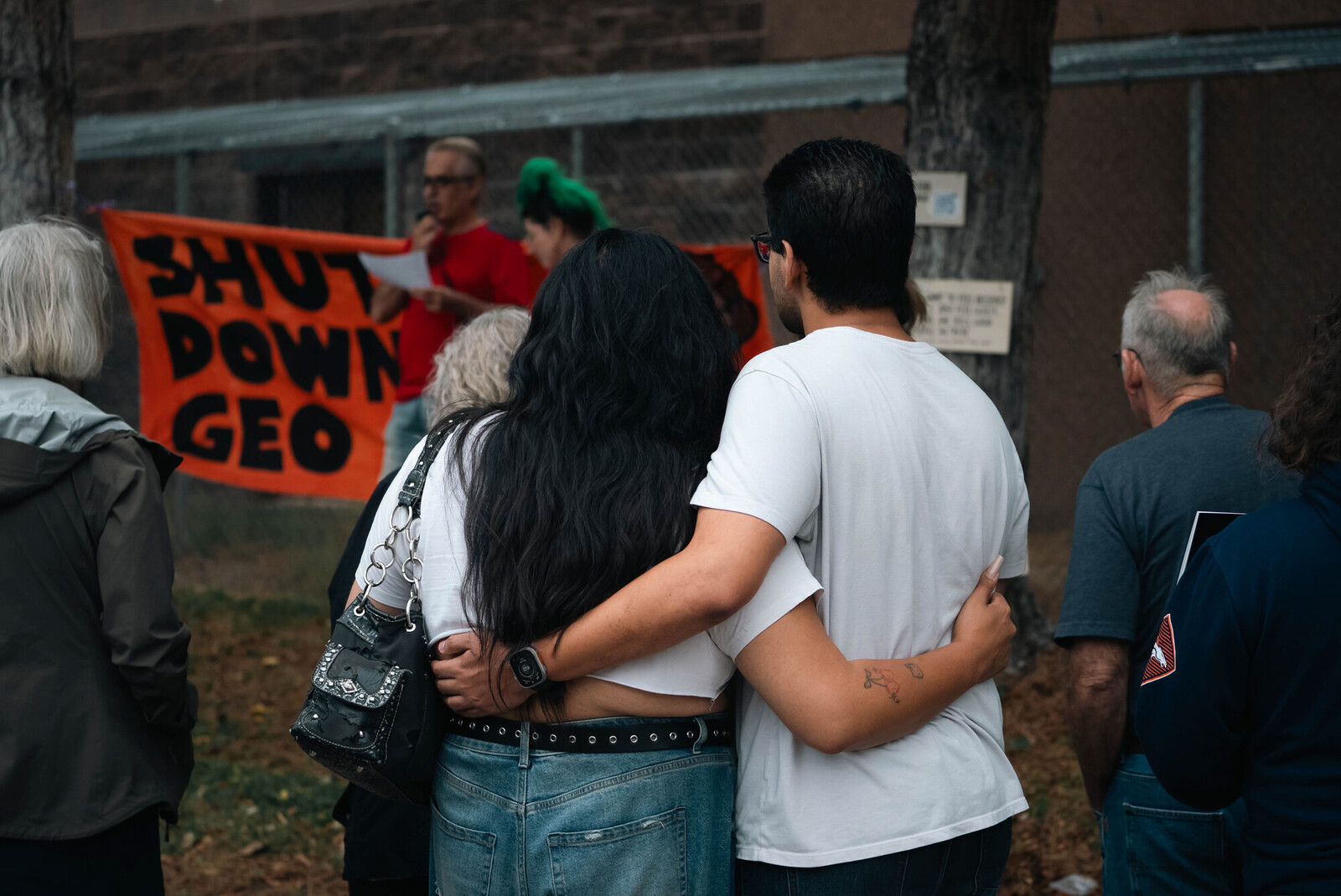
People gather at a vigil outside of the GEO immigrant detention facility in Colorado. Photo: Oscar Juarez
Weeks went by with no order - so we wrote one ourselves! Using a previous state health order as a template, we created the People’s Public Health Order. Close to 300 people signed online, and dozens more signed on the steps of the State Capitol during one public action. Our street theater portrayed the inaction of CDPHE and Gov. Polis. The action drew press and social media attention, raising the pressure.
We invited the governor and CDPHE to the action. The director of CDPHE, Jill Hunsaker Ryan, came and expressed her support. We welcomed her, but words alone couldn't be enough. People inside GEO needed action.
During the event, I said what I believe with my whole heart. “There’s a part of your humanity that dies when you don’t help a person asking for help, and those detained are asking.”
Days later, the Colorado Department of Health and Environment issued its public health order. When GEO refused to comply, Colorado’s attorney general sued. The lawsuit doesn’t address medical neglect itself, but it is an important step toward accountability and a declaration that GEO cannot exist outside the law.
Bearing witness
We’ve also worked to make sure the public can see what’s happening inside. Through open records requests, our Shut Down GEO campaign obtained recordings of 911 calls from inside GEO. These recordings revealed the same patterns of medical neglect and GEO’s dangerous lack of emergency training for non-medical staff.
N1Mas and Casa de Paz built a publicly available website that hosts the 911 recordings alongside voices of immigrants in our community.
In September, N1Mas, Shut Down GEO, and Casa de Paz, organized a pop-up audio-visual installation outside GEO. We hung QR codes from the trees so people could walk from tree to tree and listen on their phones. Dr. Daly also spoke, offering to connect GEO workers with legal help if they’re asked to do anything unethical or illegal. To people trapped inside, she said, “We believe you, and we haven’t forgotten you.”
I believe that if any one of us has to bear witness to this horror, everyone should, because we aren’t supposed to be the same after we witness it. What’s happening at GEO is a small window into every detention center.
The TB threat isn’t over. Since 2024, our Shut Down GEO Aurora campaign has documented hundreds of cases of medical neglect. Our healthcare cohort is planning its next campaign, and a state senator has offered to help us write health legislation for the next session. Organizers who accompany people in detention now meet regularly to track patterns, support one another, and bring ideas for action back to people inside, so those most affected guide our work.
At AFSC, we believe every person has worth and that healthcare is a human right. No one’s health is safe in a cage. That’s why we’re committed to ending immigration detention for good.