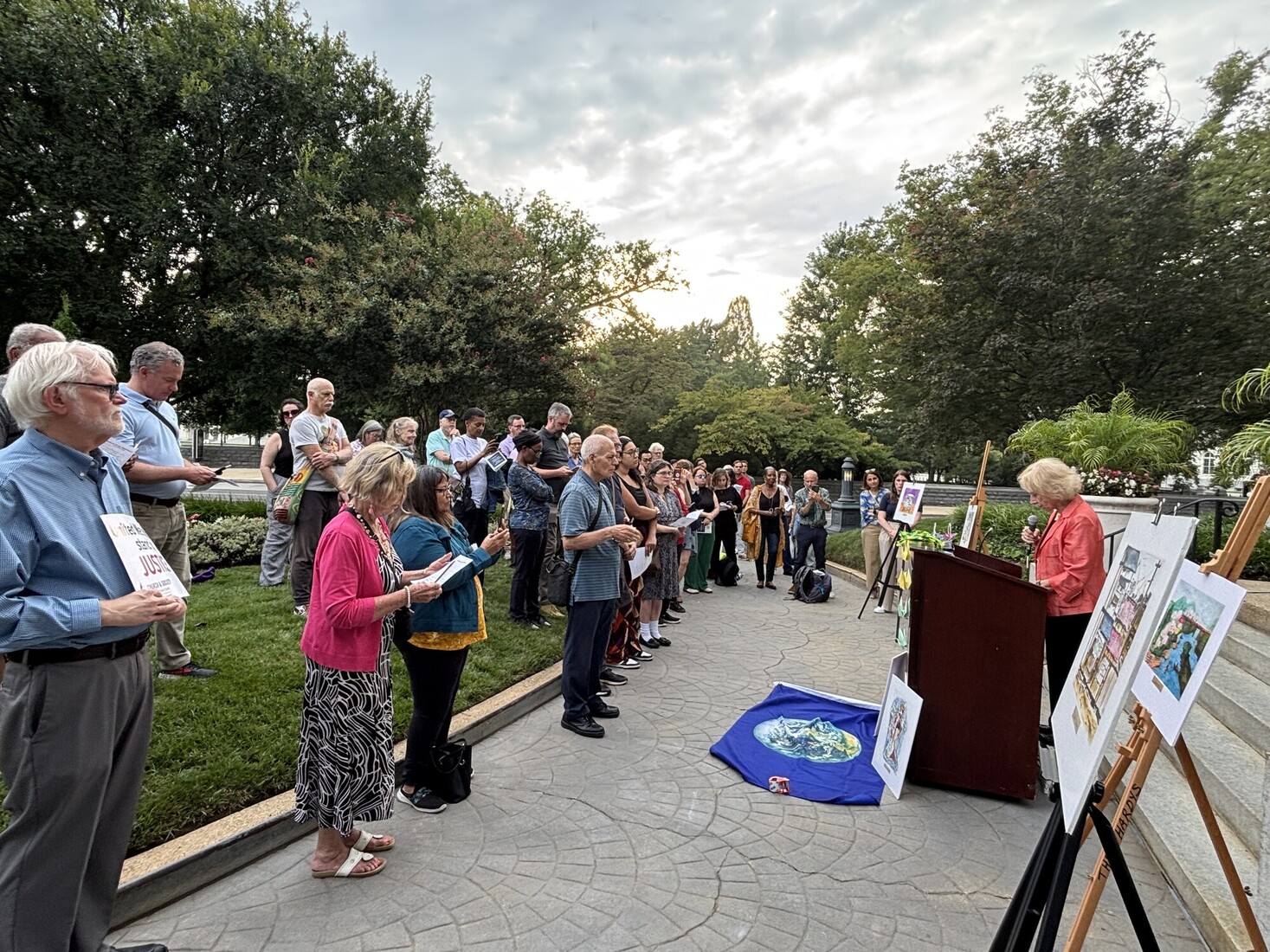
2025 Nuclear Prayer Day vigil. Photo: AFSC
Over 80 years ago, on Aug. 6 and 9, 1945, the United States dropped atomic bombs on Hiroshima and Nagasaki. Approximately 200,000 people were killed. Radiation went on claiming lives for decades, causing sickness and birth defects among survivors and their children. The magnitude of that death and destruction made it clear that nuclear weapons must never be used again.
On Aug. 6, 2026, AFSC joined faith communities across the country for Nuclear Prayer Day to remember the victims, to honor the survivors, and to renew a commitment toward a world free of nuclear weapons.
Here are five things to know this Nuclear Prayer Day:
1. The harm did not end in 1945.
Hiroshima and Nagasaki were deliberate attacks intended to cause mass casualties and total destruction. But the suffering of the nuclear age extends far beyond those two cities. More than 2,000 nuclear weapons tests have left their own legacies of sickness and sorrow—from the Trinity Test in New Mexico to the Marshall Islands and beyond. The entire process of mining, testing, production, storage, and waste management for nuclear weapons inflicts lasting harm on people, land, water, and air, most acutely in Indigenous and marginalized frontline communities. On this 81st anniversary, we remember the hibakusha (Hiroshima and Nagasaki survivors) and their descendants, and the countless other survivors, who continue to call for peace.
2. The danger today is greater than ever.
Eighty years on, the nuclear risks have only increased. Today, communication channels between nuclear-armed states have eroded, arms-control guardrails have collapsed, and emerging technologies are compressing the time leaders have to make life-or-death decisions. There is no technical deterrence and no shield to protect us from nuclear destruction. As former Defense Secretary Robert McNamara reflected on nuclear war, “At the end we lucked out. It was luck that prevented nuclear war.” We cannot keep staking human survival on luck. The only world free from the dangers of nuclear war is a world free from nuclear weapons.
3. A "limited" nuclear war would not be limited.
The idea that a nuclear exchange could be contained is a dangerous myth. Even a regional conflict using a small fraction of the world's arsenal could inflict enormous casualties through the climate disruption and famine that would follow. When we speak plainly about this, the illusion of nuclear security falls away. These weapons do not provide safety. They create permanent vulnerability, resting on fear and the mutual holding of civilians as hostages.
4. The money spent on these weapons is taken from human needs.
Here in the U.S., we are on track to spend nearly a trillion dollars on nuclear weapons over the coming decade (averaging nearly $100 billion a year), with still more proposed for new programs. This spending comes as lawmakers cut health care, food assistance, housing, and education. Every dollar spent on weapons of mass extinction is a dollar taken from the essential needs of our communities.
5. Progress is possible.
Despite the challenges of this moment, another way is possible. We have reduced the threat of nuclear weapons before. Global stockpiles have fallen from nearly 70,000 warheads during the Cold War to roughly 12,000 today. That progress shows that we can make progress towards a world free of nuclear weapons. We reject a status quo in which a handful of nuclear-armed states claim a permanent right to their arsenals while demanding restraint from everyone else. This betrays the spirit of the Non-Proliferation Treaty whose Article VI binds every party—including the nuclear-weapons states—to negotiate in good faith toward disarmament. Non-proliferation was meant as a shared road to abolition, not a permanent nuclear apartheid. Eighty years after Hiroshima and Nagasaki, the nuclear states that committed to good-faith negotiations toward nuclear disarmament have broken that promise.
Our call
On this Nuclear Prayer Day, we join with people of faith around the world calling for our governments to commit to a world free of nuclear weapons. We urge the U.S. to lead the world back from the brink of nuclear war, reverse the arms race, and adopt a nuclear policy of no-first-use. We call on our elected officials to halt the development and deployment of new nuclear warheads and pursue new arms-control and disarmament agreements now that New START has expired.
How you can help
Join AFSC and faith communities across the country by contacting your members of Congress to urge them to support H. Res. 317 and S. Res. 323, resolutions calling for renewed U.S. leadership on nuclear arms control and a pathway toward a world free of nuclear weapons. A growing number of members of Congress have already joined these efforts—but far more leadership is needed. We believe a safer and more just future is possible if we join our voices together and call for it.