
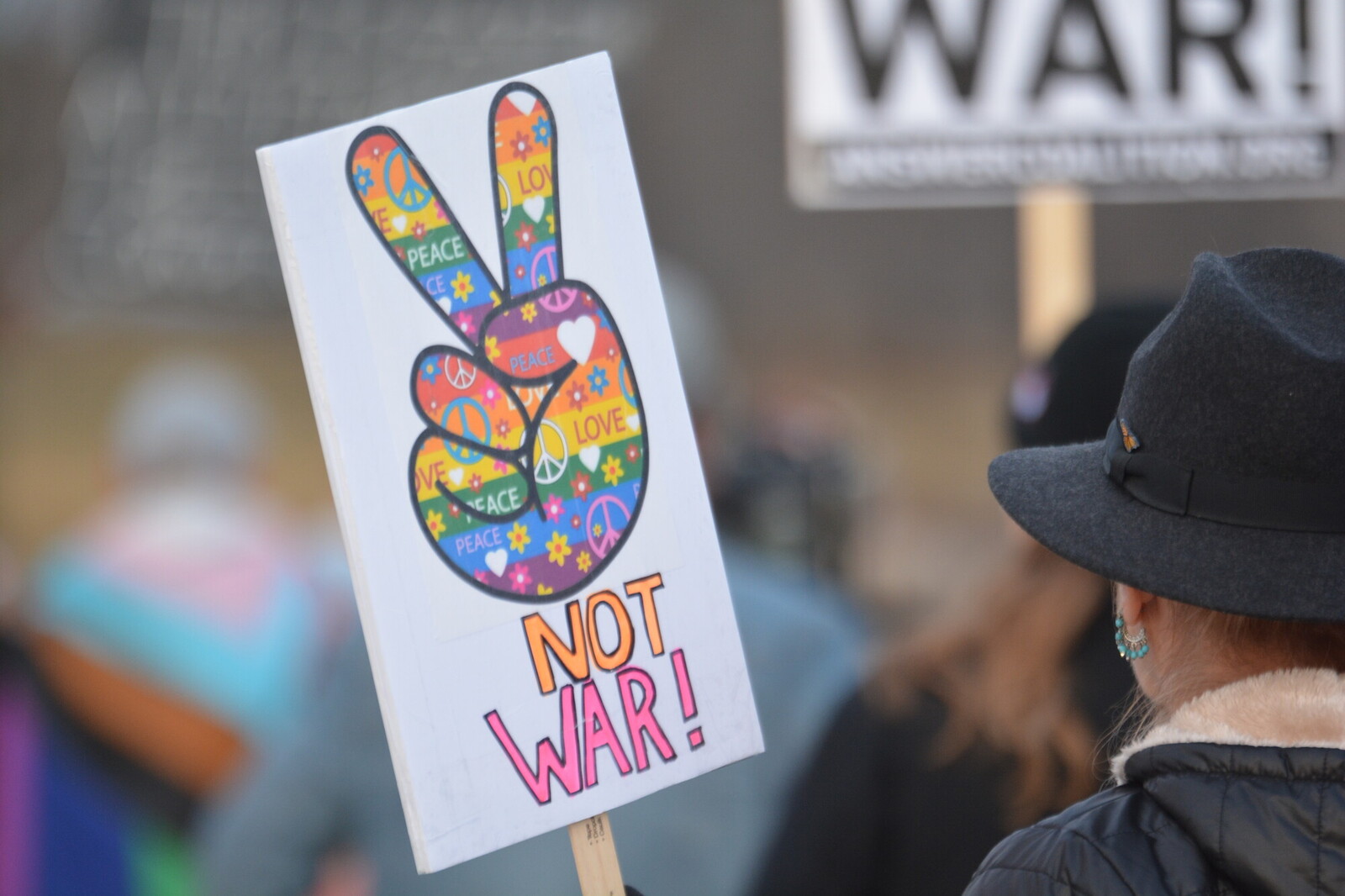
Photo: Jon Krieg
Twenty-five years after Sept. 11, 2001, we remember those killed that day and honor the countless communities around the world impacted by violence, displacement, and fear in the wake of that day.
On Sept. 11, 2001, the transnational Islamist extremist organization Al-Qaeda carried out coordinated terrorist attacks against the United States, killing nearly 3,000 people by hijacking four commercial airplanes, flying two into New York City’s World Trade Center, one into the Pentagon, and crashing a fourth one in Pennsylvania after passengers and crew attempted to regain control.
Subsequent actions by the U.S. government profoundly reshaped national and international security for decades, with major implications for the international peacebuilding sector. The U.S. government asserted that terrorism posed a sustained global security threat requiring not only law-enforcement measures but a broader military, diplomatic, intelligence, and financial response, launching what became known as the “global war on terror.” The U.S. Congress authorized the use of military force against those responsible for the attacks and those who harbored them, providing the basis for military operations in Afghanistan and, over time, a much wider global counterterrorism effort.
On the 20th anniversary of 9/11 in 2021, AFSC reflected on the enormous human costs of the global war on terror: lives lost, millions displaced, expanded surveillance, rising Islamophobia, and military interventions that too often deepened conflict. We argued then, as we do now, that these policies made the world less secure.
This year’s anniversary asks us to look beyond Afghanistan, Iraq, and U.S. foreign policy to a broader global question: How has the war on terror reshaped global peace and security—and what does that mean for international peacebuilders today and in the future?
The war on terror not only changed military policy. Over time, it changed governance approaches and how governments talked about security: where money went, which threats mattered, and how they were understood, how risk was measured, and what kinds of peace seemed possible. If we want a different future, we have to understand what this period has left behind.
How the war on terror narrowed the meaning of security
The Sept. 11 attacks were a turning point. Before 2001, many international debates centered on preventing conflict, protecting people, strengthening cooperation, and addressing the root causes of violence. After the Cold War, there was at least some room to imagine security as something broader than military strength.
The war on terror narrowed that space and what was possible in peacebuilding. Counterterrorism moved to the center of foreign policy, and the spread of anti-terrorism laws meant that in many places, peacebuilding and dialogue were no longer possible, while racial targeting increased. Military action often replaced preventive diplomacy. Surveillance expanded. ‘Stabilization’ efforts, often ill-designed, frequently displaced long-term peacebuilding. Development, humanitarian work, migration policy, and diplomacy were increasingly treated as security tools. In practice, security came to mean protecting states from perceived threats, rather than protecting people, especially the most vulnerable groups, from violence, exclusion, and injustice.
The expansive interpretation of U.S. material-support laws created a profound contradiction at the heart of the post-9/11 security architecture with global implications: activities intended to move armed groups away from violence, such as dialogue processes, negotiation support, and conflict resolution training, could themselves be treated as support for terrorism. The effects reached far beyond the US, shaping donor requirements, financial compliance systems, and organizational risk appetites and making engagement with proscribed groups increasingly difficult. The result was a chilling effect on global peacebuilding—constraining dialogue and mediation, weakening locally led efforts, and narrowing the space for precisely the engagement often needed to move armed actors away from violence.
While the war on terror is less of a reference today, much of its ‘legacy’ remains. Governments still spend far more on military tools than on prevention. Counterterrorism laws still limit humanitarian access and civil society. Peacebuilding organizations still work within funding systems shaped by security priorities. Civic space and the ability of peacebuilders to bring people together and to engage with all parties continue to shrink as governments invoke national security to justify surveillance, limits on protest, and pressure on independent media.
New geopolitical realities
The world today is very different from the one that produced the global war on terror. Interstate conflict is at its highest level in decades. Ukraine and Gaza have exposed deep fractures in the international and multilateral order and raised hard questions about the credibility and consistency of international law. Sudan has become one of the world’s largest humanitarian catastrophes, yet receives far too little sustained attention.
Russia’s full-scale invasion of Ukraine has underscored the need to defend states against aggression and support Ukraine’s right to self-defense under international law. But the international community has responded differently to different types of conflicts (i.e., Ukraine versus Gaza or Sudan). That has further undermined trust in international law and peacebuilding support more broadly. It has also pushed many governments even further toward military deterrence, defense spending, and rearmament, often at the expense of diplomacy, prevention, civilian peacebuilding, and investments in long-term inclusive peace.
At the same time, authoritarian practices, democratic backsliding, and attacks on civic space are accelerating in many regions, including in long-established democracies. Climate change is multiplying insecurity. Forced displacement, including a rising number of third-country deportations, has reached historic highs. Artificial intelligence, cyber conflict, and information warfare are reshaping global competition and safety. The multilateral norms and processes designed to prevent conflict and uphold international law are losing legitimacy at an alarming pace, weakening the collective foundations on which international peace and security depend.
These crises spill across borders. They are political, ecological, technological, and deeply connected. The posture of permanent confrontation will not resolve them. Prevention, cooperation, and global solidarity are not soft alternatives to security; they are what real security requires.
What this means for peacebuilding today
The shifts outlined above have deeply shaped the international peacebuilding sector at its very foundations. In the years after 9/11, funding moved away from long-term peacebuilding toward short-term security goals and preventing or countering violent extremism. In many contexts, these approaches backfired, inadvertently deepening grievances, reinforcing the exclusion and stigmatization of communities, and contributing to the very insecurity they sought to prevent. Despite advocacy and evidence that these short-sighted approaches were frequently counterproductive, long-term investments in dialogue, reconciliation, democratic governance, and social transformation became much harder to sustain. Local peacebuilders often had to navigate counterterrorism rules that made it much more challenging to partner with communities most affected by conflict.
At the same time, the peacebuilding sector evolved in its own terms. Peacebuilders have professionalized the sector, deepened their use of systems thinking, expanded locally led peacebuilding and conflict-sensitive and trauma-informed practices, adopted more inclusive and transformative models of conflict transformation, dialogue, and mediation, and enhanced their understanding of cross-sectoral approaches. These ways of working start from a simple truth: conflict cannot be addressed by treating symptoms alone. It requires understanding and changing the systems, relationships, institutions, incentives, and power dynamics that produce and maintain violence – precisely what security-focused approaches do not deliver.
The recent cuts in Official Development Assistance (ODA), the abrupt dismantling of USAID, and the broader funding crisis facing humanitarian, development, and peacebuilding organizations have deeply disrupted the sector. But they are not only budget problems. They point to a deeper political shift away from prevention and international solidarity, and toward militarization and national self-interest. Peacebuilding must respond in practical and political ways: defend strategic long-term investments, build broader support for shared security, strengthen locally led action, and show why peacebuilding matters for long-term global stability.
Choosing a different future
For decades, AFSC has advanced a vision for peace grounded in shared security—the understanding that our safety is inseparable from others’. Security cannot be achieved through domination, deterrence, or military power alone. Lasting security comes from strong relationships across divides, accountable institutions, respect for human rights, inclusive democracy, ecological sustainability, and the capacity of societies to manage conflict constructively without violence.
This vision is rooted in Quaker values: the rights and dignity of every person, the recognition that violence diminishes our shared humanity, and the belief that peace takes courage as well as imagination. This vision asks us to stop treating security as something nations compete to possess, and to see it instead as something people build together. No military can stop climate change. No intelligence system can rebuild trust. No border wall can contain pandemics. No nation can insulate itself from democratic erosion, mass displacement, economic injustice, or nuclear risk.
As AFSC prepares to mark its 110th anniversary in 2027, it also marks the 80th anniversary of the Nobel Peace Prize it accepted jointly with the British Friends Service Council on behalf of Quakers worldwide. The prize honored three centuries of Quaker efforts to heal rifts and oppose war. Now we stand at another historic crossroads.
For more than a century, AFSC has spoken truth to power, supported peacebuilders and conscientious objectors, and challenged the belief that peace can be secured through violence. That witness remains urgent and relevant today, not because our challenges are the same as in 1917 or 2001, but because this moment calls for a new way of thinking about global peace and security.
The task before peacebuilders is bigger than improving programs or refining tools. It is to help shape the next vision and architecture for international peace and security. That means defending civic space, democratic institutions, and international law, even when doing so is politically difficult. It means investing in prevention before crises escalate, supporting locally led peacebuilding, and sustaining the patient and often invisible work of quiet diplomacy and relationship-building. Above all, it means insisting that security must be rooted in global solidarity, not in fear, but in justice, dignity, and our human interdependence.
It also means changing the systems, institutions, and incentives that still make militarized responses seem easier, faster, or more serious than prevention, justice, and building peace. No single organization or sector can do this alone. Reimagining peace and security means changing who gets to define security, whose voices are heard, and how peace is built and sustained.
Every generation inherits the security assumptions of its time. Every generation also has a choice: to accept those assumptions, or to question them. The next chapter of international peacebuilding will be shaped by those willing to imagine, organize for, and build a different future together.