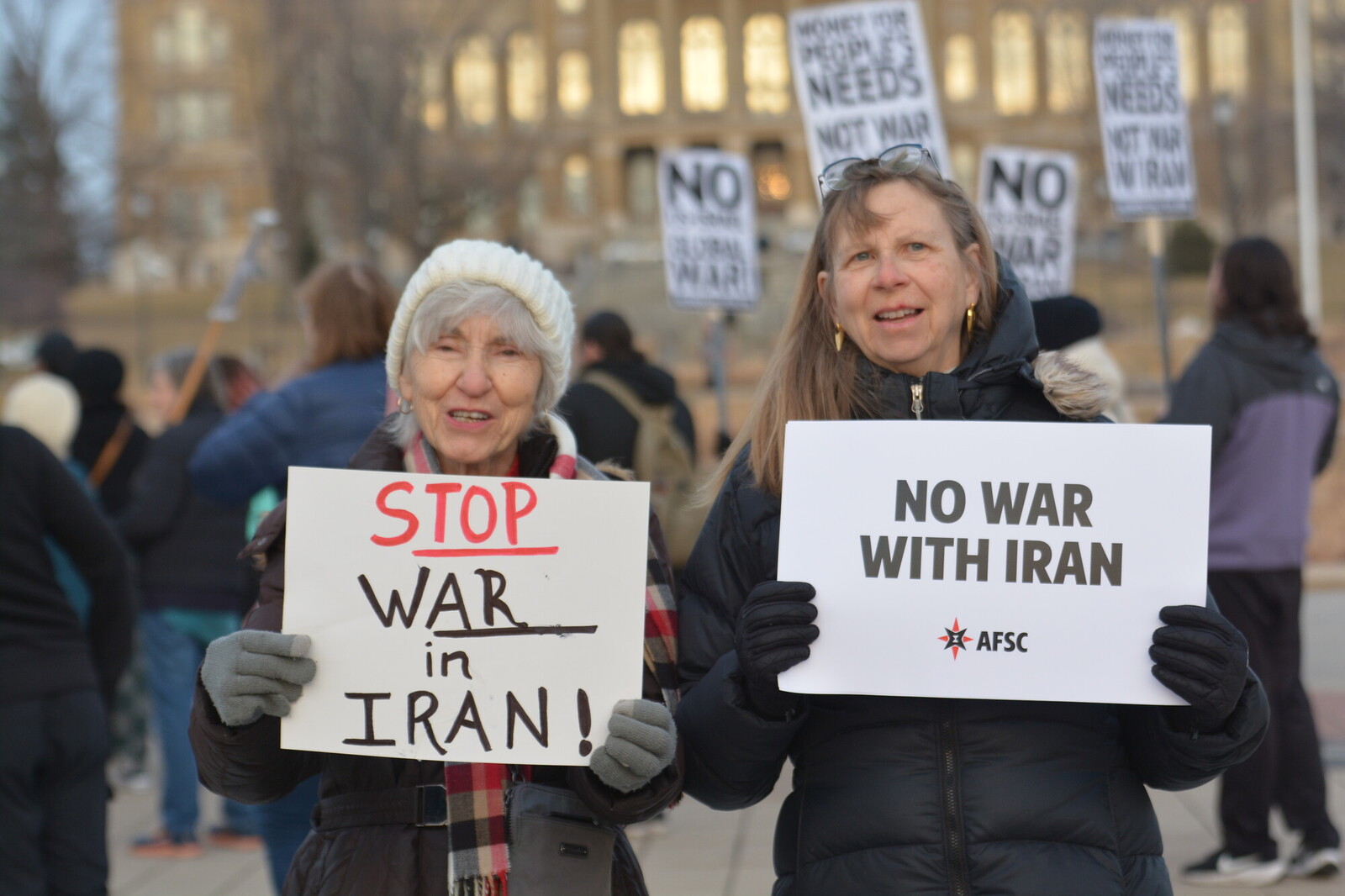
Community members in Iowa protest against the U.S. war with Iran. Jon Krieg/AFSC
War is never the path to peace. The U.S. and Israel’s war on Iran is illegal, unprovoked, and a war of choice—not necessity. We mourn every life lost and hold the victims’ loved ones and communities in the Light as we call for an immediate end to this war.
On Feb. 28, the U.S. and Israel launched a war of aggression on Iran, dropping bombs on cities across the country and calling for regime change. In the first wave of attacks, at least 175 people—mostly children—were killed when a school was struck. The Iranian leader, Ayatollah Ali Khamenei, was also killed in an airstrike.
Since then, thousands of people have been killed in Iran, Lebanon, and across the region. Hundreds of thousands have been displaced. No one knows how far this conflict will spread, or how many more lives will be lost before it ends.
This is another costly, deadly war that most people in the U.S. do not support. Three in four say the country should focus on priorities at home, not military force abroad.
Here’s what you need to know.
1. This war is illegal.
Under U.S. law, the president does not have the authority to start a war. Only Congress has that authority. The Constitution requires the president to seek congressional approval before engaging in hostilities against another country. President Donald Trump did not do that.
This war is also illegal under international law. The U.N. Charter prohibits the use of force against the territorial integrity or political independence of any country. There is no recognized right to preemptive military action unless a state has clearly positioned forces for an imminent attack. Iran had not done that.
Even in situations of self-defense, states must seek approval from the U.N. Security Council before using force. The U.S. did not seek that approval, and there was no demonstrable threat from Iran.
Any retroactive approval from Congress would not make this war legal, either. This was an illegal and immoral war of aggression from the start.
2. The Trump administration’s justifications for this war are based on lies.
Counter to what President Trump has said, Iran did not pose an imminent threat to the U.S. Iran has no long-range missiles that can reach the U.S. It is at least a decade away from being able to produce such missiles, according to a 2025 assessment from the Defense Intelligence Agency.
Iran also has no program to produce nuclear weapons and no capacity to do so soon. The U.S. bombing of nuclear weapons facilities in 2025 destroyed most of Iran’s nuclear capacity and buried its enriched uranium supplies in locations that cannot be reached. There are no credible indications that Iran has any intention of building nuclear weapons.
In the days before the U.S. attack, the Iranian government had indicated a willingness to sign a comprehensive nuclear nonproliferation agreement. Mediators in Oman said the deal on the table would have gone far beyond all previous agreements. But the Trump administration refused to negotiate in good faith and chose war over diplomacy.
This was a war of choice.
3. The war will cost us here at home.
The U.S. is spending billions of dollars to bomb people abroad. That’s money that should be invested in meeting human needs at home.
Experts at Penn Wharton estimate the direct cost of this war at $65 billion. That’s almost exactly what it would cost to extend the enhanced Affordable Care Act subsidies for two more years. Congress recently let those subsidies expire, pushing millions off their coverage.
To look at it another way, we are spending $220 million a day on this war. That’s enough to pay the annual salaries of 3,300 teachers every single day.
These are choices. It is unconscionable to cut health care, food assistance, and other vital programs while spending billions on war abroad.
4. The U.S.—not Iran—is the biggest obstacle to nuclear nonproliferation.
For years, the U.S. has taken steps that make nuclear war more likely, not less. It has let all major nonproliferation treaties expire. That includes the New Start Treaty—the last major nuclear arms reduction agreement—which expired in February. The U.S. also plans to invest over $1 trillion in nuclear weapons over the next decade and is threatening to restart nuclear weapons testing.
In addition, the U.S. continues to ignore Israel’s nuclear weapons stockpile and its violations of the Nuclear Nonproliferation Treaty.
Instead of war, the U.S. should pursue a comprehensive regional nonproliferation agreement coordinated with other international actors—including Russia and China—that guarantees a nuclear-free Middle East. The U.S. should also pursue renewed international commitment to nuclear weapons abolition.
5. This war is not about protecting human rights.
The Trump administration has pointed to Iran’s human rights record as justification for these attacks. The Iranian government’s human rights record, including its recent killings of thousands of protesters, is horrific. But waging war against Iran will not bring peace or human rights to the Iranian people.
The U.S. government cannot claim the moral high ground while it detains people without due process, criminalizes dissent, and pursues a policy of murder and assassination in Latin America. It has no credibility on human rights after more than two years of supporting Israel’s genocide in Gaza. Last year alone, Israel bombed Lebanon, Yemen, Syria, Iran, Qatar, and the occupied Palestinian territory.
Human rights will not be secured through bombs. They are secured through diplomacy, investment in humanitarian assistance, and other actions to help meet human needs.
We oppose this war, and we stand with the Iranian people—including the many who have risked their lives to demand freedom and justice. Their right to determine their own future cannot be delivered by U.S. and Israeli bombs.
6. This war is a tool to further the Trump administration’s authoritarian agenda.
Authoritarians have long used war to consolidate power, suppress dissent, and distract from problems at home. This war fits that pattern.
The attacks on Iran are just one of a string of unilateral military actions taken by the Trump administration in recent months. Between December 2025 and February 2026, the U.S. bombed Nigeria, murdered alleged drug smugglers in the Caribbean and the Pacific, attacked Venezuela and kidnapped its president, and now attacked Iran. Beyond military action, the administration has imposed sweeping tariffs, threatened to take over Greenland, and blockaded Cuba. These are all part of the same approach: power and force over international law.
These actions abroad mirror what the Trump administration is doing at home. In its first year, the administration has attacked civil rights and speech, carried out arbitrary arrests and detentions, deployed armed federal agents into communities, destroyed key government agencies, transferred massive wealth to the ultra-rich, politicized the judiciary and military, carried out extrajudicial executions, and centralized power in the executive. Each of these actions is a part of an unprecedented shift in political and social norms that move the U.S. closer toward authoritarianism.
Taking the country to war without congressional approval or public accountability is another step in that direction. It is also out of step with what the U.S. public wants.
The war with Iran will likely be used to justify the further erosion of civil liberties. We must oppose this war—and the authoritarian agenda it is part of.
7. You can take action to stop this war.
The U.S.—not Iran—is currently the most significant threat to international peace and security. Congress must act immediately to assert its authority and end this war. People must make their voices heard.
Take to the streets, protest, and engage in acts of nonviolent resistance. We must make clear that the U.S. public does not stand behind this war.
This moment demands all of us.