
“Funds not Feds” rally in Chicago, organized by the Public Health and Safety Coalition and the People’s Unity Platform. Sarah-Ji/Loveandstugglephotos
All young people deserve to live in safe neighborhoods and have the resources they need to thrive. That includes access to mental health services, summer jobs for youth, and adequately funded schools, parks, and libraries.
As the director of AFSC's Chicago Peacebuilding Program, I’ve had the privilege of working alongside young people who are demanding that their city invest in their futures—not in policing them.
Too often, however, city governments across the country respond to trauma with harm. Young people are seen as threats rather than full members of our communities. But thanks to a lot of hard work by AFSC youth and allies in Chicago, we’re flipping this script.
On Dec. 20, 2025, the Chicago City Council approved a budget that included nearly all the spending and revenue demands our coalition—the Public Health and Safety Campaign—had been striving for. These historic wins will change the material conditions in communities across Chicago.
Along with allies, AFSC helped redirect $30 million in funding for 500 Chicago Police Department (CPD) vacancies to alternative areas. Additionally, we redirected $50 million from CPD overtime pay.
We also protected:
- A $7 million investment in early childhood education, which will solidify more child care services in the city.
- Funding for the Chicago Department of Public Health (DPH) in the face of federal cuts.
- Money for public mental health centers—we’re trying to get all 19 mental health centers reopened in Chicago and make them accessible 24 hours a day.
- Funding for additional youth jobs.
We also secured permanent funding for non-police crisis response. That’s something that Treatment Not Trauma (TNT)—a coalition that Chi Peace works directly with—has been working toward for years. It proves that we can solve mental health crises without police. There’s a concerted effort by some to label people who are having mental health crises as “dangerous” and in need of cops. But we know people are 16 times more likely to be murdered if police show up on the scene of a mental health crisis.
We also won a tax on social media companies that funds the expansion of public mental health centers and non-police crisis response.
A historic $1 billion Tax Increment Financing (TIF) surplus will send funds back to schools, parks and libraries in the city. The surplus will generate an estimated $230 million in revenue for Chicago. TIF districts direct a big portion of property tax collections within “blighted” geographic areas to fund economic development and infrastructure projects.
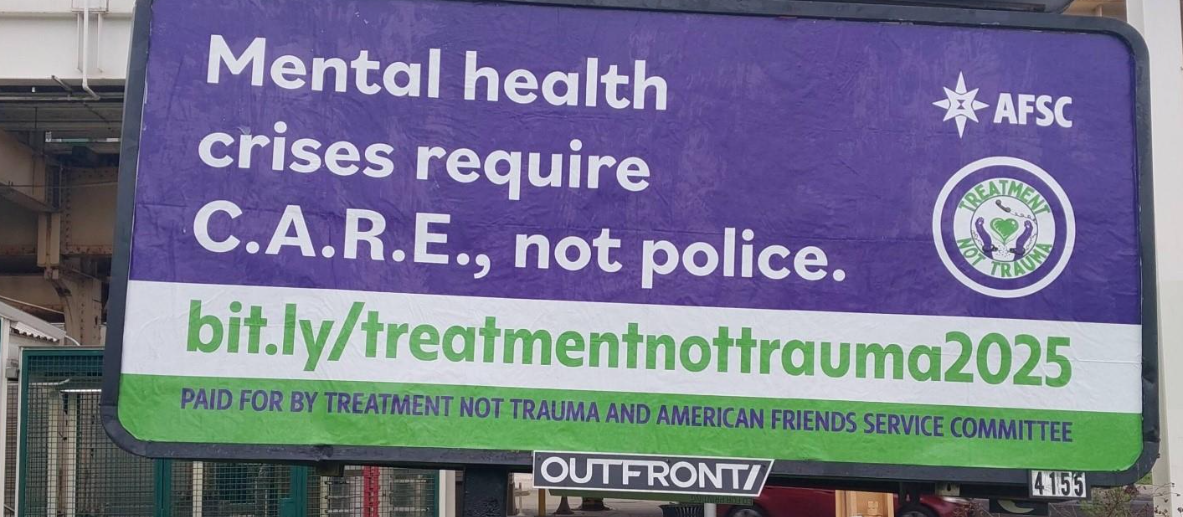
AFSC posted billboards in Chicago calling for Treatment Not Trauma.
How Chi Peace supported community efforts
AFSC’s primary role was on the citywide Political Education team. In partnership with other organizations, we conducted citywide teach-ins, both virtual and in-person, to familiarize community members with our demands and get them involved. AFSC helped people understand what public safety can look like when we invest in mental health services, youth programs, and other community supports—not policing and prisons.
Part of our strategy was getting people to contact alders (city council members) in key wards we knew we’d need to vote for the mayor’s budget. We contacted alders in the city over 4,000 times. We knocked on 70,000 doors and reached over 70,000 phone lines. There were 150 organizations involved in this work in some way.
Many people didn’t know about or couldn’t come to our teach-ins, so it was important to meet them at their door to address the issues facing their neighborhoods.
We engaged over 60 youth through our cohort and during teach-ins over the summer with the Public Health and Safety campaign. We believe youth always need to be centered in this work because it affects them so greatly.
Making the city care about young people
During our last Youth Action Program (YAP) cohort, we had a member who was particularly involved and interested in the campaign work. They canvassed with us to spread information about the campaign. They said, “We don’t really feel cared for by the city.” This was also on the heels of the snap curfew that the police superintendent tried and failed to institute.
That curfew didn’t need to pass for youth to feel like the city sees them as a nuisance and a problem to be dealt with. This young person said, “The city doesn’t care about us, but we need to make them care.”
Young people are seeing injustices at every level—especially under a presidential administration that seems to face no consequences for the violence it has perpetuated. For a lot of youth, the world doesn’t make sense most of the time. That’s why it has been so heartening for me to hear them talk about being part of collective action—and the difference it can make. It reminds me that our future is in good hands. We’re building something that will outlast any campaign.
Celebrating these wins
In January, AFSC and our coalition partners gathered for a big celebration to be in a joyful space together and celebrate this historic win. This work was extremely stressful, but we are in coalition with a lot of organizers I’ve been inspired by. Many people have been in this struggle for decades, especially around community mental health.
These budget wins come at a time when most people feel overwhelmed by the violence all around us, enacted through the federal government. People are feeling a real appetite for services that support them, for community, and caring for each other.
People want to do something positive, and they see the local sphere as the place to do that. People feel real investment in their community. And through this campaign, that energy brought real investment in resources.