
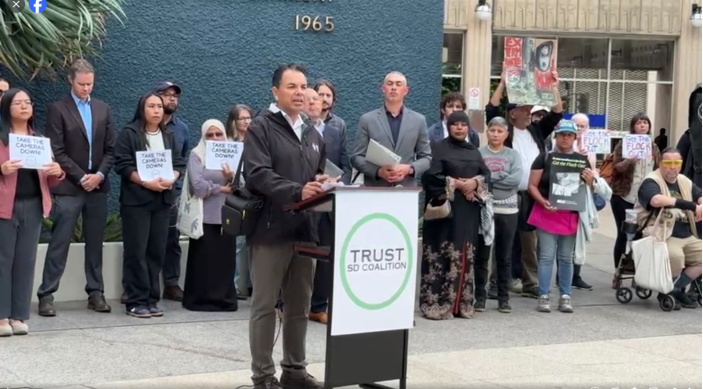
Pedro Rios of the AFSC US-Mexico Border Program speaks at a press conference in advance of the San Diego City Council’s unanimous vote to end its contract with Flock. Screenshot: Benjamin Prado/AFSC
In response to sustained pressure from a broad range of groups, the San Diego City Council on November 16 voted unanimously to cancel its contract with Flock. This will end the city’s use of Automatic License Plate Readers (ALPRs). The council also voted 5-2 to drop 500 Smart Streetlight cameras across the city.
The City Council’s action followed a press conference organized by the TRUST SD Coalition, which includes the AFSC US-Mexico Border Program. Pedro Rios of AFSC spoke at the press conference, which was filmed by his colleague, Benjamin Prado.
Pedro said that in working with migrant communities throughout San Diego, AFSC has witnessed disturbing scenes of ICE and Border Patrol agents kidnaping our neighbors. He called on city officials to “reject the use of any tools that make them complicit in these reprehensible acts of state violence.”
Pedro added that the Border Patrol operates an extensive network of fixed and mobile cameras placed in covert locations across the borderlands in Southern California. ICE also contracts with Flock and other vendors that scrutinize local community members for civil and immigration violations.
Reports have found that, even in San Diego County, local police agencies have shared data with federal agencies in violation of state law.
“There are no robust oversight measures in place to hold these agencies accountable for carelessly or maliciously violating the law,” Pedro said. “It is unacceptable to expect a fail-safe technology when a key feature of that technology is surveillance. And that surveillance leads to state-sponsored kidnapping, family separation, or even death, as we’ve seen happen here at the local detention center.”
Pedro said there is no redeemable justification for using APLR cameras in the city of San Diego. “Leadership means taking a principled stance for all members of our community,” he added, “including those who are in more vulnerable positions because of their immigration status.”
Two members of the San Diego City Council -- Sean Elo-Rivera and Henry L. Foster III – also spoke at the press conference. Elo-Rivera said that safety is a universal right that is also deeply personal. Trust between neighbors, the people and their government is fundamental. The City should address rather than dismiss concerns about Constitutional rights.
Foster emphasized the need for leadership and true accountability. He said the City has invested millions in surveillance technology that’s been misused. Ensuring the civil liberties of all people in San Diego is critical to building the kind of city we want.
Brigette Browning, President of the San Diego-Imperial Counties Labor Council, said that all people in San Diego have been a target of this tool, which has been used as a weapon against our community. "These cameras are not making our community safer," Browning said. "We should instead be using the limited resources that our city has to invest in programs and services that tackle the root causes of poverty."
Samantha Itazawa, ACLU Staff attorney for San Diego-Imperial Counties, said the cameras are unsafe in any hands. They’ve been used against immigrant communities and abortion seekers, as well as survivors of domestic violence. Rather than spend tax dollars on cameras that don’t keep us safe, she said the City should invest in things like libraries, affordable housing and public restrooms.
The press conference ended with repeated chants of “Take the cameras down!” Fortunately, the City Council heard them.