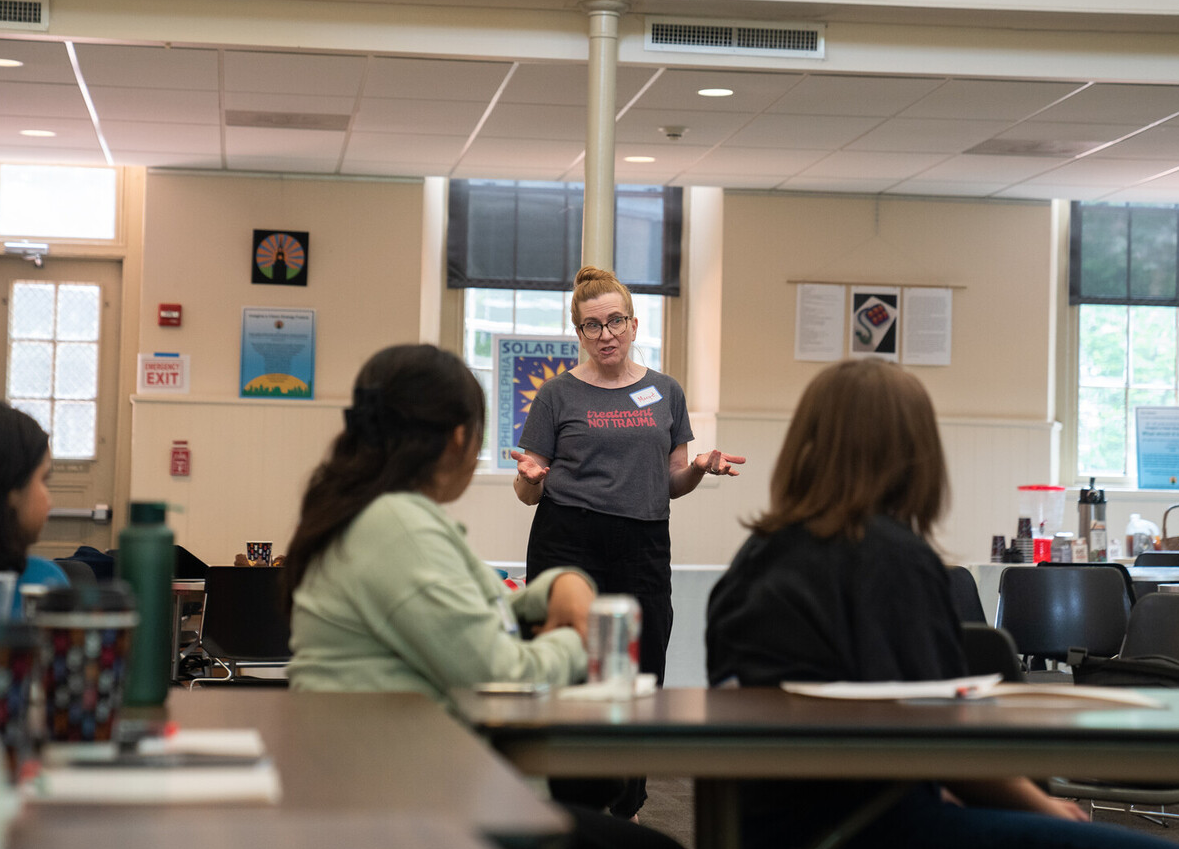
Mary Zerkel speaking at an AFSC Emerging Leaders for Liberation (ELL) gathering. Angel Edwards
Q: In your many years working at AFSC, how have you observed the power of community?
A: I’ve learned so much from being part of economic justice, peace, and abolition movements. Successful organizing centers the experience of people impacted by the systems we want to change. It works best when it builds community. So, if you go to an organizing meeting and there are kids running around, shared food, and people chatting and catching up—you’re doing it right. These folks are in solidarity and will stand up for each other and their neighbors. We’ve seen it in Minneapolis, Chicago, and L.A.
Q: Can you share some examples of how community action has resulted in positive change?
A: Most people supported the Iraq War when it began. AFSC organized in 48 states to highlight the human cost of conflict. Where we didn’t have staff, volunteers stepped in. These community members came together and created a titanic shift against support for endless wars.
More recently, AFSC has spent the last decade working in coalition to advocate that money for policing be used for things that improve community safety. Last year, our AFSC Chicago Peacebuilding program had a huge victory. We redirected $30 million in funding for Chicago Police Department vacancies to fund other needs. At the same time, we preserved services that help keep our communities safe. Examples include $7 million investment in early childhood education, funding for the Chicago Department of Public Health, and additional youth jobs.
Q: How do we build equitable, inclusive communities?
A: This is such an important question in the U.S. right now. We are facing rising authoritarianism, which opposes the values of equity and inclusivity. The longstanding use of state violence against marginalized people is expanding. As a result, our collective freedom is on the line. The important thing is not to give up. Neighbors must work together to keep everyone safe, and communities need to resist the loss of their rights.
Q: What’s giving you hope in this very challenging moment in history?
A: Communities won’t accept authoritarianism. They’re joining initiatives like Commit to Resist, which is part of building a movement of noncompliance—people saying no to harmful policies and yes to the future we all deserve. They’re attending our monthly Protect, Resist, and Build webinars, which offer a virtual space to learn concrete skills to build resistance and resilience where you live. I’m motivated by our work to grow community care, mutual aid, and ways for communities to protect each other from bad policies that lead to people getting hurt.
This is a really hard time, but we must rebuild our social infrastructure and build communities that stand up for each other. If it all seems overwhelming, start with a simple gesture. Check in on a neighbor in need and find ways to support them. Every act of care is a seed planted for our shared future.