
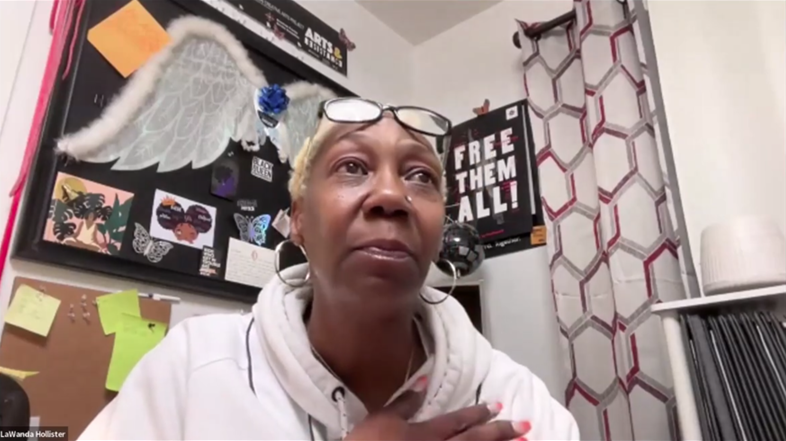
On February 17, 2026, AFSC’s monthly Third Tuesday webinar included an interview with LaWanda Hollister, a Community Organizer with the Michigan Criminal Justice Program. Emcee Barbara Gunn Lartey, St. Louis Peacebuilding Program Director, asked LaWanda to share what love and liberation looks like in the context of reentry from incarceration. Below are excerpts.
I was incarcerated at 17. I’m actually from Chicago, but I offended in Michigan. Since I’ve been home, AFSC has been my main support in my reentry. I did a lot of work with AFSC when I was inside.
I met the AFSC Michigan director, Natalie Holbrook-Combs, while I was inside. Once I came home, I called her. At that time, she said we don’t really do reentry work. But she stepped up and has been my biggest supporter.
Now I’m employed by AFSC. My most passionate part is community organizing. Earlier today, Barbara reminded me of our Midwest staff visit to a second-hand store in our little downtown of Ypsilanti, Michigan.
I was having a very hard time when I came home from prison. Being from Chicago, this little downtown of Ypsi felt like the Andy Griffith Show, with little cobblestone streets. And I was like, “What’s going on with this little downtown?” It was really cute and homely.
I ended up going into this secondhand store and I met a woman named Frieda. I was in a bad way that day. She hadn’t opened yet, but she let me in and we talked. She instilled in me the strength to move on. I was like, “I can’t do this. This is too much. I haven’t been out here. I was incarcerated for 36 years. I don’t even know how to use a phone, or none of that.”
But she instilled in me in that moment to move on. And I would go there every Wednesday morning because I worked on a nearby farm. Frieda and I became friends. Not only did she become my friend, but she became a supporter of AFSC’s reentry work.
In the store, there are clothes and shoes. It’s a very wealthy area, so there’s a lot of nice stuff in there. When people come home who I work with and deal with, I always take them to The Thrift Depot, because Frieda shows love and respect. She makes people feel very comfortable with the reentry.
Reentry is a lot to deal with. People are constantly looking at you sideways and having opinions about your worst day in life.
But Frieda makes them really comfortable. To me, that’s love and liberation. I’m so glad and proud that she’s there and has offered her space for people to relax and not be judged. And get the things they need.
She makes sure everyone is able to get whatever they need. I just love that space. That’s why I’m out there doing the work I do. For the people I get to meet and connect with. And I can connect them with other people for support.
The trauma of incarceration
Incarceration at any level for any amount of time is traumatizing. It’s a lot. For me, the love I got from Natalie came in the form of her coming into the prison to prepare me. I thought I was ready and knew what to say, how to act and be composed, what it would be like when I got in front of the people who were holding my freedom in their hands.
Natalie came in with reality. Because I’d been away from society for 36 years. It was difficult. She wrapped me with knowledge, wisdom and love – and helped me get through it. And because of that, I now do the same thing for people preparing to come home.
That’s my job. It’s more than a job. I’m glad I’m getting paid to do it, but this is what I’m supposed to be doing.
Reentry needs
One of the things is housing. No one wants you. Everyone wants you to get out of prison, but they don’t want you to move forward. So where am I going to live? How am I going to eat? People are still judging everyone by the mistake they made to be incarcerated.
We have to work around that. Because we can’t tell you what to say when it comes to your freedom. But we prepare you to get ready for parole boards and public hearings. And then – where are you going to stay? What are your plans? The state of Michigan wants to know that.
We try to help people develop a release plan. We’re also working on laws that need to be changed. We work on laws so the people incarcerated can be treated with dignity.
We have a long list of things we’re contacted for. We’re contacted by family on the outside as well as people incarcerated. We work the full gamut of things associated with criminal justice.
Work with youth and moms
By the time youth are sent to the penitentiary, they are considered of age. Not only do we work with the people in prison, we try to work with the youth before they get on that road -- the school-to-prison pipeline.
I make a lot of appearances and work with a lot of kids. I coach basketball for youth, and I don’t even know how to play. It’s an opportunity to be among youth and share and talk with them.
They’re considered “troubled” youth. I was like, OK, I’ll do it. I have a couple, I call them “my kids.” I see them around town, and they recognize me and say, “Hey, Miss LaWanda!”
Actually, Natalie has just started a program within the women’s prison called “Moms Empowering Moms.” For the women who are incarcerated, we hold groups and go and visit the children of the women incarcerated and try to help them maintain contact. Natalie’s been doing that for a few months now.
If people are interested, they can contact me and I can connect them with whatever program or initiative we’re doing, to volunteer and help.
Understanding the differences between knowledge and wisdom
I have a lot of people who want to help others. I’ll put that in the knowledge category. Everyone wants to volunteer, to help. However, they’ve not taken the time to get the wisdom to know how to help.
On the legislative side of my job, I have to take a lot of people to the state capital to speak about reentry and being unhoused and not having places to stay or food to eat. I want you to get up there and talk, but you’re hungry. I know you have the insight and knowledge. But the wisdom is you need to be fed first.
There can be knowledge but no love, no dignity, no understanding. People want to help, but you need to learn how and what needs to be done before you’re out there. You need to know what’s going on. Take the time to figure out or find out – get the wisdom before you go out there, before you sign up to do this or that. Figure out what you think you want to do and how you’re going to accomplish it.