

At Elizabeth Detention Center in New Jersey. Photo: Nathaniel Doubleday/AFSC.
As part of AFSC’s immigration work, we help to locate community members who have been detained by Immigration and Customs Enforcement (ICE) and Customs and Border Protection (CBP). Over the last six months, we have tracked a troubling pattern emerging from these cases. Several recent cases have confirmed something that advocates have long understood yet rarely capture in real time: people do not simply “get lost” in the immigration system. The system itself is designed to lose them.
These cases reveal day-to-day failures behind immigration detention tracking and shed light on how a new model of immigration detention is operating in practice. Immigration raids themselves are not new in this country, but under the Trump administration, the past year has brought a disturbing uptick in detentions across federal agencies.
ICE and CBP book-ins have climbed compared to the data in 2024. In October 2025 alone, more than 40,000 people were booked into detention, one of the highest monthly totals in over a year.
The shift isn't only in the number of people in detention, but in how quickly individuals become untraceable once they enter the system. A process that was already painful and slow has now become even more unpredictable and drawn out.
What the cases show
During October and November, AFSC saw a spike in requests for help locating and tracking individuals who had encountered ICE or CBP. Here’s an overview of six cases we handled in that period:
- The average time to locate a missing loved one was three to five days from the moment of arrest to the moment of confirmation of location and notification of family members.
- In all six cases, families received no official notice from any federal agency about where relatives had been taken.
- In four of the six cases, ICE or CBP agents misreported, denied, or withheld basic information about a person’s whereabouts.
- AFSC staff had to make anywhere from seven to 25 calls per case, often involving repeated attempts to reach the same ICE field office or hotline, or other immigration enforcement office.
- Five out of six cases involved procedural violations, including delayed or missed intake data or outdated public records.
- In nearly every case, ICE’s online locator tool failed to show the individual for days—or not at all—after they had been detained or transferred between detention facilities.
Case example: A young man disappears in the system
One case involved a young man from El Salvador, detained earlier this summer. He had been placed at the South Florida Detention Facility (infamously known as “Alligator Alcatraz”) but was soon transferred after the site shut down. The family received no official notice of this transfer and had only been vaguely informed their loved one had been moved to Texas.
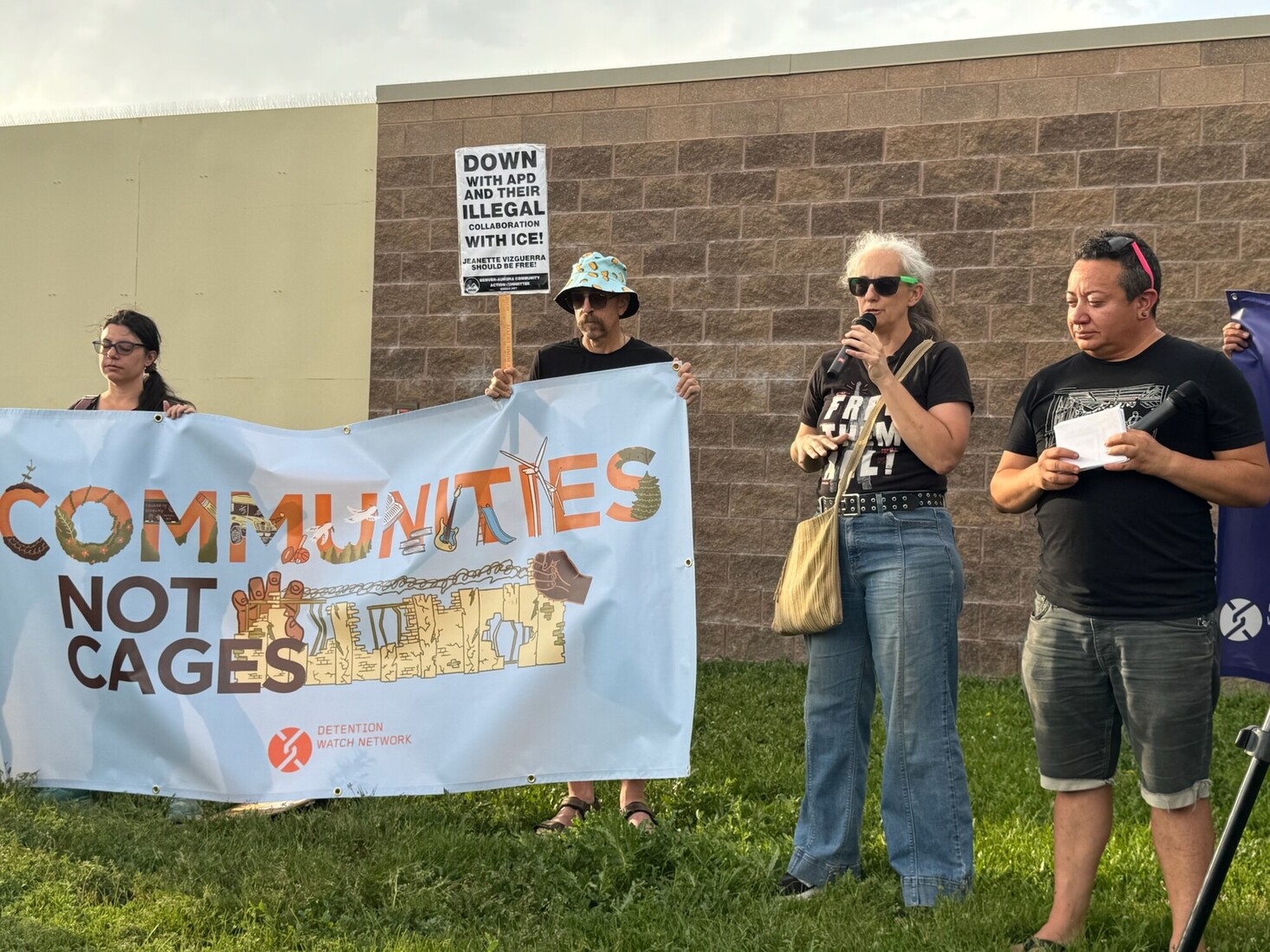
In Aurora, Colorado, AFSC staff speak at a vigil calling to free Jeanette Vizguerra at the GEO detention center. Photo: Gabriela Flora/AFSC
Over four days, we logged more than 10 calls to ICE field offices, most of which went unanswered. After persistent tracking, we finally confirmed that he was at Camp East Montana in El Paso, Texas. AFSC had been told by ICE hotline agents that this facility had been growing, facing staffing shortages and limited phone access.
For over two months, the young man, who lives with schizophrenia, had no contact with his mother. Like many people, he also did not have family members’ phone numbers memorized. That made communication nearly impossible. And without the ability to contact anyone on the outside, the young man had no one to support him. He remained absent from public databases. He was effectively denied legal recourse.
His story is one of many immigrants detained the U.S. today. Due process becomes almost theoretical. Legal representatives cannot find their clients. Transfers happen without notice or are misreported. People are deported before scheduled bond hearings. Ultimately, families cannot confirm their loved ones are safe.
Case example: “He wouldn't be here if he had come the legal way”
Another one of our cases involved a young man from Mexico who had been detained by CBP in Texas. We logged over 25 calls between local county jails, ICE Texas field offices and CBP patrol stations before ICE was able to confirm his whereabouts with CBP. I vividly remember one hostile call with a CBP agent who told me, “He wouldn’t be in this situation if he had come the legal way,” before abruptly hanging up. Soon after calling back, another agent misdirected us to the wrong sector entirely.
After five days of our tracking efforts, ICE agents finally confirmed to us the correct CBP regional sector – Laredo. But before we could confirm the exact patrol station, the young man was deported. In total, it took 11 days for him to communicate with his family again, only after he had already been returned to Mexico.
The systemic failures—failing to update databases and inform family members and legal teams of internal immigration matters—create environments where due process, legal recourse, accountability, and transparency are denied. Medical assistance is scarce and contact from inside these detention facilities can be virtually impossible.
An emerging model of detention
What we are witnessing in states like Texas, Florida, and across the country is the emergence of a new model of immigration detention. Some state-run facilities, like “Alligator Alcatraz,” operate more like extrajudicial sites than traditional detention centers. They function with little public visibility, minimal accountability, and practices that fall far short of any basic standard of humane treatment, making what was already a terrible system even worse.
Across these cases, the failures are consistent. People disappear from public records for days or weeks. Internal transfers occur quietly across state lines. Agencies refuse to disclose any basic information, and medical care and phone access vary drastically between facilities.
These past few months have made one truth painfully clear: People are not going missing in the detention system. They are being disappeared by it.
AFSC’s rapid response efforts—gathering real-time data, maintaining case notes, and supporting families—creates a record that can’t be erased. Every case we track, every call we log, builds evidence of systemic failures that demand accountability and change. This documentation alone won’t stop what is happening, but it makes the invisible visible. And that matters.